by Naomi L. | February 8, 2017 | Blog, Creative Writing |
Valentine’s Day is around the corner, which means many of us creative writers are thinking more than ever about romance (at least, I am). All the talk of love in the air has gotten me thinking about my favorite love stories and the characters who bring them to life. February is the perfect month for romantic inspiration, so it’s no wonder I always take this time to indulge in stories about my favorite fictional couples. To be honest, there are probably too many to count, but I’ve managed to narrow my current favorites down to a few that I’d love to write about!
So to celebrate the upcoming holiday, here’s a list of six of my favorite fictional couples and why I love them. Enjoy, and Happy Valentine’s Day!
Warning: the following post may contain spoilers for Harry Potter, Pride and Prejudice, Friends, How I Met Your Mother, and The Hunger Games. Proceed with caution.
1) Romeo Montague and Juliet Capulet
 Could I really have started with any other couple? Shakespeare’s Romeo & Juliet has long been my favorite love story, so much so that I’ve written a post about it every year since I started blogging and even adapted the story into my own novel-length fanfiction (not sorry). It’s a tragic tale of passion thwarted by fate, and it may well be the most famous love story ever told.
Romeo and Juliet started out as lost and lonely teenagers who quickly found meaning for their lives in each other. They defied a generations-old feud through a forbidden love affair, complete with consummated marriage and the determination to be together at all costs. And though they didn’t get the happy ending they arguably deserved, they did immortalize themselves as the star-crossed young couple whose love finally ended years of violence and hatred. Love may not conquer all, but it’s still one of the most powerful forces on Earth!
2) Ron Weasley and Hermione Granger
 To anyone who knows me well, it’s no secret that the Harry Potter books have been my favorite series since childhood. I grew up with J.K. Rowling’s beloved fantasy books and have been in love with her magical world for most of my life. Each new book was better than the last, and just when I thought it couldn’t get any better, I reached the second half of the series to find she had tossed the exact romantic subplot I wanted into the mix.
Ron and Hermione had a rocky start to their relationship, even as friends. Every Potter fan who read the entire series watched them grow from disgruntled acquaintances to close friends to jealous crushes to will-they-or-won’t-they admirers to romantic couple to happily married couple. It’s the perfect example of a childhood friend romance gone right, and Rowling couldn’t have done a better job of timing this beautiful love story all the way to its satisfying conclusion. Best friends forever indeed!
3) Elizabeth Bennet and Fitzwilliam Darcy
 I finally got around to reading Pride and Prejudice last year, and I have to say it’s such a delightful story that I’ve ranked it among my favorite books ever. The story of Elizabeth and Mr. Darcy is a complex tale of true love concealed beneath (and often obstructed by) a veil of manners and morality, with a hint of irony to comically highlight the incongruence between a charming demeanor and a good heart. These two are the ultimate proof that when it comes to romance, first impressions don’t matter as much as character, assuming both parties are willing to open their minds to humility and their hearts to the possibility of love where it’s least expected. Jane Austen was truly a master of romantic comedies!
4) Monica Geller and Chandler Bing
 Ross and Rachel may have been the star couple of Friends, with their ten-season-long will-they-or-won’t-they story that culminated in a heartwarming “they will” (“I got off the plane!“), but my favorite romance in the series was the far more stable relationship between Monica and Chandler. After hooking up the night before Ross’s wedding in England, these two best friends embarked on a beautiful journey of love that became the saving grace of the show. You didn’t think viewers would hang around for ten seasons just to see Ross and Rachel get together for good, did you?
Monica and Chandler are a classic example of a romantic experiment that worked. While Friends didn’t start with the expectation of getting them together, their chemistry was so great from the earliest seasons that their entire relationship, from friendship to happy marriage, just felt natural and real. Sometimes true love really has been right in front of you all along!
5) Marshall Eriksen and Lily Aldrin
While diehard fans of How I Met Your Mother are still arguing over which couple was better in the Ted-Robin-Barney love triangle (Ted and Robin FTW!), I’m sure everyone can agree that Marshall and Lily were the most adorable pair in the series. Not only were they college sweethearts and each other’s first love, they maintained a loving and (mostly) stable relationship all the way to the show’s conclusion. From engagement to marriage to parenthood, these two continuously took on the challenges of a committed relationship and kept knocking them out of the park. And let’s be honest: while we all waited nine seasons for Ted to finally get to his happy ending, wasn’t it fun to watch Marshmallow and Lily Pad already living theirs? Seriously, cutest couple ever!

6) Katniss Everdeen and Peeta Mellark
 I admit it: I was one of the Hunger Games fans who cheered for Katniss and Peeta from the start. Not that I had anything against Katniss and Gale; I just preferred the dynamic between the two characters who were thrown into the Games together. Katniss has a strong spirit, which often manifests as a hardened demeanor and a refusal to show weakness through emotion. Peeta, on the other hand, is considerably softer and more sensitive, though no less strong in spirit than his fellow tribute. Their chemistry not only makes for an interesting relationship but a refreshing departure from the stereotypical “strong man, weak woman” pattern. An innovative love story for the novels’ young adult audience!
Over the course of three books/four movies, District 12’s “star-crossed” duo endure two Hunger Games and a revolution, through which they evolve from acquaintances to allies to a fake couple and finally emerge as a real couple in love. They go to hell and back for the greater cause at hand, but draw enough strength from each other to never lose themselves on the way (at least, not completely). So when these two finally earn their happy ending, you know it’s a love that’ll last. It seems the odds were in their favor after all!
What about you? Who are your favorite fictional couples? What love stories inspire your romantic fiction?
by Naomi L. | February 6, 2017 | Blog, Word of the Week |
Word: maudlin
Pronunciation: MAHD-lən
Part of Speech: adjective
Definition: self-pityingly or tearfully sentimental
Source: Oxford Dictionaries
Here’s an interesting word I stumbled across a few weeks ago. I can’t remember exactly where I read it, just that it caught my attention for how poetic it sounded. I don’t usually care for tragic words, but some may consider it fitting for February due to the impending pressure of Valentine’s Day. Here’s hoping you don’t find yourself feeling “maudlin” this month!
To be “maudlin” is to be tearfully or self-pityingly sentimental. The word arose in late Middle English as a noun denoting Mary Magdalene and comes from the Old French name Madeleine. This name derives from the ecclesiastical Latin name Magdalena, also a reference to Mary Magdalene.
It’s easy to see how this adjective evolved from the image of Mary Magdalene, as she was often depicted weeping in religious art. The North American entry for this word in Oxford Dictionaries includes “often through drunkenness” in its definition, though this needn’t necessarily be the cause of such emotion. If your characters ever find themselves in a deep state of self pity or excessive sentimentality, you may want to consider including the word “maudlin” in your stories!
What are your thoughts on this word? Any suggestions for future “Word of the Week” featured words?
by Naomi L. | February 1, 2017 | Blog, Creative Writing, What If? Writing Prompts |
Welcome to the first day of February! The month of love has rolled around once again, so why not start it off with some new “What If?” Writing Prompts? This week’s batch features prompts in the genre of – you guessed it – romance. See what love stories you can create from these ideas! Enjoy!
 What if… you found your soulmate, but none of your family or friends approved of them?
What if… you were in love with someone who hated you?
What if… people had to rely on the intuition of animals to help them find their perfect match?
What if… marriage for love were banned?
What if… there were no such thing as love stories?
Have fun spinning more tales of love and romance!
If you have any “What If?” writing prompt suggestions (for any theme), please feel free to share them in the comments below. Ideas I like may be featured in future “What If?” posts, with full credit and a link to your blog (if you have one)! Also, if you’ve written a piece based on an idea you’ve found here, be sure to link back to the respective “What If?” post. I would love to see what you’ve done with the prompt! Thank you!
by Naomi L. | January 30, 2017 | Blog, Word of the Week |
Word: iconoclast
Pronunciation: ai-KAH-nə-klast
Part of Speech: noun
Definition: a person who attacks cherished beliefs or institutions
Source: Oxford Dictionaries
Here’s a word that’s made it on many vocabulary prep lists, or at least the ones I’ve studied. I remember always being intrigued by this word when I came across it in my flashcard stacks because it sounded so unusual and poetic. Of course, its definition isn’t quite as lyrical as its tone might suggest; I’d be interested in reading about an “iconoclast”, but not in being one!
An “iconoclast” is someone who criticizes or attacks cherished institutions or beliefs. The word arose in the mid 17th century in the sense “destroyer of religious figures” and comes from the Greek noun eikonoklástēs, meaning “breaker of images”. This noun in turn comprises the noun eikṓn “figure” and the verb klázō “to break”.
Aside from its primary definition, “iconoclast” can also refer to “a destroyer of images used in religious worship”. Oxford Dictionaries’ entry lists two historical examples as sub-definitions: 1) “a supporter of the 8th- and 9th-century movement in the Byzantine Church that sought to abolish the veneration of icons and other religious images”, and 2) “a Puritan of the 16th or 17th century”. If you’ve created a character who attacks or criticizes certain religious beliefs, institutions, or images, you’re definitely writing an “iconoclast” into your stories!
What are your thoughts on this word? Any suggestions for future “Word of the Week” featured words?
by Naomi L. | January 25, 2017 | Blog, Creative Writing, Off The Bookshelf |
Welcome back to my Off The Bookshelf segment! It’s been almost a year since I’ve written a book review for my blog, which is a shame since I do love recommending my favorite novels. The good news is that I read several new books last year and plan to read even more this year, so I’ll have plenty of material to work with in 2017!
So today, I’d like to start off this year’s reviews with my favorite novel from my 2016 list: Pride and Prejudice by Jane Austen!
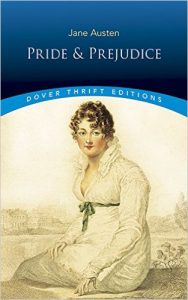
Pride and Prejudice, by Jane Austen
Summary
First printed in 1813, Pride and Prejudice is Jane Austen’s second published novel and one of the most beloved works in English literature. The novel follows the story of Elizabeth Bennet, an exceptionally clever young woman and the second of a country gentleman’s five daughters, as she navigates issues of manners, morality, education, and romance in the landed gentry society of the British Regency. Among her greatest challenges is dealing with Mr. Darcy, a gentleman with great wealth and even greater pride with whom she repeatedly clashes. As their relationship progresses, both Elizabeth and Mr. Darcy come to learn that first impressions are often misleading, and that they must overcome their pride and their prejudices before the story can reach its happy conclusion.
Review
Every so often, you come across a story so well written, so absolutely brilliant that it draws you in from the first sentence and keeps you hooked to the very last page. Such was my experience with Pride and Prejudice, a literary masterpiece from a brilliant mind of the turn of the 19th century. Jane Austen’s novel is still beloved by many readers today, and with good reason: it’s a comedy that covers some of humanity’s most relatable issues – love, marriage, etiquette, wealth, and morals – all from the perspective of an astute young heroine who challenges and overcomes the obstacles of her social position to achieve her happy ending.
Naturally, a central theme in Elizabeth’s story is the difference between the superficial and the indispensable, as well as the emotional development that comes with learning to distinguish the two. After all, there’s a reason the novel was originally titled First Impressions. In the beginning, the protagonist has a habit of forming her opinions of people immediately and consolidating those opinions through selective observation, a practice she believes is a credit to her intelligence. As a result, she dislikes Mr. Darcy from the day she meets him and grows to despise him the more time she spends with him, while Mr. Wickham earns her favor instantly with his charm and apparent good breeding. Halfway through the story, however, Elizabeth discovers that her preconceptions of both gentlemen were misplaced, proving that appearance isn’t always the best indicator of worth. The same lesson is learned by Mr. Darcy, who initially believes his proud behavior to be justified but is promptly put in his place by a woman he once thought was beneath him. Fortunately, both these characters prove mature enough to shed their most prominent flaws in favor of the romance that will make them “the happiest couple in the world”. First impressions are powerful, but thankfully they don’t always stick!
Another of my favorite themes of the book is the only-too-familiar contrast between proper behavior and real character. Throughout the narrative, it’s made apparent that while everyone behaves politely, some characters only do so to maintain a respectable place in high society while others are genuinely good at heart. A notable example comes up during a scene in Netherfield: when Elizabeth arrives at the Bingleys’ estate to take care of her sister Jane, who has fallen ill, all three of her hosts smile and treat her with the utmost kindness and hospitality. The second she leaves the room, however, Caroline and Louisa start criticizing Elizabeth’s dirty clothes while Charles remarks on how much she must love her sister to have walked so far on muddy roads just to see her. Even among siblings, people can vary greatly in character, but good manners are universal!
Austen was always an expert at implementing irony and satire in her writing, and Pride and Prejudice is no exception. Being witty and lively by nature, much of Elizabeth’s perspective includes hints of criticism about her reality: the influence of her family’s low income on their social standing (e.g. Jane’s failed friendship with Caroline Bingley), the excessive pride of some of her wealthier acquaintances (e.g. the unintentional insults in Mr. Darcy’s proposal), marriage as a requirement for women to secure a respectable position in society (e.g. Charlotte Lucas agreeing to marry Mr. Collins, a man she doesn’t love). And while the author didn’t necessarily discourage the following of such social rules in her novels, she did present them in a comical light that at least called these societal standards into question.
Overall, Pride and Prejudice is a fantastic novel that I would highly recommend to anyone who enjoys clever insights into human thoughts and behavior. For romantics and realists alike, this story has something for everyone and will surely continue to captivate audiences for generations, broadening our perceptions of the societal norms by which we live. To anyone who loves literature, it’s certainly an enlightening and delightfully entertaining read!
Inspiration
Ms. Austen’s beloved novel is one of those classic pieces of fiction that remains relevant long after its time. Though the story takes place in the early 19th century, its themes of social conduct, proper etiquette, and first impressions are still universal in the modern world. Whenever I need inspiration for character development, I know I can turn to an Austen novel for insight on general behavior and the restrictions of polite society to better understand how people think and function in everyday life. Basically, Pride and Prejudice is an excellent example of a point I’ve made in the past: that historical fiction can show us the elements of human nature that don’t change over time.
If you’re a historical fiction author or a writer of stories about the human condition, Pride and Prejudice will definitely be a great source of inspiration for your characters, whether they’re 19th-century country folk, 21st-century city dwellers, or anything in between. The greatest stories are those that explore what it means to be human, which makes it no surprise that this novel always appears near the top of best-books-ever-written lists. So if you haven’t yet, I strongly urge you to pick up a copy of Pride and Prejudice and see for yourself what a delightful read it truly is. You may find to your amazement that despite having lived so long ago, Jane Austen can still teach you a thing or two about the ironies of your economic and social reality!
by Naomi L. | January 23, 2017 | Blog, Word of the Week |
Word: excoriate
Pronunciation: ik-SKO-ree-ayt / ek-SKO-ree-ayt
Part of Speech: verb
Definition: censure or criticize severely
Source: Oxford Dictionaries
Have you ever witnessed someone say or do something so ridiculously stupid that to “criticize” them just wasn’t enough? Maybe you feel you’ve overused words like “censure” and “condemn” in your writing and find yourself looking for a fresh alternative. If so, you’re in luck, because just this month I learned a new word that addressed this same issue for me, a word that instantly caught my eye as an interesting potential addition to my vocabulary list. When people act far too dully for ordinary criticism, it may be time to “excoriate” them instead!
To “excoriate” someone is to criticize or censure them severely. The word arose in late Middle English and comes from the Latin verb excoriare, meaning “to skin”. This verb in turn consists of the preposition ex “out of” and the noun corium “hide”.
Though I wasn’t yet familiar with “excoriate”, the tone of the word and the context in which I saw it made it easy to understand from the moment I first read it. It’s worth noting that “excoriate” has a more formal connotation that “criticize”, so you may want to spare it for narrative writing over dialogue. If your characters tend to censure each other in the sharpest manner possible, “excoriate” could be an excellent addition to your vocabulary list!
What are your thoughts on this word? Any suggestions for future “Word of the Week” featured words?



Recent Comments