by Naomi L. | November 20, 2013 | Blog, Creative Writing, Notable Authors |
I’ve been feeling a little nostalgic lately: looking through my books for old favorites, watching movies from my childhood whenever they’re on TV, even listening to songs from the ’90s once in a while. That’s how I recently had an idea for another post on inspiration, because when I think about my childhood, one of the most prominent figures that comes to mind is the author of some of my favorite classics of children’s literature: Dr. Seuss.
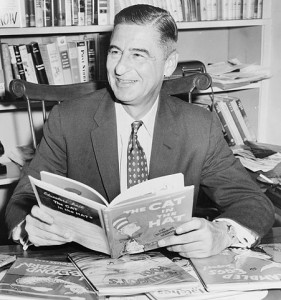
Theodor Geisel in 1957
Bio
Name: Theodor Seuss Geisel
Pen Name: Dr. Seuss
Life: Mar. 2, 1904 – Sept. 24, 1991
Gender: male
Nationality: American
Occupation: writer, cartoonist, animator, publisher, artist
Genres: children’s literature
Notable Works: The Cat in the Hat, Horton Hears a Who!, Green Eggs and Ham
My Favorite Works: The Cat in the Hat, The Sneetches and Other Stories, Horton Hears a Who!, How the Grinch Stole Christmas!
Inspiration
Dr. Seuss was a huge part of my childhood. When I was little, my mother signed us up for the Dr. Seuss book club, so we would get one of his books in the mail every month. By the time I started reading on my own, I had a large collection of fun stories to choose from, such as The Cat in the Hat, Horton Hears a Who! and Green Eggs and Ham. Because of this, my earliest memories of reading were filled with colorful characters and silly rhymes that kept me entertained for hours on end. If I ever wanted to get lost in books, I could always count on Seuss’s imaginative world.
The main reason I find this author so inspiring is because his stories were an important first step into my love of books. Sometimes I wonder if I would have grown to love reading as much as I do today if I hadn’t had the privilege of enjoying Dr. Seuss’s work at such a young age. His books were very easy to read and understand, and that always made reading such a pleasure. In fact, his rhymes and style of writing were so memorable that to this day, my mom and I can quote lines word for word back to each other. In this way, Seuss gave us the gift of memories that we could share for the rest of our lives.
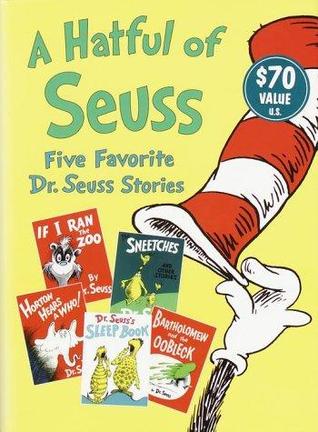
A Hatful of Seuss: Five Favorite Dr. Seuss Stories
But there was much more to these books than simple rhymes and oddly shaped characters with bizarre names. Dr. Seuss had a talent for embedding important lessons in his stories without making them blatantly obvious or patronizing. Moral issues are cleverly hidden behind tales of strange creatures living in unusual worlds: The Sneetches shows us that racism is unjustified; The Lorax shines light on environmentalism and the dangers of corporate greed to the natural world; How the Grinch Stole Christmas! criticizes the commercialization that the holiday season has suffered over time; and even a story as simple as Green Eggs and Ham can be read as a lesson on trying new things in order to form educated opinions. There was almost always something to learn in Seuss’s books, and because the lessons were presented in such a kid-friendly format (complete with his colorful illustrations), it made his stories that much more accessible to children just starting to discover the world around them.
There are quite a few authors I associate with my childhood, but Dr. Seuss is by far one of my favorites. His books inspired me to continue reading beyond the beginner level, and the lessons in his stories have stayed with me into my adult years. Even now, I can’t help but smile as I think about how I once knew The Sneetches by heart and how I still enjoy reading Horton Hears a Who! out loud once in a while. Though authors like Roald Dahl and J.K. Rowling were great inspirations for my writing, Dr. Seuss was a great inspiration for my reading, and in my opinion, there’s no greater gift that a writer can give to children. To the little girl still in my heart, Dr. Seuss will always be a hero.
by Naomi L. | November 13, 2013 | Blog, Creative Writing |
Yes, it’s time for another round of Writers Reveal! Today’s topic comes from the newest member of our circle, Emily Toxward, who sent me the prompt “circling helicopters”. Here’s the short story I wrote based on that idea. Hope you like it! Thanks for the topic, Emily!
Rescue Me
Circle overhead… searching for a lost soul…
My heart is pounding in my ears. The pain is sharp and constant. The air around me is cool on the breeze.
I wait. I’ve been waiting for hours. I may be here for a few more. Is anyone looking for me?
I know I shouldn’t have gone off the trail. But I wanted to be adventurous. I wanted to explore. Just once, I wanted to prove them wrong, show them that I’m not always so afraid, that I can live on the edge too.
And look where it’s gotten me. Maybe they were right all along.
I still think I could have made it if those darn rocks hadn’t slipped. Now I’m lost and trapped, with nothing but the wind and my own breathing to break the silence.
And the occasional whirring noise in the distance, like the one approaching now.
This is the third helicopter to pass in two hours. Or maybe it’s the same one on its third lap around the mountain. It’s hard to tell when it blends into the clouds of the evening sky.
“I’m here!” Yet again, I try to get its attention, waving my arms while trying not to move my injured leg. “Look at me! Please…”
I wince as my foot brushes against the fallen rocks. Yes, it’s definitely broken; my leg doesn’t normally bend that way.
“Help me…” The cold is so overbearing, I can hardly get the words out anymore. Not that they’d hear me anyway. But with a broken limb, my options are limited.
I watch the helicopter pass overhead. Curse these trees! Why couldn’t I have fallen on open ground? I’d have been rescued ages ago!
Wait, what’s that? In the face of a darkening sky and a rising moon, a searchlight now appears under the helicopter. By some miracle, the light finds its way to my patch of earth. Yes! Surely they can see me now!
But will they reach me in time?
The sound of howling suddenly pierces the evening air. Not now, please not now. They’re so close! I can already hear the whirring getting louder again…
The sunlight is fading fast. I’m too exhausted to move anymore. The howling grows louder, but I swear I can see the aircraft turning around. It must be coming back for me… It must…
The world around me grows dark. All I can see anymore is that beacon of hope in the sky. I close my eyes and wait for the rotating blades of salvation to reach me before the mountain beasts do…
Helicopters circle overhead, all day searching for a lost soul to rescue. It doesn’t matter if this one’s for me; the next one will find me for sure.
This has been a special topic post in Emily Morgan’s Writers Reveal. To learn more, just follow the button below to her site, and be sure to check out the other blogs participating in the event. Thanks for reading!

Other bloggers in the Writers Reveal
Emily Morgan: Emily Morgan Writes
Melissa Khalinsky: Melissa Writes
Jodi Gibson: JFGibson
Becky Fyfe: Imagine! Create! Write!
Josefa: Always Josefa
Rhianna: A Parenting Life
Ashley Howland: Ghostnapped
Emily Hawker: You Learn Something New Every Day
Emily Toxward: Have A Laugh On Me
by Naomi L. | November 6, 2013 | Blog, Creative Writing |
All native English speakers are familiar with this problem: words and phrases that appear similar in spelling, pronunciation or meaning, but that actually have distinct definitions. This, of course, can cause some confusion when writing. After all, it’s not always easy keeping track of the right words for the context we want, and even the most proficient writers make mistakes. But nobody’s perfect, right?
 To help you avoid some common (and a few uncommon) grammar pitfalls, here are 25 examples of words and phrases you may be getting mixed up in your writing. Almost all of these items were taken from The Hodges Harbrace Handbook, an excellent resource for beginning and advanced writers alike. Be sure to check it out if you can! Write wisely!
1) accept/except
It’s easy to confuse these words because they sound so similar, but they have very different definitions. “Accept” is a verb that means “to receive with consent”; “except” is a preposition that means “other than”. “Except” is also a verb meaning “to exclude”.
I accept all apologies, except those that aren’t heartfelt.
2) affect/effect
These words are so easy to mix up that I always stop and double-check if I’m using the right one before I move on. “Affect” is a verb meaning “to make a difference to”; “effect” is a noun meaning “result of a cause”. As a verb, “effect” means “to cause”.
The effect that book had on my friend’s life did not affect my opinion of it.
3) among/between
Here’s an example of two words that seem similar in meaning, but that aren’t usually interchangeable because their uses depend on context. Generally speaking, “between” is exclusively for referring to two entities, while three or more should be referred to using “among”.
Between the two of us, I don’t see any love among the three band members.
4) anymore/any more
Who among us hasn’t once mistakenly inserted a space where it wasn’t necessary (or omitted one where it was)? I’m sure we’ve all had our doubts about the difference between “anymore” and “any more”. As one word, “anymore” means “any longer”, while as two, “any more” is used with a negative to mean “no more”.
Do not give me any more problems, or I won’t have the patience to deal with you anymore.
5) can/may
Did anyone else’s parents use to answer the question “Can I?” with “You can, but you may not”? No? Just mine? OK, then. Basically, by answering sarcastically, my parents were teaching us the proper way to ask if we were allowed to do something, as “can” refers to ability while “may” refers to permission.
You can drive 80 miles an hour, but you may not go over the speed limit.
6) coarse/course
Here’s a pair of homophones that are especially easy to get confused because they only differ by one letter. “Coarse” is an adjective that means “rough”, but “course” is a noun that means “route” or “plan of study” (or a verb that means “move without obstruction”).
We’ll need a new course of action if we want to make this coarse piece smooth.
7) complement/compliment
This is another pair of words that sound alike and differ by one letter. Don’t let these verbs confuse you, though. “Complement” means “to complete”, and “compliment” means “to express praise”. Be sure to check which letter you’re using!
I had to compliment her on how well her piece was able to complement mine.
8) elicit/illicit
This mistake is a little less common, but still possible to make due to similar spelling. “Elicit” is a verb meaning “to evoke a response”, and “illicit” is an adjective meaning “illegal”.
She was quick to elicit objections from her peers by talking about her boyfriend’s illicit actions.
9) eminent/imminent
I’ve actually never made this mistake myself because I’m not too familiar with the word “eminent”, but I still think it’s worth mentioning. Though both are adjectives, “eminent” means “distinguished”, and “imminent” means “about to happen”.
For such an eminent artist, worldwide success was imminent.
10) everyday/every day
Oh, those darn spaces, always confusing us! Here’s another mistake we have to watch for, because a single space does change the meaning behind the words! “Everyday” as one word means “commonplace” or “routine”, but “every day” as two words means “each day”.
Every day, I have to help my sister deal with her everyday problems.
11) explicit/implicit
This one might not be very common, but it’s still an important mistake to note, because even though these two adjectives seem similar, they have opposite meanings. “Explicit” means “stated clearly”, while “implicit” means “expressed indirectly”. Make sure you’re not saying the opposite of what you mean!
By using explicit details, the director makes the message of the movie implicit.
12) farther/further
These adverbs may seem interchangeable, but which one you should use actually depends on context. Both are comparatives of “far”, but “farther” is used to refer to geographic distance, while “further” is used to mean “more”.
We’ll need further assistance if we’re to travel farther tomorrow than we did today.
13) fewer/less
I added this example to the list because it’s common for writers to go straight for “less” when indicating lower amounts. Like the cases of “among”/”between” and “farther”/”further”, however, context is important. Though both words mean the same thing, “fewer” is for nouns that can be counted, while “less” is for nouns that can’t.
Since I started outlining my novel, I have fewer blank notebook pages and much less free space on my desk.
14) good/well
Colloquial speech has made it very common for people to mix up the proper uses of “good” and “well”. I can attest to this from personal experience; knowing the difference between “good” and “well” doesn’t keep me from answering “How are you?” with “Good”. But even though they mean the same thing, there’s a difference: “good” is an adjective and “well” is an adverb. Make sure you aren’t confusing them!
A good writer knows how to tell stories well.
15) its/it’s
What’s a list of common grammar mistakes without a few examples of “contraction confusion”? We’ve all been guilty of this error before, but it’s understandable when one apostrophe makes all the difference. “Its” is the possessive form of “it”, and “it’s” is the contraction of “it is”. Careful with that apostrophe!
It’s easy for students to struggle with English and its many grammar rules.
16) lay/lie
This is one mistake I always have to take extra care not to make, because the past tense of one is the present tense of the other! The main difference between these verbs is that one takes an object while the other doesn’t. “Lay” means “to put (something) down”; “lie” means “to rest”.
I have to lay my things on the desk before I can lie down.
17) raise/rise
This is a tough mistake to make, but I’m fairly certain I’ve seen it happen before. Like the previous example, the difference between these verbs is that one is transitive and the other is intransitive. “Raise” means “to lift (something) up”, while “rise” means “to ascend”.
The teacher made me raise my hand and ask permission before I could rise from my chair.
18) sometime/some time
Yes, it’s another case involving a space (sorry for the lame rhyme). Whether you write it as one word or two will alter the meaning of the sentence. “Sometime” as one word means “at an unspecified time”, and “some time” as two words indicates a span of time.
Sometime next month, we’ll be able to spend some time together.
19) than/then
These are two words that I constantly mix up by accident, to the point where I always read the sentence at least three times to make sure I used the right one before moving on. “Than” is a conjunction and preposition used in comparisons; “then” is an adverb indicating a time sequence. Always be sure to double-check!
Back then, he used to say he’d rather listen to underground rock than mainstream pop music.
20) their/there/they’re
Here it is: the famous trio! You didn’t think I’d leave this one out, did you? Self-proclaimed “Internet grammar police” love picking on people for this mistake, and although I sympathize with those who commit the error once in a while, I can’t forgive those who insist on interchanging these words without any respect for the English language. “Their” is the possessive form of “they”; “there” is an adverb referring to location; and “they’re” is the contraction of “they are”. Be careful with your word choice!
They’re going there to retrieve their test scores.
21) to/too/two
Here’s another famous word trio. When one letter makes all the difference, it’s very easy to mix these words up. “To” is a preposition and infinitive marker; “too” is an adverb meaning “also” or “excessively”; and “two” is a number.
Two mistakes in your essay are still too many if you hope to ace this test.
22) weather/whether
This one may seem unlikely, but I swear I’ve seen writers mix up these words before. “Weather” is a noun referring to the state of the atmosphere (and sometimes a verb meaning “to wear away”); “whether” is a conjunction indicating a choice between alternatives. Make sure you’re using the right word!
Whether or not you believe in climate change, you can’t deny that the weather has been strange lately.
23) who/whom
We all know that person who insists on correcting us when we use “who” incorrectly (my family does for sure, because it’s me). Which word you use depends on voice: “who” is used as a subject, while “whom” is used as an object. When in doubt, try rewording the phrase with “he/she” (subject) or “him/her” (object).
To whom it may concern, I’m the one who let the birds out of the cage.
24) whose/who’s
Speaking of “who”, here’s another pair of homophones that are easy to confuse. Even I sometimes have to go back and fix the mistake. “Whose” is the possessive form of “who”, and “who’s” is the contraction of “who is”.
Whose fault is it if we can’t figure out who’s responsible for this mess?
25) your/you’re
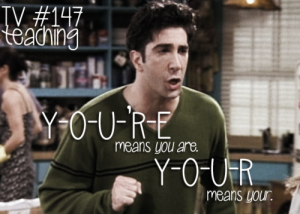
And now for the final pair of easily confused words: the famous “your” and “you’re”. Friends fans, remember that moment when Ross is fighting with Rachel over the letter she wrote him, and points out her grammar error for good measure? Yes, he was drawing attention to a mistake that many people are guilty of making at least once in their writing. But we all know which word is which: “your” is the possessive form of “you”, and “you’re” is the contraction of “you are”. The trick is making sure we’re using the right one!
You’re not going anywhere until your homework is done!
These are just some of the many examples of easily confused words in the English language. Yes, an innocent mistake now and then is forgivable; our grammar is so complex that even native speakers struggle with it from time to time. Still, as writers, we should take care to avoid these mistakes as much as possible. If nothing else, we should be setting a good example for all other English speakers!
What about you? Have you ever confused any of these words and phrases before? What other examples would you add to this list?
by Naomi L. | October 30, 2013 | Blog, Creative Writing, Motivational Music |
After recently spending hours listening to music on YouTube, I was inspired to write another Motivational Music post. Following the debut post about ambient/post-rock music, the genre featured in today’s topic is one that I’ve enjoyed since I can remember: classical. This type of music has been great inspiration for some of my writing in the past, especially poetry (since I like to think of classical music as poetry created with sound). I don’t want to go into “pretentious mode” and pretend to have a Music-major’s extensive knowledge of the genre, though, so for my first post on the subject, I’ll just scratch the surface with a few well-known Classical-era composers: Mozart, Beethoven and Bach.
Wolfgang Amadeus Mozart

Wolfgang Amadeus Mozart (1756-1791)
Genre(s): Classical
Origin: Salzburg, Austria
Writing Inspiration: Poetry, humor
My Favorite Song(s): “Rondo Alla Turca” (Piano Sonata No. 11), “Symphony No. 40”
When thinking of classical music, one of the first names that comes to mind is Mozart, and with good reason. From piano sonatas to orchestra symphonies to operas, his music is wonderfully melodic and an absolute delight to listen to. Though I do enjoy the grander compositions like his 40th symphony, my favorite pieces of his are the lighter sonatas and arias, such as “Rondo Alla Turca” (the last movement of his 11th piano sonata, also known as the Turkish March) and the Queen of the Night aria (from the opera The Magic Flute).
What I find so enjoyable about Mozart’s music is the way it bounces, like the notes are floating on a breeze. Back when I took vocal lessons, I had to learn his piece “Das Veilchen” (“The Violet”), and though it was difficult to sing in German, I still enjoyed it for the bright melody. That’s why I find Mozart inspirational not just for poetry, but for humorous writing. Even when I’m not writing, I like to listen to his compositions just because they put me in a good mood. Whether it’s a grand symphony or a simple piano solo, there’s something about Mozart’s music that always brings a smile to my face.
Ludwig van Beethoven
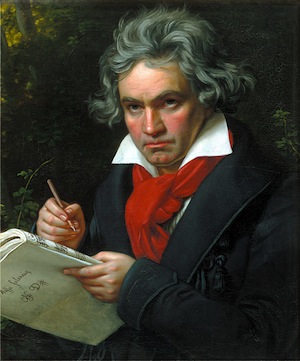
Ludwig van Beethoven (1770-1827)
Genre(s): Classical (Romantic era)
Origin: Bonn, Germany
Writing Inspiration: Poetry, drama, romance
My Favorite Song(s): “Symphony No. 5“, “Für Elise” (Bagatelle No. 25)
Yes, Beethoven is one of those composers whose music I could listen to all day. While I appreciate Mozart for his upbeat pieces, I enjoy Beethoven for his bold and powerful symphonies, which make excellent inspiration for dramatic writing. I sometimes listen to his fifth symphony when trying to get into a mindset for heavier scenes full of action or strong emotion (as demonstrated beautifully in this segment from Disney’s Fantasia 2000). Of course, the composer wasn’t limited to intense symphonies; one of his most famous pieces is the lovely piano bagatelle “Für Elise”, which contrasts with his more elaborate compositions for its soft and romantic melody.
Beethoven was an important figure in the transition between the Classical and Romantic eras of music, so it stands to reason that his pieces comprise a diversity of sources for writing inspiration, from poetry to drama to romance. Honestly, I find his music so inspiring that I’d recommend it not just to writers, but to artists of any type. If you appreciate music at all, you should have at least one composition by Beethoven in your music player. It’s definitely worth it.
Johann Sebastian Bach
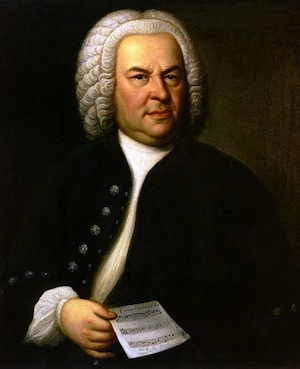
Johann Sebastian Bach (1685-1750)
Genre(s): Classical
Origin: Eisenach, Germany
Writing Inspiration: Poetry, drama
My Favorite Song(s): “Little Fugue (in G minor)“, Cello Suites
While Bach is admittedly not my favorite classical composer as far as concertos, I do enjoy his more subtle music. His cello suites are very beautiful and soothing (especially as performed by Yo-Yo Ma), and I find the slow melodies inspiring for writing drama and romance. My favorite piece, however, is definitely his “Little Fugue (in G minor)”; the music builds up as the different parts blend into each other to create a beautiful harmony, which I enjoy listening to while writing poetry or drama. Fun fact: this piece was adapted for the Dreamworks movie Shrek Forever After, where it plays as a club track (“Rumpel’s Party Palace“) in Rumpelstiltskin’s castle!
Though most of my favorite classical pieces are by Mozart and Beethoven, I find some of Bach’s music just as inspirational for certain forms of emotional writing. At the very least, I’d recommend his cello suites as background music for relaxing, as that can really help make the creative process easier!
Classical music is wonderful to listen to, as much for entertainment as for writing inspiration. Whether you write poetry or prose, comedies or tragedies, you can probably find inspiration in a good classical piece. I hope you enjoy the music I’ve shared with you today, and that you find in it the inspiration you need for your own art! Thanks for reading/listening!
by Naomi L. | October 23, 2013 | Blog, Creative Writing, Featured |
Remember the elementary school days when our teachers introduced us to those trusty reference books that would guide us through our writing? These were the friends we would come to rely on for the rest of our lives, the books containing so many of the answers we would need to survive our school years. The dictionary told us what those long words we’d never seen before meant. The atlas helped us find those faraway places we’d heard about in Geography class. There were encyclopedias and almanacs full of facts that came in handy for homework assignments. And then there was that book that gave us lists of synonyms and antonyms for the words we wanted to use in our writing: the thesaurus.
This last book is an interesting case, though, because unlike the others, it has the same potential to hinder as it does to help. Yes, the thesaurus is a top go-to resource for many writers, especially beginners looking to enhance their work. However, something our teachers may have neglected to tell us is that the guide comes with unwritten instructions: use knowledgeably.
Trustworthy/reliable friend/ally?
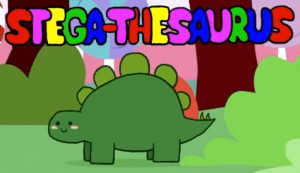
“Hooray yay for synonyms!”
(Screenshot from RubberNinja‘s Gameoverse videos)
When we were first introduced to the thesaurus, we were taught that it’s a great resource for helping to expand our vocabulary, and that’s true. I can’t even count how many new words I’ve learned just by looking up synonyms for ones I already knew. Every time I work on my stories, I have my dictionary/thesaurus widget handy to help me find replacements for words that would otherwise be repeated too soon in the narrative. It even helps me remember advanced vocabulary that I may have forgotten (which happens more often than I’d normally care to admit).
A good use of a thesaurus is as a reverse dictionary. You know how sometimes you know exactly what you mean to say, but you just can’t find the right word for it? Well, all you have to do is look up more common words for the definition you want and see what options come up. True, this method may not be as effective as using an actual reverse dictionary, which has full definitions and cross referencing, but it’s still a convenient alternative to find simpler examples, especially for writers who don’t have access to a more complete guide.
So yes, writers, the thesaurus is your friend. It will save you from plain and repetitive writing, and can teach you a thing or two (or ten) in the vocabulary department. But be warned, because placing too much trust in this guide can have negative consequences as well…
Or dubious/suspicious enemy/foe?
So how could this dependable friend of ours also be a hazard to our writing? Instead of launching into a dissertation about the dangers of overusing a thesaurus, allow me to illustrate the point instead with an example from the popular TV series Friends. In this episode, Joey wants to write a letter of recommendation for Monica and Chandler, who are planning to adopt. When he mentions that he wants to make it sound smart, Ross suggests he use a thesaurus to replace plain words with advanced ones. Unfortunately, the results are less than satisfactory…
Joey: Hey, finished my recommendation. (hands a letter to Chandler and Monica) Here. And I think you’ll be very, very happy.
[…]
Chandler: I don’t, uh, understand.
Joey: Some of the words a little too sophisticated for ya?
Monica: It doesn’t make any sense.
Joey: Of course it does! It’s smart! I used a the-saurus!
Chandler: On every word?
Joey: Yep.
Monica: All right, what was this sentence originally?
Joey: Oh, “They are warm, nice people with big hearts”.
Chandler: And that became “They are humid, prepossessing Homo sapiens with full-sized aortic pumps”?
Joey: Yeah, yeah. And hey, I really mean it, dude.
– Friends (Season 10, Episode 5 – The One Where Rachel’s Sister Babysits)
As you can see, Joey’s overuse of a thesaurus causes him to turn out a ridiculous stream of long words that have nothing to do with what he wants to say. While Ross’s advice may have been good in theory, he probably should have warned Joey not to go straight for the “smartest sounding” word every single time. The problem wasn’t just that his letter would come out overly “purple“, but that there was an important tip he neglected to keep in mind when choosing synonyms: context is key.
A notable example of a misused synonym in the above dialogue is “humid”. As we all know, while “warm” and “humid” have comparable definitions when it comes to describing the weather, only “warm” is also applicable to people. A similar problem happens with the use of Homo sapiens, which is only good for scientific writing and doesn’t really work as an alternative for “people”. With all these big words so out of place, it’s no wonder Monica and Chandler couldn’t understand anything Joey had written!
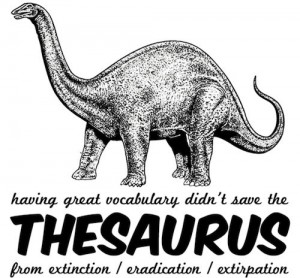 But there’s another problem with placing too much trust in a thesaurus. Although the purpose of the guide is to index words with similar definitions, there’s a catch: the “synonyms” that come up don’t always have the exact same meaning. This means you should always be aware of the full definition of a word before you try to pass it off as a replacement for a more common one, advice that many writers fail to take into account.
One particularly embarrassing example of this practice from my own experience is when I used the word “fortuitous” incorrectly in a story. My thesaurus listed it as a synonym for “random”, but what I didn’t realize until after publishing the piece was that while “random” is a neutral word, “fortuitous” usually has a positive connotation (as in “good fortune”), which was not the feeling I intended to convey. Fortunately, no one ever called me out on it, but it was still embarrassing to know the mistake was out there for anyone to see. So to be safe, make sure you look up the definition of a synonym before you use it in your writing. You’ll be glad you did.
A thesaurus can be a friend or an enemy, depending on how much faith a writer is willing to invest in it. While its uses are mostly beneficial, it’s up to you to make sure that this trusted ally doesn’t turn on you and muddle up the meaning behind your words. It’s OK to trust your thesaurus to help you enhance the vocabulary in your writing. Just try not to use it in excess!
Monica: Hey, Joey, I don’t think we can use this.
Joey: Why not?
Monica: Well, because you signed it “Baby Kangaroo Tribbiani”.
What about you? Do you make good use of your thesaurus? Has it been more of a help or a hazard to your writing?
by Naomi L. | October 16, 2013 | Blog, Creative Writing |
It’s that time again: time for another round of Writers Reveal! This week’s topic was sent to me by the host of the event, Emily Morgan, who suggested the prompt “the eyes of my enemy”. From that idea, I decided to write a short piece about an issue that many young people face at some point in their lives. I hope you enjoy what I’ve written. Thanks for the topic, Emily!
The Eyes of My Enemy

(Image used with permission from @angellastrucci. Check out her Instagram page for more amazing drawings!)
“You suck.”
“Shut up.”
“I mean it. That’s total crap. You think anyone’s gonna like that?”
“I said shut up.”
Every day was the same. I had to put up with an endless torrent of abuse from her, my worst enemy, with no ammunition to fight back. She had a power over me that I couldn’t overcome, that I hadn’t been able to overcome for years. She was the only one I couldn’t stand looking at. And I had to see her every single day.
“Good luck.” Her sarcasm burned like acid in my fragile mind. I wanted to punch her, but I would only hurt myself. She was invincible.
“Bite me.” I put down the brush and walked out the door.
The rest of the day wasn’t usually so bad. After each of our encounters, I would simply try to forget about her and go on living my life. But lately I had been finding it harder to push her from my thoughts. The more she tried to bring me down, the more confidence I lost in myself. And the more confidence I lost, the more she managed to bring me down. It was a vicious cycle, and I couldn’t take it much longer…
By the end of that day, I had somehow ended up in tears. Having finally reached my breaking point, I was ready to confront her for dragging me down to this level. I stormed into the room where I knew I’d find that girl always waiting to tear me down.
But she wasn’t there.
Instead, I found a different girl looking back at me, a girl I had never seen before. She looked vulnerable, nothing like the empowered enemy I had known for so long. In fact, I wouldn’t have recognized her…
…were it not for her eyes.
Something in those dark brown eyes spoke to me, telling me I wasn’t alone, that she had always been just as sad and scared as I was. And suddenly I realized what I should have done right from the start. I smiled at her and whispered…
“You are beautiful.”
For it was the first time that I saw myself in those eyes. The real me, not the girl who disapproved of herself and wished she had more to offer the world. All she wanted was to be loved. I took a step forward and pressed my hand against the glass. She pressed her hand against mine.
“This is ridiculous!” I laughed. “You’re beautiful! You’re smart! You’re a good person! And you deserve love.”
Her smile warmed my heart. I saw her bitter persona fade away to reveal the good soul underneath. The girl I couldn’t stand was gone, and in her place stood a girl who I would be happy to see every single day for as long as I lived.
With a newfound confidence, I turned and walked away with my head held high. She turned in perfect unison with me and disappeared into the void.
I would never see my enemy again. From that point on, I would look into the mirror, straight into those beautiful eyes, and see only myself.
She used to be my worst enemy. But now, as she’ll be for the rest of my life, she is my best friend.
This has been a special topic post in Emily Morgan’s Writers Reveal. To learn more, just follow the button below to her site, and be sure to check out the other blogs participating in the event. Thanks for reading!
Other bloggers in the Writers Reveal
Melissa Khalinsky: Melissa Writes
Jodi Gibson: JFGibson
Becky Fyfe: Imagine! Create! Write!
Josefa: Always Josefa
Rhianna: A Parenting Life
Ashley Howland: Ghostnapped
Emily Hawker: You Learn Something New Every Day




Recent Comments