by Naomi L. | October 9, 2013 | Blog, Creative Writing, Featured |
The new Romeo & Juliet movie is coming to UK and US theaters this Friday (which I admit makes me totally jealous, since there’s no set release date for where I live yet). In the spirit of celebrating one of William Shakespeare’s most famous plays, today’s topic is centered around this classic tale of love, fate and tragedy.
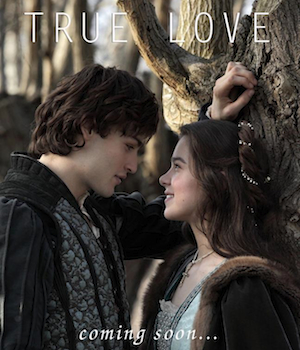
Douglas Booth and Hailee Steinfeld as Romeo and Juliet
Now I’m going to make a confession: I absolutely love this story. I love any story about forbidden love (as long as it’s well-told), and being the epitome of such a tale, Romeo & Juliet may be one of my favorites. In fact, I love it so much that I’ve read scenes several times over (yes, I read Shakespeare for fun, believe it or not), have actively sought out a fair share of adaptations, and have even used it as inspiration for my own romantic fiction.
But don’t mistake me for a silly fangirl. For the longest time, I believed the common interpretation that Romeo and Juliet were no more than two immature teenagers who recklessly rushed into a superficial relationship at the ultimate expense of their families and the rest of Verona. It wasn’t until I started researching in-depth analyses of the story (again, for inspiration) that I came to understand what I was missing in Shakespeare’s timeless classic, and what most modern readers/viewers might be missing too.
So to set your impressions straight before you head out to see this movie, here is a list of five points in Romeo & Juliet that you probably never noticed before. Get ready to see another side of this story!
(Warning: the following list contains possible spoilers for Romeo & Juliet. If you’re one of the few people on the Internet who are not familiar with this tragic story, proceed with caution. Or you can just read a full summary of the plot here.)
1) Rosaline is an important character
Before Romeo meets Juliet and falls desperately in love with her, he actually has his sights set on a different girl: Rosaline. In fact, his very first appearance in the play has him moping to his cousin Benvolio about the unrequited love he claims to feel for this unseen lady, and he even agrees to crash the Capulet ball with his friends just for the chance to see her.
But other versions of the story tend not to place very much importance on Rosaline. Most adaptations don’t even give her a face, and some exclude her character altogether, instead providing a different explanation for the Romeo character’s depression before he meets his Juliet (e.g. West Side Story: Tony longs for excitement in his life, which he finally discovers upon meeting Maria). This common alternative likely stems from the assumption that Rosaline’s only purpose in the original story is to lure Romeo to the ball so he can cross paths with Juliet, a plot point that can be easily worked around (continuing from the previous example, Tony first encounters Maria at a local dance that he only agreed to attend as a favor to his best friend).
Yet Rosaline actually plays a much greater role than a mere plot device. While pining for her, Romeo has a preconceived notion of what it means to be in love, and acts according to the lessons he’s learned from the hackneyed romantic poetry he likes to recite when thinking of her. At the first sight of Juliet, however, he abandons every thought of his former clichéd infatuation in favor of a much deeper passion that sparks some incredibly beautiful and original love poetry from his own heart (which, when you think about it, may have been Shakespeare’s way of saying “Take that!” to the poets before his time). To put it simply, the switch from Rosaline to Juliet is essential to highlight the main characters’ true feelings for each other by showing the audience the difference between Romeo thinking he’s in love and Romeo actually being in love.
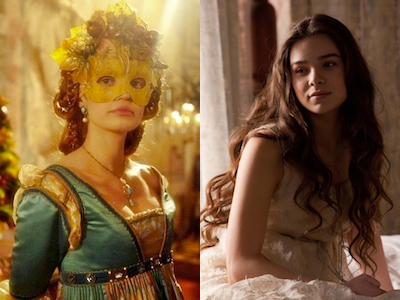
Seriously, did Rosaline ever stand a chance against Juliet?
What you’re probably thinking: He takes one look at Juliet and forgets about Rosaline just like that? Damn, Romeo is so superficial!
What you should be thinking: Wow, Juliet inspires such beautiful passion in Romeo! He must really love her!
2) Mercutio’s Queen Mab speech is a warning
One of the many famous monologues in Shakespeare’s works is the Queen Mab speech delivered by the bold Mercutio in Act 1, Scene 4 of Romeo & Juliet. This is the scene in which he teases Romeo for pining after Rosaline and tries to break his illusions of love by delivering a lecture about the dreams of men and how they can ultimately lead to ruin. Sound familiar?
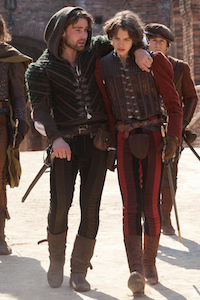
“True, I talk of dreams,
Which are the children of an idle brain” (1.4.97-98)
Mercutio starts by talking about Queen Mab, the mythical fairy queen who rides through the night bringing pleasant dreams tailored to every sleeping individual. But as he goes on, the lighthearted speech quickly takes a morbid turn into a downward spiral through darker visions of depravity (from lovers dreaming of romance to soldiers dreaming of killing), until finally culminating in a bitter yet accurate portrayal of society. Instead of taking from the speech a lesson about realism and the twisted nature of humanity, however, the idealistic Romeo simply disregards his friend’s words as another of his many mischievous taunts, silencing him with a single exasperated comment, “Thou talk’st of nothing.”
Like Romeo, modern audiences might be inclined to dismiss the Queen Mab speech as unnecessary rambling that contributes little to the rest of the story. Indeed, the monologue’s main purpose is to illustrate Mercutio’s wit and roguish nature, but it can also be interpreted as a critique against the romantic ideals that drive the play’s entire plot. In a way, Mercutio’s speech is foreshadowing the tragedies that will occur over the course of the story, and while it isn’t necessarily important, it certainly adds an interesting subtext to the themes of Romeo & Juliet.
What you’re probably thinking: Man, Mercutio really likes to hear himself talk!
What you should be thinking: Mercutio knew a thing or two about realism. Romeo probably should have listened…
3) Paris and Lady Montague even the score
Remember that part near the end of the story when Romeo kills the Count Paris in the Capulet tomb, and that other part when Montague says his wife died of grief after their son was banished from Verona? No? Then you must be familiar with any version of Romeo & Juliet other than the original play itself.
The fact is, most adaptations of this play tend to exclude the deaths of Paris and Lady Montague because they don’t contribute very much to the plot. The latter even goes virtually unnoticed, her offstage death being summed up in only two lines. So why would the playwright even bother killing these characters off in the first place?
Because it’s only fair. Before Romeo and Juliet famously take their own lives at the end, two other important characters suffer dramatic deaths in the middle of the story: Mercutio and Tybalt. But wait, wasn’t Mercutio on the Montagues’ side? Yes, but he was not a member of their family, as Tybalt was of the Capulets’. Mercutio was actually from the third noble family in the play: the Prince’s. This means that after all four of these characters die, the House of Capulet would technically have suffered the greatest loss.
Unless one more family member were to be lost from each of the other two houses. Enter Count Paris and Lady Montague. Paris, though aligned with the Capulets, is another kinsman to the Prince, and ends up being killed in a fight with Romeo during his visit to Juliet’s tomb while she’s faking her death. A little later, after the bodies are discovered in the tomb, the Prince calls forth the heads of the feuding households, at which point Montague accounts for his wife’s absence by explaining that the news of her son’s banishment ended up killing her.
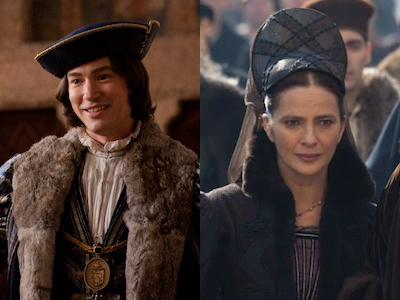
Surprise: one of them might not survive the movie this time. Guess who.
Final death toll:
- Capulets – 2 (Juliet and Tybalt)
- Montagues – 2 (Romeo and Lady Montague)
- Prince – 2 (Mercutio and Paris)
Conclusion: everyone loses, but at least in perfect balance.
What you’re probably thinking: Six people die by the end of the story? Shakespeare was twisted! No wonder most newer versions cut out these deaths!
What you should be thinking: Wow, every house loses two loved ones? How sad!
4) The poison and the dagger are symbolic
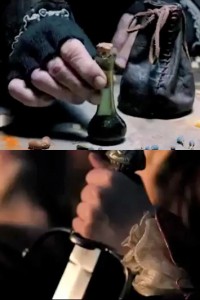
Romeo: “Thy drugs are quick. Thus with a kiss I die.” (5.3.120)
Juliet: “O happy dagger,/ This is thy sheath. There rust and let me die.” (5.3.169-170)
If there’s one thing for which Shakespeare was notorious, it was his innuendos. Plenty of his works contain their fair share of double entendres and the like, and Romeo & Juliet is no exception. However, instead of covering every example in the play (which would take a while, especially for scenes involving Mercutio), let’s just skip ahead to the one hidden in the famous double suicide ending.
You know how Romeo kills himself by drinking poison when he thinks Juliet is dead, and then Juliet stabs herself with Romeo’s dagger after she finds his body? Well, guess what: those two items are not random, but were carefully chosen to secretly represent the lovers’ intimate relationship. Romeo’s weapon of choice comes in a cup, which is a symbol of femininity. In contrast, Juliet uses a blade, a symbol of masculinity, to take her own life. In this way, their deaths are meant to reflect the intimacy they shared in life, thus completing the play’s theme of love ending in tragedy.
Or it’s all just another product of Shakespeare’s deviant mind, depending on how you choose to read into it.
What you’re probably thinking: Shakespeare must have been a misogynist, to have Juliet suffer a much more painful death than Romeo.
What you should be thinking: Even their deaths symbolize their intimate love. Shakespeare was clever with metaphors.
5) Romeo & Juliet is a coming-of-age story
Now I know what you might be thinking: how can Romeo & Juliet be a coming-of-age story if the entire plot only happens over four days? Perhaps it’s not a coming-of-age story in the traditional sense, as the teenage protagonists never actually reach adulthood, but their characters do mature throughout the course of the play, from the moment they meet to their untimely end.
At the beginning of the story, Romeo and Juliet are little more than naïve adolescents, both fairly inexperienced in life and in love. As soon as they first cross paths, however, they quickly propel each other toward the maturity of adulthood. Upon meeting Juliet, Romeo sheds his superficial conceptions of romance to become one of the most truly passionate lovers in all of English literature, and it is this passion that drives his actions for the rest of the play. Juliet, in turn, draws strength from her love for Romeo to develop into a confident and levelheaded young woman, making shrewd observations (“You kiss by th’ book”) and logical decisions that balance out her lover’s spontaneity. The intense love that outweighs the hatred around them makes their marriage all the more pure, and their loyalty to one another drives them to choose an eternity together in death over a miserable life alone. In short, though modern interpretations mistake these young lovers for foolishly infatuated teenagers, in-depth analyses reveal the true qualities of their complex characters, bringing to light the real depth of Shakespeare’s classic story of “death-marked love”.
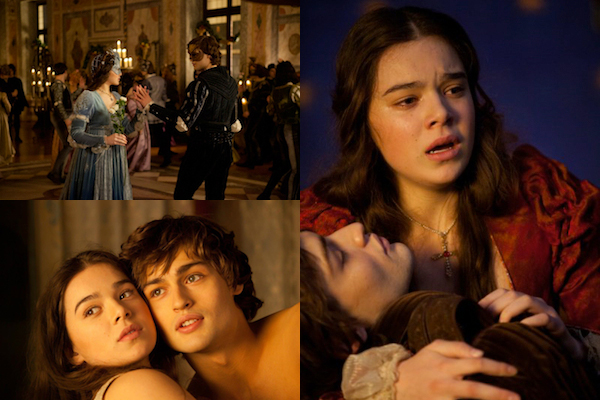
“For never was a story of more woe
Than this of Juliet and her Romeo.” (5.3.309-310)
What you’re probably thinking: They rushed into marriage after less than a day and then killed themselves because they couldn’t live without each other? Romeo and Juliet were so immature!
What you should be thinking: They were so young and they experienced such a grand romance. Romeo and Juliet were truly in love!
All caught up on these secret details?
Great! To leave you on a high note, here is the official trailer for the 2013 release of Romeo & Juliet (the original UK trailer can be found here). Enjoy!
[youtube=http://www.youtube.com/watch?v=Gp9yaZcrtnU]
Reasons I have high hopes for this movie:
- A screenplay adapted by Downton Abbey creator Julian Fellowes
- A stellar cast featuring talents such as Hailee Steinfeld, Douglas Booth, Ed Westwick, Damian Lewis and Paul Giamatti
- Good chemistry between co-stars Hailee Steinfeld and Douglas Booth
- Shot entirely on location in Verona and Mantua, Italy
I hope you’ve enjoyed reading about the secrets hidden in Romeo & Juliet! I understand that many will disagree with some of these points, but honestly, I think that’s part of the beauty of this tale: that it can be interpreted in so many different ways. To some, it’s a tale of love thwarted by fate; to others, it’s a warning about the dangers of being too impulsive. In any case, I’m sure we can all agree that this classic story has greatly endured the test of time, and will probably continue to intrigue admirers of Shakespeare and inspire the romantic at heart for generations to come.
On a final friendly note: kids, trust me when I say you do not want a romance like Romeo and Juliet’s! Yes, this is a beautiful story and a great one to read and learn from, but the story you want to live is that of Grandma and Grandpa, who had a life and grew old together. It’s important to know the difference!
Oh, and if anyone from the UK or US happens to watch this film, please let me know if it’s good. I’m very much looking forward to it. Thanks for reading!
(Disclaimer: All images and video in this blog post are courtesy of Swarovski Entertainment and Amber Entertainment. For news about the film, follow them on Facebook and Twitter. I own nothing; I’m just a fan hoping to spread the love. Thank you!)
by Naomi L. | October 2, 2013 | Blog, Creative Writing |
One of my favorite things about cinema is finding analogies in movies that are applicable to the real world. In much the same way I relate to the characters I read about in books, I often notice themes and metaphors in films for patterns I see in my life. Disney princess films showed me the (sometimes admirable, sometimes flawed) standards that women are expected to live up to; movies like How to Train Your Dragon touch on such subjects as the hidden value in an awkward youth who doesn’t quite fit in (the tried and true zero-to-hero plot) and the open-mindedness to see the world in a new light; and even films like Avatar appeal to my biologist side for the often clichéd but still valid theme of how the natural world is mistreated by the human race in general.
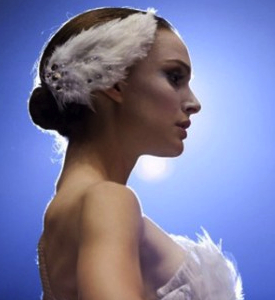
One interesting example I’ve found of an analogy for my creative side is from the 2010 movie Black Swan, which seems to reflect two different sides of my writing: technique and emotion. Of course, to understand this comparison, one first needs to be familiar with the story…
Rise of the Black Swan
As many are surely aware, Black Swan is an award-winning psychological thriller film, directed by Darren Aronofsky and starring Natalie Portman, Vincent Cassel, and Mila Kunis. The movie tells the story of Nina Sayers, a ballet dancer who is up for the highly coveted lead role of the Swan Queen in her company’s upcoming production of Swan Lake. In the beginning of the movie, the director, Thomas Leroy, is looking for a dancer who can embody both sides of the ballet’s main character: the delicate, innocent White Swan; and her sensual “evil twin”, the Black Swan. Thomas assures Nina that her flawless technique makes her a perfect match for the White Swan, but she must learn to let go of her inhibitions and release her emotional side in order to embrace the passion of the Black Swan. Despite her poor audition, the director sees enough of a spark in her to cast her as the Swan Queen, though he continues pushing her to bring out the fire he glimpsed when she asked for the part. The pressure of living up to her role proves incredibly stressful for Nina, and she soon finds herself transforming from her innocent White Swan persona into the dark Black Swan as she tries so hard to be “perfect”.
What really intrigued me about this film was seeing the contrast between the two Swans in creating the character of the Swan Queen. Though here they represent opposing sides of Nina’s personality, I find that they prove to be a good analogy for any form of art, which often requires a decent balance between both: the technique of the White and the emotion of the Black. In fact, the first comparison I made between the movie and my real life was not about my writing, but my singing. Back when I used to take vocal lessons, I focused so much on achieving technical perfection that I found it difficult to emote, for fear of losing that ideal sound. It wasn’t until later that I realized how applicable the concept was to all my other experiences in art, including – and perhaps especially – creative writing.
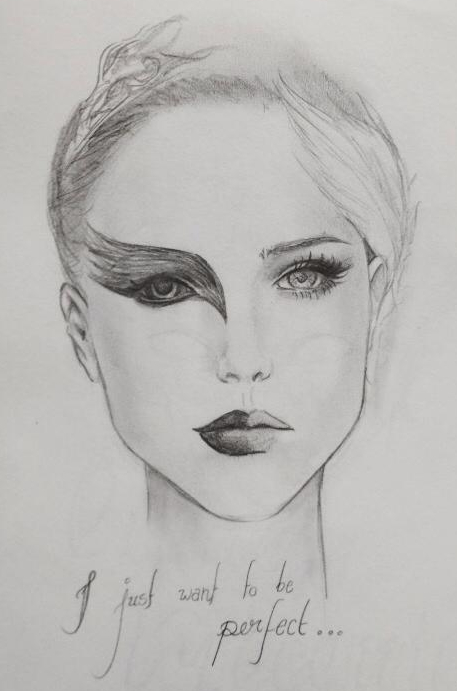
Natalie Portman as the Black and the White Swan
(Image used with permission from @angellastrucci. Check out her Instagram page for more amazing drawings!)
From Black to White
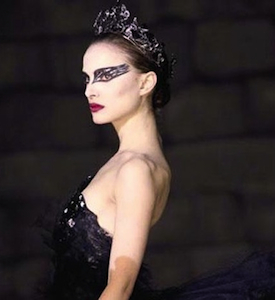 Interestingly, in contrast to Nina’s psychological breakdown, my own transformation seemed to happen backwards. Before I started seriously considering writing as a career, I wrote mostly for school assignments and my personal enjoyment, not really expecting to show my work to anyone. As a result of this, much of my earliest writing was carefree and uninhibited, but it was also rather sloppy. I think of this period as my “Black Swan” phase, when I poured my heart and soul into my words with hardly any regard for structure and refinement. For the preadolescent me, writing was all about emotion.
 As I grew older, however, my approach to creative writing began to change. I started to pay more attention to the technical aspect of my stories, focusing on details like grammatical coherence and proper structure instead of putting pure heart into my writing. It actually got to a point where I was so obsessed with writing “correctly” that I would often write dialogue in proper language even if it wasn’t in tone with the characters involved in the conversation. Because of this, my stories started to become mechanical, lacking the spontaneity that used to come across so easily in my earlier works. This was my “White Swan” phase, when technique came first and I only worried about the feeling behind the words later. My teenage self was a technical perfectionist.
The Swan Queen
As you can imagine, neither of these approaches alone was ideal for my creative writing. Too much emotion without technique made my stories seem juvenile and amateurish, while too much technique without emotion made them stiff and a little flat. I needed to learn how to touch on both sides in order to balance my stories. In other words, I needed to learn how to play the Swan Queen.
So that’s the goal I’ve been trying to reach in my writing: balance between these two complementary elements. I still see much of the White Swan’s technique in my work, but I’m continuing to let more of the Black Swan’s emotion back into my words, in the hope of achieving the equilibrium that will make me a better writer. In a similar (albeit healthier) way that Nina strives to fully embody her character, an artist should strive to draw from both Swans and embrace the metaphorical role of the Swan Queen.
What about you? Do you see more of the Black Swan or the White Swan in your own art? Have you managed to tame the Swan Queen (or King) in you?
by Naomi L. | September 25, 2013 | Blog, Creative Writing |
You know that moment while you’re writing a story, carefully following the plot in your mind, when you’re suddenly struck with inspiration for a specific point in the middle of the narrative? It’s that moment when the details start stringing themselves together in your head to form the perfect scene, word for word, exactly the way you want to read it back on the page, and you know you have to write it down before the moment passes and the right words are lost for good. Does that sound familiar at all?
OK, maybe it doesn’t happen to you, but it certainly happens to me all the time. Maybe you’re one of those writers who can plow through the events of a story in the order they’re supposed to happen, who can stick faithfully to an outline from the hook in the first paragraph to the final lines of the very last page. I’m sure there are writers who manage to write in a “straight line”. But I’m not one of them. I zig-zag. I shuffle. I start in the middle and shift between the beginning and the end. I write backwards (maybe not in the literal sense that Leonardo da Vinci could, but you get my point). Basically, I write every which way but straight.
So how do I turn these scattered pieces into a story? In a similar way that a famous fictional scientist turned separate body parts into his iconic monster: by “stitching” them together.
Collecting Parts
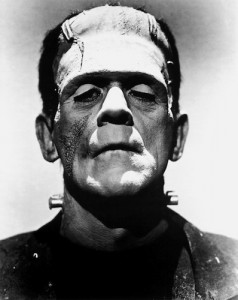
Frankenstein’s Monster (Frankenstein, 1931)
Everyone at one time or another has heard the name Frankenstein. Since the first publication of Mary Shelley’s novel in 1818, the name has become practically a legend in the horror and science fiction genres, and today is even one of the more obvious monster themes associated with Halloween. Even if most people haven’t read the book, many have probably seen at least part of the 1931 film adaptation (especially fans of the Universal Monsters movie series), and it’s on this interpretation of the creature that I based my writing method. While Shelley’s novel leaves the process of the monster’s creation ambiguous, the movie has Dr. Frankenstein build it out of collected limbs and organs that he pieces together into a human body. As for what happens after he brings the body to life, suffice it to say it all goes downhill from there.
Sometimes I like to think of my stories as my own little Frankenstein’s monsters, not in the sense that they’ll unleash untold horror on the world (which some of them might, though it’s too soon to tell), but in the sense that many of them are comprised of prewritten pieces that I later connected by inserting more words in between. Some of them are only a couple of lines long, some are a few paragraphs, and some take up more than a page. But they all come to me “out of turn”.
I spend a lot of time daydreaming about my stories, and a common result of this is the inspiration for a perfectly worded sequence that I haven’t yet reached in the main draft. In order to hold on to these ideas, I often keep a separate file on my computer where I can type them out while they’re still fresh in my mind. After making a note of it, I don’t usually read a scene again until I’ve worked my way up to that point in my story. That’s when the fun of stitching begins.
Stitching the Parts Together
When I have my individual scenes laid out, the next step is to insert them into my stories. While working on the main draft, I’ll eventually come to that part of a story that I had already written in a moment of inspiration. All I have to do then is copy the piece from the separate file I’ve made and paste it into the draft to move on from that point. Simple as that. Usually.
The thing is, it doesn’t necessarily end there. Sometimes after pasting it in, I find that a prewritten scene doesn’t quite fit into the rest of the narrative the way I had anticipated, either because of simple inconsistencies in style or minor details that I had changed since first writing the separate piece. To solve this, I edit the selection to accommodate the newly inserted sequence, revising details in the narrative and/or the added part, until everything fits together like the pieces of a puzzle.
The method doesn’t always work the same way. There are times when I’m struck with the inspiration to write two different scenes that I later realize are close enough in the story’s sequence of events that I can just stitch them together right there on the spot. Other stories of mine have been born from drafts that were nothing but a collection of separate scenes in which I eventually started closing the gaps. But any way I choose to put together the events of a narrative, it’s rarely in the right order. In much the same way I imagine Dr. Frankenstein must have worked to fit all his collected organs into a fully functional body (especially in the novel, where the creature is eight feet tall!), I work to stitch my scattered ideas into complete stories that function well as fiction.
So what writing method works best for you? Do your stories usually unravel in a straight line, or do you stitch them together from separate pieces?
by Naomi L. | September 18, 2013 | Blog, Creative Writing, Writer's Toolkit |
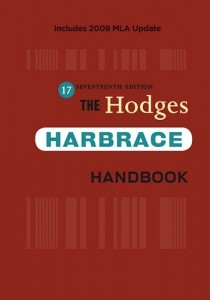
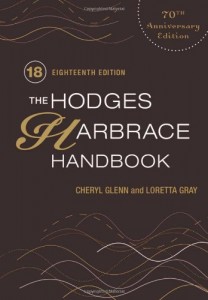
Who among us writers hasn’t found themselves doubting at one time or another whether the grammar in our writing was correct? I myself have at least three doubts regarding the previous sentence in this paragraph! We’ve probably all been in this situation before, getting stuck during the editing process over a comma we weren’t sure was correctly placed or the appropriate formatting for a citation. That’s why today’s Writer’s Toolkit review features a nifty handbook designed to aid writers through the trials of editing and revision: The Hodges Harbrace Handbook by Cheryl Glenn and Loretta Gray.
Book Summary
This handbook was one of the required materials for the online creative writing course I took through UC Berkeley. I currently own the 17th edition, published in 2009 with an MLA update, though at the time of writing this review, an 18th edition has already been released (and you can be sure that more will follow).
Originally published in 1941 by English professor John Hodges as the Harbrace Handbook of English, this book has since evolved into one of the richest English writing resources available today. The contents are organized into seven parts:
- Grammar
- Mechanics
- Punctuation
- Spelling and Diction
- Effective Sentences
- Writing
- Research and Documentation
Parts are subdivided into chapters and color-coded for your convenience (sorry, I couldn’t resist). Also included are a preface by the authors outlining new features and revisions for the current edition, a glossary of usage, a glossary of frequently used terms, and an index.
Pros
The first thing one might notice upon opening The Hodges Harbrace Handbook is the table of contents printed right into the back of the front cover and the first pages. At a glance, it’s clear how thorough this manual is, covering as many topics as possible from grammar and mechanics to proper usage of English in college-level writing. The table provides a quick guide to different sections and chapters, which are colored and numbered for easy reference.
As for the actual content, I find the explanations easy to understand, bearing in mind that the book is geared toward college students and above. To add to the educational experience, practice exercises are included within chapters, as are checklists for certain cases that come up in the editing process. Other notable features are the special boxes interspersed throughout the book: “Thinking Rhetorically” invites writers to consider the impact of their writing choices on their target audience; “Multilingual Writers” notes common areas of confusion for English learners, especially those for whom English is not a first language; and “Tech Savvy” provides helpful tips for using word-processing software, a useful feature for writers of the digital age. The last pages of the handbook include indexes for “Multilingual Writers” boxes, checklists and revision symbols.
One of my favorite details about the most recent editions of The Hodges Harbrace Handbook is the update for writers of modern times. As of the 17th edition, a new chapter titled “Online Writing” is included in the “Writing” part of the guide, and revisions reflect updates to MLA and APA guidelines and an expansion to a chapter on using writing software for business. Because of these updates, I would strongly advise against purchasing any edition of this handbook earlier than the 17th, published in 2009.
Cons
Honestly, this list is pretty short. In fact, the first issue I found with this handbook may have been due to error on my part. There were a couple of questions for which I couldn’t find answers in the handbook, either because I was searching for them in the wrong chapters or because they simply weren’t there. Also, the preface mentions some supplemental materials that are only available when bundled with the handbook at an additional cost. Not exactly a downside, but just a point to keep in mind if you’re looking for a complete learning experience to go with this guide.
Oh, and of course there’s the matter of price. A new latest-edition hard copy goes for over $80 on Amazon, which may seem steep to a student who only plans on using it for a semester. On the other hand, a prolific writer who needs to constantly edit and revise their work would probably find any price under $100 quite reasonable. As with any product, it’s all a matter of whether or not you feel you’d be able to get your money’s worth out of it.
Summary
Pros
- Versatile and thorough guide to the English language
- Well-organized contents
- Easy to understand
- In-chapter practice exercises
- Special boxes for “Thinking Rhetorically”, “Multilingual Writers” and “Tech Savvy” tips
- Extra indexes for “Multilingual Writers”, checklists and revision symbols
- Updated edition for writing in the modern age
Cons
- Possible missing information
- Supplemental materials available at additional cost
- Price ($80+ new on Amazon)
Conclusion
I highly recommend this handbook to any writer who puts as much effort into editing as into writing, if not more. Though I purchased my copy as a requirement for a class two years ago, I have since found it quite helpful when revising my work, and continue to use it today. Whether you’re looking for a complete guide to basic grammar or a full learning experience in the English language, The Hodges Harbrace Handbook is a great resource to keep handy, as much for the student writing for college as for the creative individual writing for life.
by Naomi L. | September 11, 2013 | Blog, Creative Writing |
Hello, and welcome to another Writers Reveal (formerly Secret Subject Swap) post, brought to you by Emily Morgan of Emily Morgan Writes. This month’s topic was sent to me by Melissa, who suggested the prompt “When I grow up… Water”. Based on that idea, I decided to write about my thoughts as a child on what else besides a writer I wanted to be when I grew up. Thanks for the topic, Melissa!
The Dreams of Children
Elementary school is an important time in every person’s development. It’s that time when we learn the basic knowledge that will get us through the rest of our lives, when our minds are always buzzing with hundreds of questions about the world around us (or at least, mine was). It’s also a time when many of us start to think about what career paths we’d like to follow in the future.
When we were still children, grown-ups started asking us what we wanted to be when we were older, and those of us who took the question seriously began to ponder the possibilities. Some of us chose to become doctors. Some of us chose to become lawyers. Some of us chose to become scientists, or journalists, or politicians. Some of us chose to become athletes. And some of us chose to become artists.
But how many of us stuck to the first plan that came to mind? How many of us had only one plan to begin with?
I didn’t.
My Other Dream
Writing about what I wanted to be when I grew up is easy, but I still had to think about the last part of Melissa’s prompt: “water”. What could I say about “water”? I could write a fictional story about a young girl with a dream to study the ocean, but it would still be based heavily on real facts, because the truth is… that’s my story.
The first time I knew I wanted to be a writer was in the fourth grade. Creative writing was my greatest passion at the time, and I knew in my heart it was a decision that I was going to stick to for the rest of my life. But writing wasn’t the only career I wanted to pursue when I was a kid, because I had another passion: science.
 Ever since I was about six years old, my favorite animal has been the bottlenose dolphin, mostly for its incredible intelligence and playful nature. Having spent a large part of my childhood living in southern Florida, my parents used to take us to Orlando all the time, where we’d visit all the big theme parks, including Sea World. It was there that I really developed a major interest in marine mammals, and I loved the attractions with dolphins so much that I eventually decided I wanted to be a dolphin trainer.
Over time, my passion for dolphins grew into a passion for ocean life in general, so that by the time I was in high school, my original plan had evolved from pursuing dolphin training to studying marine science. Years later, I graduated from university, and I now have a Bachelor’s degree in Biology.
From Dreams to Reality
So now what? Now I’m pursuing both my chosen career paths: creative writing and marine biology. I’m still doing research at my university while I prepare to start working toward a Master’s degree in Ecology, specializing in marine environments. In the meantime, I’m working on this blog to develop my skills and my identity as a writer, and I’m writing stories to release the creative energy inside me.
But these two paths are certainly not mutually exclusive. As a writer, I plan to draw from my experiences in science to write sci-fi stories with as much accurate detail as possible. As a biologist, I need to be skillful at writing to turn out high-quality papers for scientific journals, not to mention I need to be a creative thinker. In short, being able to follow both these paths is a wonderful experience, a real dream come true. I’m a scientist by day, an artist by night, and a dreamer by always.
What about you? What else did you want to do in life besides writing?
This has been a special topic post in Emily Morgan’s Writers Reveal. To learn more, just follow the button below to her site, and be sure to check out the other blogs participating in the event. Thanks for reading!

Other bloggers in the Writers Reveal
Melissa Khalinsky: Melissa Writes
Jodi Gibson: JFGibson
Becky Fyfe: Imagine! Create! Write!
Josefa: Always Josefa
Rhianna: A Parenting Life
Ashley Howland: Ghostnapped
Zanni: My Little Sunshine House
by Naomi L. | September 4, 2013 | Blog, Creative Writing, Off The Bookshelf |
Since the 9th century, the legend of King Arthur has been a well-known and popular one, spawning several myths and original retellings around the world over hundreds of years. Today, modern adaptations of Arthurian legend are hardly in short supply, from fantasy fiction portraying tales of the Knights of the Round Table to historical nonfiction seeking the truth behind the myths. Among the Arthurian fantasy novels that stand out the most, however, is Marion Zimmer Bradley’s celebrated four-part saga: The Mists of Avalon.
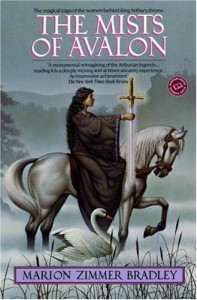
The Mists of Avalon, by Marion Zimmer Bradley
Summary
The novel series was first released in the United States by publisher Alfred A. Knopf in January 1983, for a targeted audience of adults, particularly women of any mature age. The Mists of Avalon tells the story of the rise and fall of King Arthur Pendragon in Britain during the late 5th and early 6th centuries, spanning across generations to narrate events from a little before his birth to sometime after his death. While it still encompasses many of the legend’s fantasy elements so well known today, the saga has a creative twist in that it relates the entire Arthurian legend from a completely different perspective: that of the female characters.
Review
As excited as any admirer of medieval fantasy fiction may be to start on a novel series with an Arthurian theme, the sheer length of this saga may prove daunting enough to warrant it a place on a summer reading list instead. This would likely turn out to be a wise decision, for one quickly discovers that Bradley’s elaborate plot, complex characters, detailed descriptions of medieval Britain, and fantastically original perspective of the Arthurian legend are capable of making the novels nearly impossible to put down for periods longer than are enough for basic necessary tasks, such as eating and sleeping. It’s arguable that enraptured readers would probably reach the end of the book well before the aforementioned list’s respective summer is over, and somehow feeling more conscious of – and respectful toward – the many possible interpretations of the story of King Arthur.
One of the most obvious themes that sets this novel apart from other Arthurian adaptations is feminism. The most widely known versions of these myths portray King Arthur and the Knights of the Round Table as the heroes of the story, while the women remain further toward the background as supporting characters with only a few key roles. In The Mists of Avalon, it’s almost exactly the opposite; Arthur and the other male characters sink into supporting roles, while the women rise up to become the protagonists in this original retelling. Readers are brought into the same world they know so well from the classic tales of King Arthur, yet at the same time, it becomes an entirely different world altogether, proving that vantage point really does make all the difference in the telling of a story.
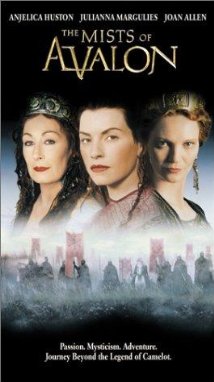
The Mists of Avalon (2001 TV Movie)
The majority of the narrative is told from the perspective of Arthur’s half-sister: the Avalon priestess Morgaine (known as Morgan le Fay in other Arthurian tales). Many chapters are also narrated from the viewpoints of other important women, among them Arthur’s wife, Queen Gwenhwyfar (the Welsh spelling of ‘Guinevere’); Avalon High Priestess and Lady of the Lake, Viviane; and Arthur and Morgaine’s mother, Igraine. Not only are these characters graced with much longer periods in the center of the narration, but Bradley also does a wonderful job of pulling these women out of their original unidimensional roles and giving them true depth, making them worthy of protagonism. Morgaine is no longer just an evil witch or a simple healer, but a strong druid priestess with good intentions and a tragic destiny. In turn, Gwenhwyfar’s innocent Christian veil is not just a plain matter of faith, but a slow descent into fanaticism brought on by an inferiority complex, her inability to bear children, and her search for salvation from her not-so-innocent infatuation with her husband’s best knight.
Which leads into the next main theme of the book: religion. One of the basic historical aspects of the Arthurian legend is the Christianization of Anglo-Saxon England, at a time when paganism was equally common. Again, a new light is shed on the story, as the conquering over dark pagan ways by Christianity becomes more of a struggle of rising tension and intolerance of the increasingly unstable balance between religions. The matriarchal society of Avalon is cast onto the defensive side against the overbearing patriarchal Church, eventually leading into a sequence of events in which Morgaine and the pagans strive to save Avalon and their native religion from disappearing from their country’s history altogether. Obviously, such strong religious implications – as is true of many novels with similar themes, notably Dan Brown’s The Da Vinci Code and Philip Pullman’s His Dark Materials trilogy – tend to spark equally strong criticism from religious groups, likely qualifying this book for a more “tolerant” audience.
Many might argue that it takes a certain kind of reader to enjoy a story like this, which boasts a generous share of heavy mature themes, such as sexuality and political radicalism. In light of such arguments, it may be best to recommend the series to readers deemed mature enough to refrain from dwelling excessively on these superficial themes (key as they are in many parts of the narrative) and truly appreciate the central concept Ms. Bradley intended to portray in her books: a story isn’t necessarily a simple matter of black and white or good and evil, but instead may hold several truths.
Inspiration
I first read this series when I was 14, after my mother gave me the single four-part volume as a Christmas gift. Since immersing myself in the world of Avalon, this saga has inspired me for its unique take on the legend of King Arthur, a story that has always fascinated me for its fantasy themes and insights into Celtic mythology. It was interesting to read this classic tale from the perspective of the women, and I quickly became entranced by the core theme of feminism present throughout The Mists of Avalon. Looking back, I’m glad my mom considered me mature enough to read the novels during my adolescence, for they introduced me to major political and religious topics during a key stage in my development as an independent thinker, and have thus become a great inspiration for the subtexts and themes that I like to write into some of my own stories.
The Mists of Avalon is, in my opinion, a classic work of art. Whether you’re an Arthurian enthusiast, a feminist, an intellectual with a fascination for religious debate, or simply a fan of well-written fantasy fiction, you will most likely enjoy this book. And if you happen to fit into every one of the above categories – as this writer likes to think she does – you will certainly devour it in no time, and still be left hungry for more.



Recent Comments