
Word of the Week: Prevaricate
Word: prevaricate
Pronunciation: prə-VE-rə-kayt
Part of Speech: verb
Definition: speak or act in an evasive way
Source: Oxford Dictionaries
While there may be some times when you do want to engage in confrontation, most people prefer to avoid it and will even go out of their way to dodge unpleasant topics that would lead to awkward situations. Taking an opposite approach from last week’s vocabulary word, today’s Word of the Week refers to evasive speech and action, a concept I’m sure we’re all familiar with. Who among us hasn’t tried at least once to “prevaricate” our way out of a conversation?
To “prevaricate” is to act or speak in an evasive manner. The word arose in the mid 16th century in the sense “to go astray” and comes from the Latin verb praevaricare, meaning “to walk crookedly”. This verb comprises the preposition prae “before” and the verb varicare “to straddle”.
Interestingly, it seems to “prevaricate” is such a common goal that there are several ways to accomplish it. For instance, one way to speak evasively is through “circumlocution“, using long-drawn-out sentences when a few words could get you straight to the point. Another way is to use the rhetorical device of “paralipsis“, bringing up a subject by saying you won’t mention it so as to avoid being held accountable for the consequences. However they choose to go about it, if your characters tend to be evasive in their speech and actions, “prevaricate” may be a good word to add to your stories!
What are your thoughts on this word? Any suggestions for future “Word of the Week” featured words?
A Fresh Start
I boarded the plane with a racing heart and tears in my eyes. Goodbyes are never easy, especially with family. You just have to keep telling yourself that it isn’t farewell for good; you’ll see each other again on holidays and special occasions. In the meantime, the separation will make future reunions all the sweeter.
That’s what I told myself as I settled in my seat, what my subconscious whispered in the back of my mind through the whole flight as I read my books, watched in-flight movies, and struggled to fall asleep, tossing and turning under my blanket. The dark sky outside had never looked so welcoming and intimidating at once.
It wasn’t until the great city came into view below that I really started to feel excited. The end of my journey was drawing near. What was waiting for me on the other side? I already knew what to expect as I stepped off the plane. It was why I couldn’t stop smiling as I stood in line at Passport Control or shaking as I pulled my suitcase off the conveyor belt.
I knew that the moment I stepped through the doors to the Arrivals deck, I would see his face smiling back at me, his loving brown eyes just as bright with hope and happiness as mine. The feeling of running into his arms was the most comforting in the world, knowing I’d never have to leave them again.
Time for a fresh start. My new life was about to begin!
10 Inspirational Quotes for a Hopeful Future
November 2016 has been an incredibly hectic month, hasn’t it? From the chaos surrounding the U.S. presidential election to the final sprints of NaNoWriMo, it certainly hasn’t been the easiest few weeks for many writers who actively follow politics. As it draws to a close, I confess I found myself more emotionally drained this month than I can recall feeling at any point during the last few years (and that’s saying something). Sounds like now would be a good time for some more inspirational words!
So just for fun, and as a little ray of sunshine for anyone else who may be needing it these days, here are ten inspirational quotes for hope and a brighter future. Enjoy!
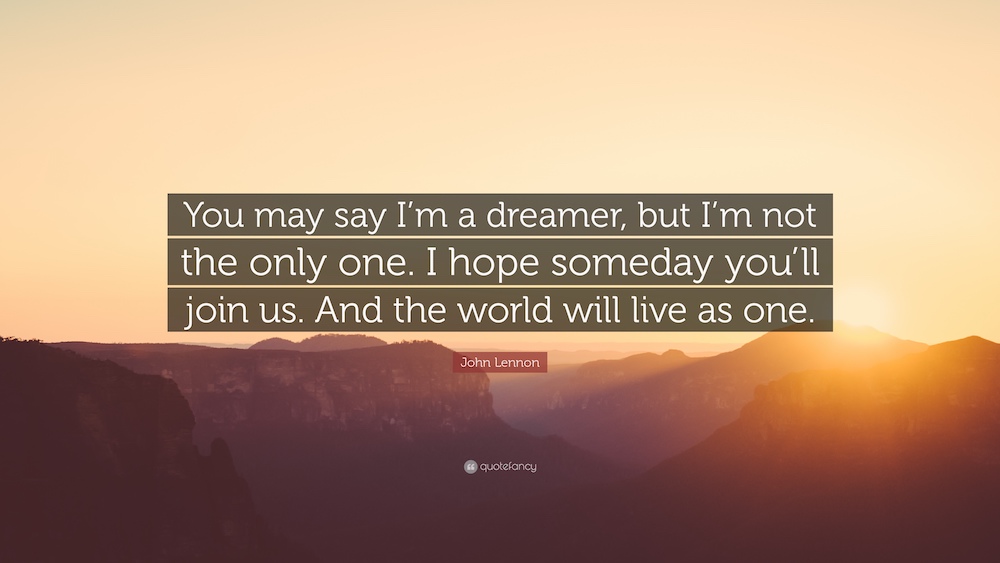 1) You may say I’m a dreamer, but I’m not the only one. I hope someday you’ll join us. And the world will live as one. – John Lennon
2) It’s really a wonder that I haven’t dropped all my ideals, because they seem so absurd and impossible to carry out. Yet I keep them, because in spite of everything, I still believe that people are really good at heart. – Anne Frank, The Diary of a Young Girl
3) We are only as strong as we are united, as weak as we are divided. – J.K. Rowling, Harry Potter and the Goblet of Fire
4) There is some good in this world, and it’s worth fighting for. – J.R.R. Tolkien, The Two Towers
5) Only when it is dark enough can you see the stars. – Martin Luther King Jr.
6) There is a saying in Tibetan, ‘Tragedy should be utilized as a source of strength.’ No matter what sort of difficulties, how painful experience is, if we lose our hope, that’s our real disaster. – Dalai Lama XIV
7) Remember, hope is a good thing, maybe the best of things, and no good thing ever dies. – Stephen King, The Shawshank Redemption
8) The road that is built in hope is more pleasant to the traveler than the road built in despair, even though they both lead to the same destination. – Marion Zimmer Bradley, The Fall of Atlantis
9) I am fundamentally an optimist. Whether that comes from nature or nurture, I cannot say. Part of being optimistic is keeping one’s head pointed toward the sun, one’s feet moving forward. There were many dark moments when my faith in humanity was sorely tested, but I would not and could not give myself up to despair. That way lays defeat and death. – Nelson Mandela, Long Walk to Freedom: Autobiography of Nelson Mandela
10) The best way to not feel hopeless is to get up and do something. Don’t wait for good things to happen to you. If you go out and make some good things happen, you will fill the world with hope, you will fill yourself with hope. – President Barack Obama
What are your thoughts on these quotes? Any others you would add to the list?
Word of the Week: Vitriolic
Word: vitriolic
Pronunciation: vi-tree-AH-lik
Part of Speech: adjective
Definition: filled with bitter criticism or malice
Source: Oxford Dictionaries
There are many words out there to define the bitter, the critical, and the downright mean. As a writer, you may often find yourself in need of a variety of these words to keep your descriptions of villains and conflicts fresh and vivid. Today’s vocabulary post features one such word that I feel adds a poetic touch to otherwise coarse writing. Why call certain acts “sour” or “cruel” when you can call them “vitriolic”?
To be “vitriolic” is to be filled with bitter malice or criticism. The word is the adjective form of the noun “vitriol“, meaning “cruel and bitter criticism”. This noun arose in late Middle English as a reference to the sulfate of various metals and comes from the Latin noun vitriolum “sulphuric acid”, which in turn stems from the Latin noun vitrum “glass”.
As noted above, “vitriolic” derives from a word that was once a chemistry term for “sulfuric acid” but has since become dated in this sense. Today, the noun “vitriol” mostly refers to abusive language, so by extension, the adjective “vitriolic” also refers primarily to caustic and malicious speech. However, I’ve also seen it used to describe violent actions, so I assume it’s up to a writer’s discretion how best to use it. If your characters often engage in harsh and spiteful speech or actions, “vitriolic” may be a good word to add to your vocabulary!
What are your thoughts on this word? Any suggestions for future “Word of the Week” featured words?
A Day for Giving Thanks
There are many things that make me
Happy every single day of my life:
A loving family who always support me,
Never-ending inspiration to write, learn, and live,
Kisses and hugs from the people I love most.
So many blessings for which I’m ever
Grateful, I give thanks for today as the
Innumerable favors that make up the
Vivid beauty of my incredible life.
I wish you all a wonderful day, and may you
Never forget to be thankful for the joys in your life too!
God bless, and have a Happy Thanksgiving!
Happy Thanksgiving to all my friends and family! May you all have a blessed weekend!
About J.C. Wolfe

Follow The Wolfe's (Writing) Den on WordPress.com
Read More…
Copyright

The Wolfe's (Writing) Den by J.C. Wolfe is licensed under a Creative Commons Attribution-NonCommercial-NoDerivatives 4.0 International License.
Recent Comments