by Naomi L. | June 10, 2015 | Blog, Creative Writing |
Yes, I know it’s been a while since I’ve posted one of these, but I haven’t forgotten about this series! On the topic of art and science, so far I’ve discussed their similarities and differences in reading, writing, and research. Now it’s time to discuss another important part of any type of writing: editing. How do art and science compare when it comes to proofreading your work?
How the Art is like the Science
Editing is an essential part of writing, no less important than the creative part. It’s a practice that every writer must undertake at least at the most basic level. Even if you hand your work off to someone else for proofreading, you still need to be confident in the quality of whatever you’re passing on, and the only one who can make that call is you. Whether you write artistically or scientifically, rewriting is writing, and you can’t expect that writing to go very far unless you give it the care and attention it deserves.
Artists and scientists alike are expected to master the technique of editing. We have to know how to take a step back and review everything we’ve written with a fresh perspective. We must be able to channel our inner writer and our inner critic and learn when to listen to which voice. We have to be able to catch mistakes in a second, third, fourth reading. We need to be able to identify weak points and figure out how to connect all our ideas into one coherent picture. Regardless of our form, style, or content, the ability to edit our own work is indispensable if we wish to be taken seriously in this ever-expanding world of the written word.
At its core, editing is crucial to all forms of writing. The process of editing, however, differs between artistic and scientific writing.
How the Art is unlike the Science
Editing artistic writing is something of a linear process. First, it’s up to the writer to look over their work and make as many changes as they deem appropriate. As the best of us know, this part alone can take weeks, if not months or even years. Once the author is satisfied with their draft, the baton is often passed to an editor, ideally a professional, who provides fresh opinions on how to improve the piece. A back-and-forth between the writer and the editor is encouraged at this stage for the benefit of the work being revised, and some writers choose to include a beta reader or two for additional insight. Novelists who opt for the traditional route also need to wait for their manuscript to be approved by a publishing house, yet another stop on the road to publication. Only when a written work has passed all the checkpoints can it finally reach the public, and while there may be some overlapping along the way, the process as a whole is basically one continuous track.
 Scientific writing, on the other hand, is revised through a sort of “simultaneous editing”. For example, my first experience writing a research paper involved a collaborative effort among me, my professor, and two other authors. One researcher was responsible for most of the writing, then we each had to review the first draft on our own time and send each other our notes so the lead author could incorporate them all into one updated draft for a second round of reviews. This process was repeated several times until we were all satisfied enough with the final draft to submit it for peer review, at which point it was up to another group of researchers to simultaneously read it over and contribute their opinions. Since an academic paper usually takes more than one writer to put together, it’s much more time efficient to have multiple editors review it at the same time throughout the stages from writing to publication, especially in an age when information is emerging faster than we can keep up with it. In short, multiple reviewers plus simultaneous editing equals faster science.
The art of editing is learning how to balance the inner writer and the inner critic, while the science of editing is refining your work into a piece worthy of public attention. How to go about it may depend on what exactly you write, but if you can master the technique, you can be sure it’ll bring you one step closer to being on the outside what you already are at heart: a full-fledged writer.
by Naomi L. | June 3, 2015 | Blog, Creative Writing, What If? Writing Prompts |
Time for another set of “What If?” Writing Prompts. Speaking of time, this week’s batch is centered around a fascinating theme yet to be featured in this segment: history! How might true stories have played out differently if certain historical details were changed? Have fun exploring the possibilities!
 What if… most of the greatest leaders in history had been women?
What if… the Roman Empire had never fallen?
What if… the Church had not been the most powerful entity in the Middle Ages?
What if… the slave trade had never made it to the United States?
What if… the Axis powers had won World War II?
Good luck writing your own twists on history!
If you have any “What If?” writing prompt suggestions (for any theme), please feel free to share them in the comments below. Ideas I like may be featured in future “What If?” posts, with full credit and a link to your blog (if you have one)! Also, if you’ve written a piece based on an idea you’ve found here, be sure to link back to the respective “What If?” post. I would love to see what you’ve done with the prompt! Thank you!
by Naomi L. | May 27, 2015 | Blog, Creative Writing, What If? Writing Prompts |
So it seems my ultra busy grad school schedule is catching up with me yet again, so for now, I’m afraid I’ll have to pad over my creative writing topics with some “What If?” Writing Prompts at least every other week. My apologies for not being able to bring you more fulfilling content for a while, but I hope you’ll find these posts entertaining nonetheless.
Since I enjoyed writing for the Earth Day post so much, I figured I’d try my hand at coming up with another batch of nature-themed prompts. See what sorts of environmental stories you can create based on these ideas! Enjoy!
What if… the world ran entirely on renewable energy sources?
What if… a massive space object were to black out the sun?
What if… there were ecosystems completely uninfluenced by human actions?
What if… species could evolve fast enough to keep up with the accelerated environmental changes caused by people?
What if… humans were an endangered species?
Have fun spinning your own environmental tales!
If you have any “What If?” writing prompt suggestions (for any theme), please feel free to share them in the comments below. Ideas I like may be featured in future “What If?” posts, with full credit and a link to your blog (if you have one)! Also, if you’ve written a piece based on an idea you’ve found here, be sure to link back to the respective “What If?” post. I would love to see what you’ve done with the prompt! Thank you!
by Naomi L. | May 20, 2015 | Blog, Creative Writing, Featured |
I love colors. I’ll say it over and over again: I love colors! They’re beautiful. They’re stimulating. Sometimes I even think they’re magical. I love everything about them, from the power they have to evoke emotions to the subtle yet distinct differences they make in a work of art. But my favorite thing about colors is their symbolism, the way they can be used to hide secrets and hint at details of a bigger picture without drawing focus away from the story at hand.
It’s simple enough to use colors in visual art, but what about in writing? Challenging as it may seem, I believe it is possible to create symbolism with words, such as when describing color schemes of character outfits and settings. Color symbolism has fascinated me for as long as I can remember, and while it would take an entire book (or series of books) to get into it all, I’d like to at least scratch the surface today with some of the basics I’ve picked up throughout my experience researching and implementing meaningful colors in my stories. You may want to consider these tips the next time you set a scene; they can help add a vivid new layer to your story! Enjoy!
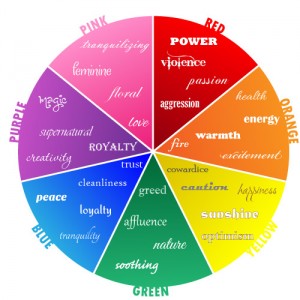
 Red – Red is a bold and passionate color, often symbolizing such strong ideas and images as courage, fire, power, and violence. It’s a color that demands attention, which is why it’s commonly used to signify danger. Use red for passionate or aggressive characters, or for any sort of intense scene, whether it’s the heat of love or the violence of war.
 Orange – Not quite passionate and not quite joyful, orange is a middle ground between red and yellow. It symbolizes energy and creativity, and is used in psychology to stimulate enthusiasm and determination. Use orange for adventurous or creative characters, or when you want to paint some vibrant warmth into a scene.
 Yellow – Yellow is the two-sided coin of colors. On the one hand, it symbolizes happiness, optimism, sunshine, and friendship. On the other hand, it can also stand for cowardice, illness, hazard, and deceit. Golden shades represent wealth and luxury. Use yellow when you want to add hints of joy or caution to a scene. For the best effect, I recommend using yellow ambiguously, such as for characters who seem jubilant and optimistic on the outside but who are fearful or deceitful on the inside.
 Green – Think of green and you’re sure to picture beautiful scenes of nature, complete with lush vegetation as far as the eye can see. Indeed, green is the color of the environment, and it represents such ideas as youth, fertility, health, and rebirth. Abstractly, it also symbolizes jealousy and good luck. Use green for characters associated with natural themes such as environmentalism or the practice of healing, or to hint at fortune or envy in relationships.
 Blue – Blue is my favorite color because it represents all my favorite things. It’s a color that symbolizes intelligence, tranquility, trust, and loyalty. In nature, it’s associated with the sky and the sea, and different shades from turquoise to navy can be used to signify sophistication, knowledge, and integrity. Use blue for characters who are more intellectual than emotional, and for settings fitting an atmosphere of calm and authority.
 Purple – Purple is the color of royalty, and has long represented such themes as nobility, wisdom, honor, and extravagance. Being a relatively rare color in nature, it is often associated with mystery and magic. Lighter shades such as lavender also convey grace and elegance. Use purple as a motif for regal or arrogant characters, mysterious settings, and storylines brimming with fantasy.
 Pink – A soft complement to the bold red, pink is the color that most famously signifies love and romance. Strongly associated with femininity, it represents tenderness, caring, and acceptance. I myself tend to associate the color pink with flowers. Use pink to add a soothing or feminine quality to a scene, or to signify elements of a romantic subplot.
 Brown – Brown is well known as an earth tone, and as such tends to represent stability. Common ideas associated with the color brown include simplicity, comfort, and endurance. Use brown when you want to convey a sense of plainness or tenacity in a scene without having to resort to the blatant dullness of gray.
 Gray – The dull middle ground between white and black, gray is most commonly associated with boredom and depression. On the positive side, it also stands for security, modesty, practicality, and reliability. Use gray for conservative characters or when you want to create a colorless air for a particular setting.
 White – White is the international color of peace, and is often regarded as a symbol of light, purity, and faith. Some even go as far as to associate it with perfection. Note that white takes on a different meaning in Eastern cultures, where it’s associated with death and mourning. Use white when you want to convey innocence in your characters and cleanliness in your settings, or when you want to create strong religious symbolism in your scenes.
 Black – The exact opposite of white, black represents everything that its counterpart doesn’t. Darkness, evil, and death are themes commonly associated with black, but it can also stand for austerity, formality, style, and sexuality. Arguably the most powerful color of all, black has a long history of symbolizing strongly opposed ideas on the spectrum of good and evil. Use black to convey depth in your characters or to add dark themes to a scene. For best results, combine it with other colors to create interesting contrasts of ideas in your stories.
I hope you’ve enjoyed exploring the symbolism of color with me, and that you’ve picked up a few hints along the way! Have fun experimenting with the colors in your stories! Good luck, and thanks for reading!
Do you use color symbolism in your stories? Which colors are your favorites?
References and Further Reading
by Naomi L. | May 13, 2015 | Blog, Creative Writing, What If? Writing Prompts |
To keep up with my creative writing, I’m sharing a new set of “What If?” Writing Prompts for you to enjoy. This week’s post features another batch of prompts in the paranormal genre. See what sorts of mysterious stories you can write based on these ideas! Have fun!
What if… the two-hundred-year-old ghost of a former resident were haunting your house?
What if… you lived alone, but kept finding notes scribbled on your bathroom mirror whenever you took a shower?
What if… you had a mirror in which you could see the future?
What if… you could telekinetically manipulate objects based on your emotions?
What if… you held a seance for a departed loved one… that went horribly wrong?
Good luck spinning your own paranormal tales!
If you have any “What If?” writing prompt suggestions (for any theme), please feel free to share them in the comments below. Ideas I like may be featured in future “What If?” posts, with full credit and a link to your blog (if you have one)! Also, if you’ve written a piece based on an idea you’ve found here, be sure to link back to the respective “What If?” post. I would love to see what you’ve done with the prompt! Thank you!



Recent Comments