by Naomi L. | January 28, 2015 | Blog, Creative Writing, Off The Bookshelf |
For Christmas 2013, I received a copy of Neil Gaiman’s newest acclaimed novel released in the same year. Unfortunately, though I wanted to add it to my Off The Bookshelf segment as soon as possible, other priorities in my life have been delaying my leisurely reading time, so that I only just managed to finish the book last month. It’s a shame I couldn’t get through it quicker, because the truth is that it was a delight to read. So without further ado, here’s my review of The Ocean at the End of the Lane by Neil Gaiman.
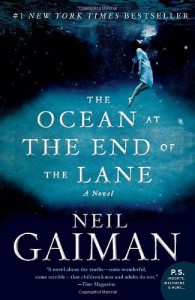
The Ocean at the End of the Lane, by Neil Gaiman
Summary
Published in June 2013, The Ocean at the End of the Lane tells the story of an unnamed man and a strange experience he faced in his youth. After returning to his childhood home for a funeral, the middle-aged narrator pays a visit to the farmhouse down the lane, where he met an extraordinary girl named Lettie Hempstock and her mother and grandmother when he was seven. While sitting at the edge of the pond behind the house – a pond Lettie had called an ocean – he suddenly recalls the details of the most fantastic and terrifying event of his past – “a past too strange, too frightening, too dangerous to have happened to anyone, let alone a small boy”.
Review
First off, I have to thank Vanessa Levin-Pompetzki for the book recommendation on her blog, since that’s where I first heard about this novel. I’m glad I stumbled upon her post, because the book really is a wonderful read. A fantasy tale narrated from the memories of a seven-year-old boy, the story touches on such themes as existentialism, the struggles between good and evil, and the discrepancies between childhood and adulthood.
What drew me in most about this book is the way it so subtly yet realistically depicts the simple qualities that make us human, such as curiosity and fear. The author does an excellent job of portraying the theme of self-identity throughout the story without emphasizing it too greatly; it was more of an impression left on me after finishing the book than a prominent point to focus on with every turn of the page. In that respect, I believe the author made a wise decision in creating a seven-year-old protagonist, as few adults in this world experience life as purely and innocently as children do.
This is another favorite theme of mine from the book: the divide between the world of children and the world of adults. From the beginning of the story, it’s implied that the middle-aged narrator sitting by the Hempstocks’ “ocean” feels somewhat disconnected from his youth, which he vaguely remembers as not being a particularly happy time in his life. Throughout his childhood memories, references are made to how differently grown-ups behave compared to children, as well as how difficult it would have been for him to make his parents understand what was happening at the time the strange events took place. Yet the author makes a point of illustrating how these differences are merely superficial; one of my favorite excerpts in the novel comes from a conversation between the narrator and Lettie about the true nature of adults:
Grown-ups don’t look like grown-ups on the inside either. Outside, they’re big and thoughtless and they always know what they’re doing. Inside, they look just like they always have. Like they did when they were your age. The truth is, there aren’t any grown-ups. Not one, in the whole wide world.
– Lettie Hempstock, The Ocean at the End of the Lane (Neil Gaiman, 2013)
Overall, Mr. Gaiman has constructed a beautiful work of art that readers of any age group can appreciate. Personally, I believe this novel would appeal mostly to adults for its deeper message of understanding the world and one’s own self, which many of us tend to forget as we grow older. Whether we need reminding to search for our true identities or to compare our past perspectives to our present outlook on life, The Ocean at the End of the Lane is a captivating read with the potential to leave its readers asking the simplest questions they didn’t even know were hidden in the depths of their minds.
Inspiration
In a way, The Ocean at the End of the Lane reminds me of The Little Prince in that the story centers on life and existence from the perspective of a child, with a gentle hint of fantasy to add to the intrigue of the narrative. I love stories that depict the world from the eyes of children, as such tales remind me of how I used to live when I was younger. For artists in particular, it’s interesting – if not essential – to remember the past once in a while, and there’s nothing like a well-written work of fiction to take us there in ways we never even imagined.
So if you too enjoy stories that can make you see the world and even your own life in a different light, I highly recommend giving this book a read. You may just catch a glimpse of yourself within the pages of Gaiman’s mysterious “ocean”.
by Naomi L. | January 21, 2015 | Blog, Creative Writing |
I’ve already talked about words that people use incorrectly and words that used to have another definition. But what about those word meanings that are just plain wrong? Continuing on the topic of grammar pitfalls, here’s a new post focusing on words that people seem to think mean one thing but that really mean something totally different. To keep things light, I’m starting with four of my favorites, but please feel free to suggest more in the comments! Thanks, and enjoy!
Please note: accounts behind the words listed here are based entirely on personal experience and may not accurately reflect the majority of people’s understanding. The definitions, on the other hand, are correct to the best of my (and the Oxford Dictionaries editors’) knowledge. Read consciously! Thank you!
Inception means “beginning”, not “a dream within a dream”
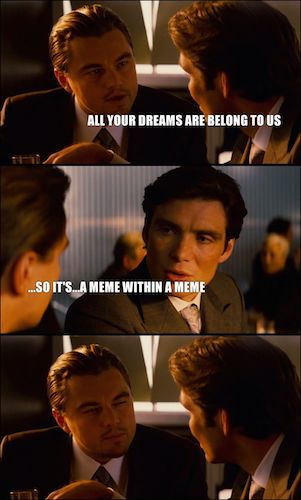
Memeception?
Shortly after Inception came out in 2010, the Internet was flooded with jokes and memes based on the blockbuster sci-fi film, from captioned dialogues between Leonardo DiCaprio and Cillian Murphy to videos containing the trailer’s infamous “BRAAAM“. One of the most common jokes I’ve heard is to add the suffix -ception to any word to indicate that said thing is contained within another of the same thing (e.g. Jokeception = a joke within a joke). Apparently, the idea of multilayered dreams is such a prominent theme in the film that many believe it to be the major point of the plot. And while it isn’t fair to assume that all or even most people who use this meme don’t know what “inception” really means, there’s always that minority who aren’t even aware there’s a mistake until it’s pointed out to them.
So those of you who count yourselves among this group, take note: “inception” indicates the beginning of something, not a dream with a dream (or any X within an X, for that matter). Feel free to make all the jokes you want, but don’t let the memes confuse you!
Note: in case you were wondering, the actual word for “a thing within a thing” is “recursion”. The title of the movie is Inception because the main characters’ goal is to trigger the birth of an idea within someone’s mind. You’re welcome.
Star-crossed means “ill-fated”, not “soulmates”
When one hears the term “star-crossed”, the first idea to come to mind is most likely William Shakespeare’s Romeo & Juliet. This is to be expected; it is, after all, the play that originated the trope:
From forth the fatal loins of these two foes,
A pair of star cross’d lovers take their life,
Whose misadventur’d piteous overthrows
Doth with their death bury their parents’ strife.
(I.Prologue.5-8)
To anyone even remotely familiar with this story, it should be obvious from the opening sonnet that “star-crossed lovers” are those who struggle against fate. Romeo and Juliet do everything they can to live happily together, yet circumstances and bad luck lead them to a tragic end instead. However, some people seem to misinterpret “star-crossed” as having the opposite meaning, that is, a term for lovers who are destined to be together. It’s an understandable mistake, since hardly anyone can argue against the idea that the eponymous lovers are at least supposed to be together, but that doesn’t make it any less incorrect.
For future reference, “star-crossed” refers to a relationship doomed to be thwarted by external forces. Evidently coined by Shakespeare himself, the term stems from the old belief that the stars controlled fate, and thus the “crossing” of two people’s stars indicated misfortune in their path. Therefore, it should never be used to indicate that two people are soulmates, as it means just the opposite. Be careful!
Wherefore means “why”, not “where”
While we’re on the subject of Romeo & Juliet, here’s a word that everyone has misread at least once. The most famous line in the play comes up during Juliet’s balcony monologue, when Romeo eavesdrops on her musing, “O Romeo, Romeo! Wherefore art thou Romeo?” (II.ii.33)
For modern-day readers, it’s natural to read “wherefore” as a fancy “where”, and to assume that Juliet is wondering where her beloved Romeo has gone after the Capulet ball. However, “wherefore” actually comes from a Middle English phrase meaning “what for”, and should thus be read as “why”. This, of course, changes the entire meaning of the above line. Juliet is really saying “Why are you Romeo?”, as in she is lamenting the fact that he is a Montague. It may not mean what you thought it did, but the true definition of “wherefore” makes this line much more poetic, don’t you think?
Decimate means “reduce”, not “obliterate”
While it isn’t a common mistake, I’m almost certain I’ve heard someone use the word “decimate” incorrectly before, probably in a phrase along the lines of “completely decimated”. This is actually something of an oxymoron, as “decimate” refers to the destruction of a percentage of something, not the entire thing. Perhaps this incorrect use was simply a rare example, but just in case, it’s worth clearing up for future reference.
Historically, to “decimate” was to kill one in every ten of a group of people (generally soldiers) as punishment for the entire group. Nowadays, it usually means to destroy a large portion of something, but the historical evidence is still there in the Latin root deci-, which means “tenth”. In any case, it’s generally agreed that the word should not be used to mean “defeat utterly”, so take care with how you use it yourself!
Have you been reading any of these words incorrectly? What other words would you add to this list?
by Naomi L. | January 14, 2015 | Blog, Creative Writing, What If? Writing Prompts |
Here’s a new bunch of “What If?” Writing Prompts for you. This week’s post consists of prompts in a genre that has yet to be featured in this segment: paranormal. What stories can you spin around the phenomena lying just outside the scope of normality? Good luck!
 What if… you could use your mind to move objects… as long as they were your own possessions?
What if… you found out your dreams about the future were actually visions?
What if… you could divine a person’s greatest dreams and worst fears just by looking into their eyes?
What if… psychic abilities were scientifically proven to be real?
What if… you discovered a way to bridge the gap between the spirit world and the material world?
Have fun turning out tales of the paranormal!
If you have any “What If?” writing prompt suggestions (for any theme), please feel free to share them in the comments below. Ideas I like may be featured in future “What If?” posts, with full credit and a link to your blog (if you have one)! Also, if you’ve written a piece based on an idea you’ve found here, be sure to link back to the respective “What If?” post. I would love to see what you’ve done with the prompt! Thank you!
by Naomi L. | January 7, 2015 | Blog, Creative Writing |
Happy New Year! It’s the beginning of 2015, and that means it’s time to think about our plans for the year ahead. After reviewing what I’ve learned about writing in 2014, here’s what I still hope to learn in 2015. Enjoy!
How to keep balancing grad school and my blog
Like I mentioned last week, managing grad school and a creative writing blog at the same time is hard work, and it’ll definitely be even more difficult now that I’m going into the second year of my Master’s program. It’s going to take a lot of organizational skill, something I seriously lack, so I expect to face plenty of challenges when it comes to writing in 2015, both scientifically and artistically. Still, I’m confident I’ll be able to manage it somehow; if I’ve made it this far without failing, I’m sure I can last another year!
How to better network with other writers and readers
Networking is something I’m still trying to figure out. Though I have done my research on social media and actively maintain my profiles as best I can, I still feel like a newbie when it comes to actually connecting with other writers and readers. Maybe it’s my lack of real-life social skills showing in my online persona, but I just can’t seem to develop the proper habits to build a solid and extensive network with fellow artists and a potential audience. Hopefully that’ll change in 2015; I’d like to connect with as many writers and readers as I can!
How to find the time to actually write those novels
I’ll probably be too busy to finish writing a book this year, but I’d still like to figure out how or even if I can manage to find the time to work on those novels I’ve been planning to write. Planning is important, and I’ve gotten plenty of that done already, but it means nothing if I never get those ideas written out, right? If all goes well, I hope I can get a decent amount of novel writing done in 2015!
What about you? What are your plans for 2015?
by Naomi L. | December 31, 2014 | Blog, Creative Writing |
It’s the last day of 2014, and you know what that means: time for a recap of the year! To celebrate the turn of the year, here’s a brief review of what I’ve learned about writing in 2014. Enjoy, and Happy New Year!
Juggling grad school and a blog is hard work…
I was admitted into a graduate program at the beginning of this year (yay!), and I’m now halfway toward achieving a Master’s degree in Marine Ecology. While I have been enjoying the experience so far (stressful as it may be at times), it also takes away from the time I would otherwise spend writing creatively. Sometimes I have to spend all day at my university, and even when I don’t, there are still scientific papers to read and lab files to organize for my thesis. With everything I have to handle at once, I’ve come to learn a harsh truth: multitasking is hard!
…but miraculously, I can do it.
Despite the challenges of balancing these passions of mine, I’ve still managed to keep up with my creative writing. I haven’t yet fallen behind schedule on my blog posts, and I still stay ahead on ideas for upcoming topics. Let’s hope it stays that way; next year is going to prove even more challenging!
Scientific writing and artistic writing are surprisingly similar…
Whether written for a scientific journal, a literary magazine or a book, prose is prose, and all of it is subject to a basic foundation of rules. Aside from obvious guidelines such as grammar and spelling, scientific papers and fictional stories both have to follow a set structure in order to be complete, that is, they need a clear beginning, middle and end. Both require a ton of editing and proofreading before being released to the public, and when not written well, expect a storm of criticism to rain down shortly after publication.
…yet also very different.
Scientific writing requires that you follow strict formatting rules (so strict, in fact, that one mistake can get your whole paper rejected for publication), while artistic writing offers much more freedom to experiment. Art is also considerably more flexible about getting facts straight than science. In other words, there are plenty of things you can get away with in art that you can’t in science. But more on that subject later.
Writing is and always will be my one true calling.
Whatever I do in my life, there will be times when I seriously doubt if I have what it takes to be successful at it. It’s happened with my singing, with my video editing and even with science. The only exception is writing. Though I’ve dealt with my fair share of doubts and stress when it comes to my writing, I have never once questioned if it’s something I was born to do. I know it is. It’s embedded in the very core of my soul. And it always will be.
So what about you? What have you learned about your writing in 2014?




Recent Comments