by Naomi L. | November 4, 2013 | Blog, Word of the Week |
Word: acquiesce
Pronunciation: a-kwee-ES
Part of Speech: verb
Definition: accept something reluctantly but without protest
Source: Oxford Dictionaries
Elizabeth Swann: Captain Barbossa, I am here to negotiate the cessation of hostilities against Port Royal.
Captain Barbossa: There are a lot of long words in there, Miss; we’re naught but humble pirates. What is it that you want?
Elizabeth: I want you to leave and never come back.
Barbossa: I’m disinclined to acquiesce to your request. …Means “no”.
– Pirates of the Caribbean: The Curse of the Black Pearl (2003)
Ten years ago, Walt Disney Pictures and Jerry Bruckheimer Films released the first in a series of movies based on the beloved Disney ride “Pirates of the Caribbean”. I remember watching it as a teenager and really enjoying it, mostly for how certain details of it took me back to our Walt Disney World trips during my childhood (the dog with the keys, anyone?). I also remember laughing at the above dialogue for Captain Barbossa’s wit in conversing with Elizabeth Swann, not to mention the handful of “long words” they used with which I wasn’t yet familiar. While I could just as easily have gone with any of the others, I chose to feature in this segment the word I considered the most interesting. I hope you’ll agree!
To “acquiesce” in a request or proposal is to accept it without protest, albeit reluctantly so. The word comes from the Latin verb acquiescere, meaning “assent” or “submit”. This word is made up of two roots: the preposition ad- “to, at” and the verb quiescere “to rest”.
Honestly, I haven’t heard the word “acquiesce” used much outside of the first Pirates movie. I do think it sounds rather elegant, though, which is why I wouldn’t mind using it occasionally (that is, sparingly) in my writing to add to the flow of a story. I should also note that I can’t be certain if Captain Barbossa used the correct preposition after “acquiesce”; the only examples I’ve found use “in” instead of “to”, but I haven’t yet been able to find out if “to” is also fine, so be sure to use the word carefully. Still, even without ever having heard the word before, it’s pretty clear from context that the captain is blatantly refusing to agree to the young lady’s proposal. He may be just a humble pirate, but you have to admit, Barbossa did find a pretty clever way to say “no”!
What are your thoughts on this word? Any suggestions for future “Word of the Week” featured words?
by Naomi L. | October 28, 2013 | Blog, Word of the Week |
Word: acumen
Pronunciation: ə-KYOO-mən; A-kyə-mən
Part of Speech: noun
Definition: the ability to make good judgments and quick decisions, typically in a particular domain
Source: Oxford Dictionaries
“Acumen” is one of those words that I don’t see or hear very often because it only seems to come up in very specific contexts. For instance, the first example that comes to my mind is always “business acumen”, referring to the sharp wit it takes to succeed in the business world. I have to admit, though, that “acumen” is something I myself don’t possess, since I tend to take my sweet time thinking things through before coming to a conclusion…
“Acumen” is a person’s capacity for making quick decisions and good judgments, usually in a specific domain. The word itself is originally Latin and means “sharpness” or “point”. This noun comes from the verb acuere “sharpen”, which is also the root of the word “acute” (as in “having or showing a perceptive understanding or insight”).
When it comes to general uses of the word, I can’t be entirely certain how to apply it, as I don’t believe I’ve heard it used outside of references to particular areas of expertise before. Every time I’ve encountered the word “acumen”, it’s always been preceded by an adjective, suggesting that it works best when describing a specific type of shrewdness. Therefore, I would use it to define the capacity of characters who excel in their respective fields, and simply use synonyms like “sharp-wittedness” and “astuteness” for general contexts. Some have “business acumen”, some have “political acumen”, and some have “scientific acumen”. Now I have to wonder: is there such a thing as “writing acumen”?
What are your thoughts on this word? Any suggestions for future “Word of the Week” featured words?
by Naomi L. | October 21, 2013 | Blog, Word of the Week |
Word: gerrymander
Pronunciation: JE-ree-man-dər
Part of Speech: verb
Definition: manipulate the boundaries of (an electoral constituency) so as to favor one party or class
Source: Oxford Dictionaries
Today’s Word of the Week was suggested by my dad, an intelligent man with a keen interest in politics. Anyone following the political news in the USA has probably been hearing a lot of the word “gerrymandering” lately. Some of you may already be familiar with this word, but to those of you wondering what in the world it means, I understand how you feel. I admit I don’t care very much for politics, so when I first heard talk of “gerrymandering” happening in the American government, I took it as an opportunity to learn a new word. What I found upon doing research was much more than a simple definition, but an interesting backstory to go with it…
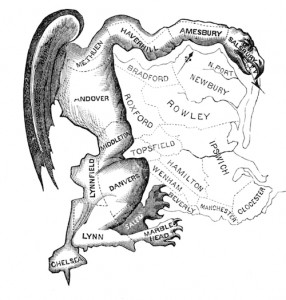 “Gerrymander” (often used as the noun “gerrymandering”) means to establish a political edge by creating partisan-advantaged districts through manipulation of boundaries. The word was coined from a political cartoon printed in 1812 (shown right), satirizing the redrawn Massachusetts election districts under Governor Elbridge Gerry, which when mapped out, resembled the shape of the mythical salamander. Since the first printing of the term “Gerry-mander” (originally pronounced GE-ree-man-dər) as a reference to the advantage Governor Gerry gained for his party after redistricting the state, the word was officially included in the English language in 1848 and remains in use today.
Since I don’t want to spark a political debate, I’ll leave opinions on the word’s most recent uses entirely up to you. What I can say, however, is that its references to a disproportion in power definitely give “gerrymander” a negative connotation. Though it’s a good word to know, its uses are obviously limited to very specific contexts. So if you write political thrillers, you’ll certainly be able to get much more use out of it than I ever will. Be sure to keep “gerrymandering” in mind if your characters are politicians!
What are your thoughts on this word? Any suggestions for future “Word of the Week” featured words?
by Naomi L. | October 14, 2013 | Blog, Word of the Week |
Word: numinous
Pronunciation: N(Y)OO-mə-nəs
Part of Speech: adjective
Definition: having a strong religious or spiritual quality; indicating or suggesting the presence of a divinity
Source: Oxford Dictionaries
Today’s Word of the Week was suggested by HD of No Vinyl Mind, who recommended it after reading it in a book (and again online). I admit that I myself was not familiar with this word, for as hard as I thought about it, I couldn’t recall a single instance in which I had ever heard something described as “numinous”. I did like the sound of it, though, so I jumped at the chance to research it and add another word to my vocabulary list. Thanks for the suggestion, HD!
When something is defined as “numinous”, it’s implied that it has some sort of spiritual quality or religious undertone to it. That’s because the word comes from the Latin noun numen (also used as a word in English), meaning “divine power” or “god”. This word arose in the mid 17th century and is supposedly derived from the verb nuere “to nod”, suggesting an original definition along the lines of “divine approval expressed by nodding”.
Now, according to the research I did, “numinous” can also be used to describe what is awe-inspiring, as in what evokes a mystical or sublime sense (as noted on this interesting vocabulary blog, also recommended by HD). Based on this, I’d suggest using the word to describe something so overwhelmingly magnificent that it gives the sense of having a spiritual presence (e.g. “numinous beauty of ancient landmarks”). “Numinous” itself is a fascinating word, so have fun working it into your writing. See what you can find in your own worlds with such divine character!
What are your thoughts on this word? Any suggestions for future “Word of the Week” featured words?
by Naomi L. | October 7, 2013 | Blog, Word of the Week |
Word: opalescent
Pronunciation: oh-pə-LE-sənt
Part of Speech: adjective
Definition:
- showing varying colors as an opal does
- showing many small points of shifting color against a pale or dark ground
Source: Oxford Dictionaries
I love colors. Anyone who knows me well can vouch for my nerdy knowledge of colors names, from vermilion to chartreuse to aubergine. I’ve been called out for describing things as “turquoise” or “cerulean” when “blue” would have sufficed, and I probably recognize enough shades of green to write an epic poem about a tree in midsummer. So when I find a word that covers several different colors at once, I almost instantly fall in love with it. “Prismatic”, “harlequin”, “kaleidoscopic”, all are great adjectives for defining different things that are multicolored. But of this list of synonyms, my favorite is probably “opalescent”.
Anything “opalescent” shows a variety of shifting colors. Naturally, it’s easy to recognize the root noun “opal” in this adjective, a reference to the semitransparent gemstone most notable for its varying colors. The very word “opal” can be traced back to different languages like the French noun opale or the Latin noun opalus. Interestingly, these Latin-based words probably originated from the Sanskrit noun upala “precious stone”, as the first samples of these gemstones came from India.
Why do I consider “opalescent” my favorite “multicolored” word? Honestly, I think it has a lot to do with the fact that the opal is my birthstone (for anyone keeping track, its month is October). Maybe it’s for this reason that I’ve always had a fondness for this stone, or maybe it’s simply for its beautiful array of colors that seem to outshine almost every other type of gem. The opal is my favorite precious stone, and for that, I feel that only the loveliest displays of varying color deserve to be described as “opalescent”.
What are your thoughts on this word? Any suggestions for future “Word of the Week” featured words?



Recent Comments