by Naomi L. | May 3, 2017 | Blog, Creative Writing |
This week marks a special occasion for two of the most important people in my life, the couple who taught me everything I know about love, especially the value of romance born from friendship. Thinking about their love has inspired me to write about the different levels of “friends first” romance and my favorite fictional couples who started as friends. There are many types of romance I admire, but love based on friendship is by far my favorite!
So to celebrate the occasion, here is a list of five types of romance based on friendship, with my favorite examples of fictional couples for each. Enjoy!
1) Coming-of-Age Romance – Hermione Granger and Ron Weasley (Harry Potter)
 Being an avid fan of the Harry Potter books, Hermione and Ron are one of my favorite examples of a Childhood Friend Romance couple. Though they don’t like each other very much when they first meet, they quickly become close friends as the series progresses, and even more than that by the time they reach young adulthood. Through all their arguments and disagreements, Ron and Hermione clearly harbor some complicated romantic feelings for each other in the second half of the saga, so when they finally get together in the last book, it’s nothing short of epic. A magical love story indeed!
2) Reunited Childhood Friends – Simba and Nala (The Lion King)
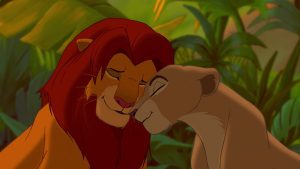 If you grew up with Disney movies like I did, you no doubt have fond memories of watching (and probably singing along to) The Lion King. Though the central theme of the story is Simba’s coming of age, his romance with Nala deserves special mention as a classic example of how best friends can turn out to be soulmates as well. After being separated as children, these two lions are reunited in adulthood by chance and, in true Disney fashion, quickly fall in love by rekindling the affection they’ve always had for one another. Nala does whatever she can to push Simba in the right direction, while Simba is ready to defend Nala and the rest of their pride after gaining the sense to return home. From their adventures as cubs to the final battle for Pride Rock, these best friends prove they’ll always have each other’s back, so after they reclaim their home at the end of the story, you know the Pride Lands will be ruled by the best king and queen ever!
3) Lifelong Love – Carl and Ellie Fredricksen (Up)
 On the other hand, sometimes childhood friends end up staying together their whole lives, and the best of these friendships turn into a romance for the ages. Such is the case of Carl and Ellie Fredricksen from Pixar’s 2009 film Up, who’s four-minute montage of their marriage tells one of the greatest love stories ever seen in a Disney movie. From exploring old abandoned houses as children to sharing a loving home into old age, these two adventurers at heart were clearly meant to be together for life. Seriously, just try to watch the beginning of this film without tearing up! Sweetest romance ever!
4) Crossing Paths – Forrest Gump and Jenny Curran (Forrest Gump)
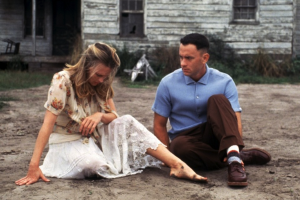 The childhood friends of the famous 1994 film, Forrest Gump and Jenny Curran are a classic example of a pair of soulmates whom fate continuously throws into and out of each other’s lives. After growing up together in 1950s Alabama, they end up going their separate ways after college, from which point Forrest’s story mentions several reunions between them up to the present day. Despite living so far apart from her for much of his life, it’s made abundantly clear by the end of the story that Forrest never stopped loving Jenny since they were kids, and that deep down she always knew he was the right man for her. It may not be the happiest of romances, but Forrest and Jenny had a beautiful love story nonetheless!
5) On Again, Off Again – Ross Geller and Rachel Green (Friends)
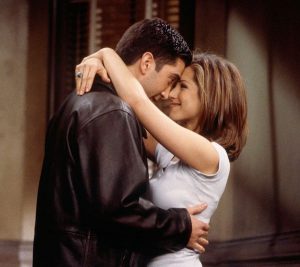 Every fan of Friends remembers the on-again-off-again rollercoaster that was Ross and Rachel’s relationship. Having grown up on the same street, these two friends have known each other since childhood, though at the time they were really friends by extension through Monica. After their reunion as adults in the first season, it becomes apparent that the crush Ross developed on Rachel in high school never burned out, which leads to ten years of one of the most complicated friendships ever. Although they suffered many breakups and makeups throughout the series (“We were on a break!”), Ross and Rachel’s unwavering love would inevitably lead them back to each other in the end, solidifying their status as one of television’s favorite couples. Best friends for life!
Who are your favorite “friends first” couples? What other examples of “friends first” romance would you add to this list?
Dedicated to my parents, the happiest couple I know. Thank you for teaching me everything I know about true love! Happy Anniversary, Mom and Dad! I love you!
by Naomi L. | May 1, 2017 | Blog, Word of the Week |
Word: insidious
Pronunciation: in-SI-dee-əs
Part of Speech: adjective
Definition: proceeding in a gradual, subtle way, but with harmful effects
Source: Oxford Dictionaries
Bird Chorus: He’s a nasty bird!
Nigel: I’m insidious.
Bird Chorus: He’s ghastly!
Nigel: Oh, I’m hideous!
Bird Chorus: He was a real macaw!
Nigel: I’m a cockatoo!
Bird Chorus: An obscene bird!
Nigel: Yes, that bit’s true.
– “Pretty Bird“, Rio (2011)
Okay, maybe I’ve had a couple of Jemaine Clement songs stuck in my head recently (thanks, Moana), so I felt like sharing a vocabulary word from one of them. The above excerpt is from the full version of “Pretty Bird” from the 2011 film Rio, a song Nigel sings to reveal his backstory to Blu and Jewel and establish his status as the villain. This example may not show today’s featured word in its primary sense, but it’s still easy to understand in context; Nigel is indeed an “insidious” cockatoo!
To be “insidious” is to proceed in a subtle and gradual way with harmful effects. The word arose in the mid 16th century and comes from the Latin adjective insidiosus, meaning “cunning”. This adjective stems from the noun insidiae “ambush”, which derives from the verb insidere “to lie in wait”. This verb comprises two roots: the preposition in “in” and the verb sedere “to sit”.
Aside from its main definition, “insidious” can also be used as a synonym for “treacherous” or “crafty”. This is arguably its most common use in modern speech, though its primary meaning can be just as useful in more formal contexts (such as an “insidious” disease). Either way, you can be sure this adjective always has a negative connotation. If you write characters with a crafty nature or actions that cause harm over time, you may find a place for the word “insidious” in your stories!
What are your thoughts on this word? Any suggestions for future “Word of the Week” featured words?
by Naomi L. | April 26, 2017 | Blog, Creative Writing |
A couple of weeks ago, I shared a list taken from the Elevate – Brain Training app of common phrases that are unnecessarily wordy and should be edited out of most writers’ first drafts. Continuing on that theme, today I’d like to share another list of phrases from a similar Elevate game, Brevity, this time of redundant phrases that should be simplified for conciseness. Redundancy is another common plague of first drafts, so you can never know too many tips for making your writing as clear and concise as possible!
So for your reference, here are 16 redundant phrases you should simplify while editing your writing. Enjoy!
 1) Empty space: Space, by definition, is an unoccupied area, so the word “empty” is redundant. Simplify “empty space” to “space”.
2) Evil fiend/villain: The word “fiend” or “villain” already implies said person is evil. Simplify “evil fiend” to “fiend” or “evil villain” to “villain”.
3) First and foremost: An unnecessarily long phrase to indicate something that is most important. Simplify “first and foremost” to “first”.
4) Follow after: To follow already means to go or come after someone or something. Simplify “follow after” to “follow”.
5) HIV virus: HIV stands for “human immunodeficiency virus”, so the word “virus” is redundant. Simplify “HIV virus” to “HIV”.
6) In order to: A longer and less direct way of saying “to”. Simplify “in order to” to “to”.
7) Join together: To join means to connect two things to each other, making the word “together” redundant. Simplify “join together” to “join”.
8) None at all: None, by definition, means not any, so the phrase “at all” is unnecessary. Simplify “none at all” to “none”.
9) LCD display: LCD stands for “liquid crystal display”, so the word “display” is redundant. Simplify “LCD display” to “LCD”.
10) Might possibly: Both “might” and “possibly” indicate uncertainty of an event taking place. Simplify “might possibly” to “might”.
11) Past experience: Experience already indicates knowledge gained in the past. Simplify “past experience” to “experience”.
12) Please RSVP: RSVP stands for the French expression “répondez s’il vous plaît”, or “please reply” in English, making the word “please” redundant. Simplify “please RSVP” to “RSVP”.
13) PIN number: PIN stands for “personal identification number”, so the word “number” is redundant. Simplify “PIN number” to “PIN”.
14) Terrible disaster: A disaster is an event that causes great damage, making the adjective “terrible” unnecessary. Simplify “terrible disaster” to “disaster”.
15) Totally destroyed: To be destroyed is to be completely ruined, so the adverb “totally” is unneeded. Simplify “totally destroyed” to “destroyed”.
16) Unsolved mystery: A mystery is already an unexplained or unsolved event. Simplify “unsolved mystery” to “mystery”.
Are you guilty of using any of these phrases in your writing? What other redundant phrases would you add to this list?
by Naomi L. | April 24, 2017 | Blog, Word of the Week |
Word: terraform
Pronunciation: TE-rə-form
Part of Speech: verb
Definition: transform a planet so as to resemble the earth, especially so that it can support human life
Source: Oxford Dictionaries
Earth Day was this past weekend, but I’d still like to acknowledge the date one more time with a related vocabulary word. I learned today’s Word of the Week from watching my boyfriend play Elite: Dangerous, a space exploration game scaled to scientifically accurate proportions. Every once in a while, he discovers a water world on his travels through the galaxy, and scanning it will reveal, among other data, whether the planet can be modified to become habitable. These are naturally the most valuable planets when exchanging data for in-game credits; a world that humans could “terraform” would be the ultimate treasure of space!
To “terraform” a planet would be to transform it to resemble Earth, especially with the purpose of supporting human life. This word was coined in 1942 by the science fiction author Jack Williamson, who first used the term in his short story “Collision Orbit”, published in Astounding Science Fiction magazine. The verb comprises the Latin noun terra “earth” and the suffix -form “having the shape of”.
Given its hypothetical nature, the word “terraform” is especially popular in science fiction, but it does have a place in real science as well. The potential colonization of Mars, for example, is a subject that often ties in with the concept of “terraforming“, as altering the planet’s surface and climate would make it hospitable to human beings. The idea is so fascinating and has so many possibilities, it’s really no wonder that it’s such a popular subject in sci-fi stories and scientific debates alike! If you write science fiction about the transformation and colonization of extraterrestrial worlds, “terraform” is a must-use word for your stories!
What are your thoughts on this word? Any suggestions for future “Word of the Week” featured words?
by Naomi L. | April 19, 2017 | Blog, Creative Writing, What If? Writing Prompts |
Earth Day is this Saturday, and that means it’s time for some new “What If?” Writing Prompts! This week’s post features yet another batch of prompts in the theme of nature and environmentalism. See what stories you can spin from these ideas, and feel free to add more of your own! Enjoy!
 What if… there were only one way to save the environment from total destruction… and it came at the price of half the global human population?
What if… human beings were the only animals in the world?
What if… all the trees in the world disappeared?
What if… every food source on the planet became sustainable?
What if… all major sources of carbon emission on Earth suddenly stopped?
Good luck writing more environmentalist stories!
If you have any “What If?” writing prompt suggestions (for any theme), please feel free to share them in the comments below. Ideas I like may be featured in future “What If?” posts, with full credit and a link to your blog (if you have one)! Also, if you’ve written a piece based on an idea you’ve found here, be sure to link back to the respective “What If?” post. I would love to see what you’ve done with the prompt! Thank you!
by Naomi L. | April 17, 2017 | Blog, Word of the Week |
Word: prognosticate
Pronunciation: prahɡ-NAH-stə-kayt
Part of Speech: verb
Definition: foretell or prophesy an event in the future
Source: Oxford Dictionaries
Today’s vocabulary entry is about another word I happened to pick up from Oxford Dictionaries‘ Word of the Day list. Though I’ve long been familiar with “prognostic” and “prognosis”, it was interesting to stumble upon a verb form of these words. Funny how hard it is for me to “prognosticate” what strange new words will make it into my Word of the Week segment!
To “prognosticate” a future event is to prophesy or foretell it. The word arose in late Middle English and comes from the Latin verb prognosticare, meaning “to make a prediction”. This word traces back through the adjective prognosticus to the Greek adjective prognōstikós “foreknowing”, which in turn comprises the prefix pro- “before” and the adjective gnōstikós “knowing”.
As mentioned above, the verb “prognosticate” is related to the adjective “prognostic” (meaning “serving to predict the likely outcome of a disease or ailment”) and the noun “prognosis” (meaning “the likely course of a disease or ailment”). Note that despite their primary use as medical terms, both these words can function as nouns indicating the prediction of future events, though this sense for “prognostic” has become archaic in modern use. If your characters often make predictions about the future, “prognosticate” may be a good word to add to your vocabulary!
What are your thoughts on this word? Any suggestions for future “Word of the Week” featured words?



Recent Comments