by Naomi L. | March 9, 2016 | Blog, Creative Writing, Off The Bookshelf |
How about a new book recommendation for this year’s reading list? This one’s a little different from my other Off The Bookshelf entries as it’s actually a nonfiction tale, and a marine biology-themed one at that! I read this book last year for school, and I was so enraptured by this incredible true “scientific epic” that I had to share it on my blog.
So if you’ve never heard of the coelacanth, or you have but want to learn the details of its history, you’re in for a treat! I hope you’ll enjoy my review of this must-read book: A Fish Caught in Time: The Search for the Coelacanth by Samantha Weinberg.
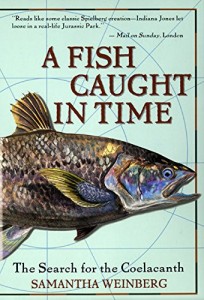
A Fish Caught in Time: The Search for the Coelacanth, by Samantha Weinberg
Summary
A Fish Caught in Time tells the true story of the coelacanth (SEE-luh-kanth), one of the most mysterious and fascinating fishes (yes, “fishes“) in scientific history, as written by English journalist Samantha Weinberg. Originally published in 1999 by HarperCollins, the book recounts the events surrounding this prehistoric fish, from the shocking discovery of a living specimen (Latimeria chalumnae) in 1938 to the discovery and study of a second species (Latimeria menadoensis) 60 years later. The narrative relates these events from the perspective of the researchers who dedicated much of their time and resources to studying this fish, all of whom played an important role in the amazing story of the elusive “King of the Sea”.
Review
I read this book last year in preparation for a Vertebrate Zoology class I had to help teach as part of my Master’s program. My lesson was about the Sarcopterygii class of fishes, so my professor lent me his copy of A Fish Caught in Time as supplementary material for telling the story of the coelacanth. By the time I was done, I was ready to teach an entire semester on this one fish. I never thought I would feel so strongly about any one fish, but then again, the coelacanth is no ordinary fish.
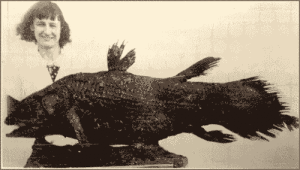
Marjorie Courtenay-Latimer with the modern coelacanth (Latimeria chalumnae) she discovered in 1938
To summarize, the coelacanth was long thought lost to history by the Cretaceous-Paleogene extinction event that wiped out three quarters of the plant and animal species living on Earth (most famously the dinosaurs). It was known only by its fossil record for (almost exactly) 100 years, until, to the world’s surprise and excitement, a living specimen was fished off the South African coast in 1938. Over the next six decades, the coelacanth would be the focus of global headlines, political plays, and scientific rivalries, all the while remaining an enigma to the world that it continues to captivate to this day.
A rare example of a nonfiction story told in a highly narrative form, A Fish Caught in Time does an excellent job of capturing the majesty and mystery of the coelacanth while staying true to the history of its discovery and study. Ms. Weinberg paints such a vivid picture of this 60-year-long story that I couldn’t help but be completely drawn in, as if I were living the story along with the real-life characters: the excitement of discovering the coelacanth wasn’t extinct after all, the rush to find out where it had been hiding for the past 65 million years, the desperation to not only capture a living specimen but keep it alive at the surface, the awe that only a lucky few in history have ever known of watching this deep-sea fish swim in its natural habitat. I’d even go as far as to say that it’s impossible to read this book and not fall in love with the coelacanth!
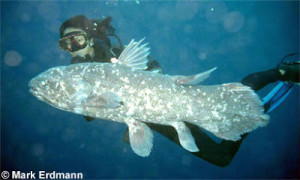
Arnaz Erdmann swimming with the Indonesian coelacanth (Latimeria menadoensis)
A fair note of warning: oftentimes the story focuses more on the researchers who dedicated their lives to studying the coelacanth than on the coelacanth itself. Readers who hope to gain an insight exclusively into the life of the fish may find this a bit off-putting, but then again, it hardly makes sense to attempt to recount the history around the animal without offering even a glimpse into the lives of the people who shaped that history. It’s much more than a story about a fish; it’s a lesson about what it means to be a researcher. It takes intelligence, curiosity, patience, an unquenchable thirst for knowledge, and an unrelenting passion for science, all of which shine through the pages of this brilliant narration of scientific truth.
Overall, A Fish Caught in Time is a captivating read that any science enthusiast will enjoy. I owe much of my appreciation for the coelacanth to this book, and I recommend it to anyone who wants to immerse themselves in a world of marine biology without being overwhelmed by the technicalities of it all. As quickly becomes evident from the first chapter, science doesn’t have to be fictional to blend well with creative writing!
Inspiration
I love science and I love a good story, but it’s rare that I get to enjoy both at the same time, or at least in the same book. A Fish Caught in Time offers an opportunity to glimpse the joy and passion that goes into conducting good science by presenting it in an enjoyable narrative format. Though much research has gone into understanding the coelacanth, A Fish Caught in Time never conveys that research in a manner too difficult for the layman to comprehend or appreciate, making it an unusual kind of literary gem: a scientific subject made accessible to the general public, that is, a community of non-scientific readers.
So if you appreciate science and a good story based on true events, A Fish Caught in Time may be just the inspiration you need for your creative writing! It certainly has been for me; in my opinion, there’s never too much writing inspiration to be found in science!
by Naomi L. | March 7, 2016 | Blog, Word of the Week |
Word: indolent
Pronunciation: IN-də-lənt
Part of Speech: adjective
Definition: wanting to avoid activity or exertion; lazy
Source: Oxford Dictionaries
…and as for Mr. Hurst, by whom Elizabeth sat, he was an indolent man, who lived only to eat, drink, and play at cards…
– Pride and Prejudice (Jane Austen, 1813)
Oh yes, I’m learning so many new words from Pride and Prejudice! Similar to last week’s entry, today’s Word of the Week comes from a description of one of the story’s supporting characters, this time Mr. Hurst. While dining with Bingley and company during her stay at Netherfield, Elizabeth finds herself seated next to Mr. Bingley’s brother-in-law, a gentleman so dull and lazy that his interests are limited to dining and playing cards. At one point in the story, when everyone else in the room is too preoccupied with books and conversation to play cards with him, he uses the time to take a nap on the sofa instead! Small wonder such an “indolent” character never made it into the films!
An “indolent” person is someone who likes to avoid activity, that is, who is inherently lazy. The word arose in the mid 17th century and comes from the Latin noun indolentia, meaning “freedom from pain”. This noun is composed of the particle in “not” and the verb dolere “to suffer pain”.
The word “indolent” is primarily used to describe people, but it also serves a function in medical terminology as a definition for a disease condition that causes little or no pain. More specifically, it can also refer to a persistent ulcer that is “slow to develop, progress, or heal”. It shouldn’t be confused with the adjective “insolent”, which means “showing a rude and arrogant lack of respect”, though I suppose in certain cases a person can appear to be both. If you can find inspiration in people who are lazy to the point of actively avoiding activity or exertion, you may have room for some “indolent” characters in your stories!
What are your thoughts on this word? Any suggestions for future “Word of the Week” featured words?
by Naomi L. | March 2, 2016 | Blog, Creative Writing |
So I just discovered Silver Threading‘s Writer’s Quote Wednesday blogging event, a collaboration with Ronovan Writes‘ Be Writing on Wednesday event, and I thought to myself, “Hey, that sounds like fun! Maybe I should give it a try!” I do love quotes, after all, and writers can never have or share too much creative inspiration!
The quote I chose to share for this event is one of my all-time favorites: Albert Einstein’s wise words on the importance of imagination compared to knowledge.
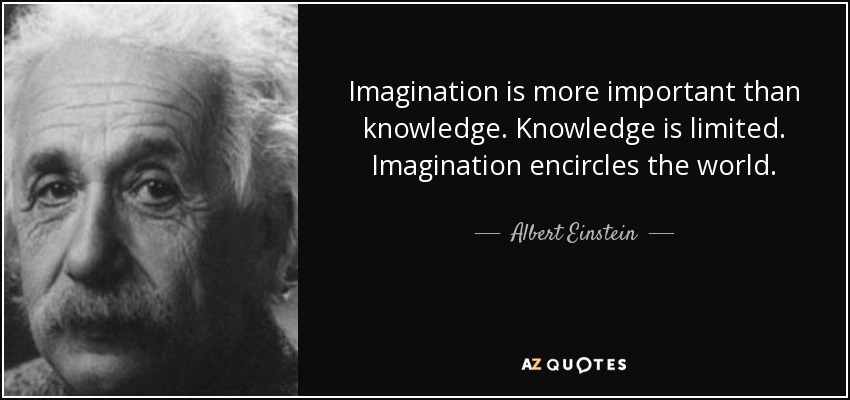
I am enough of an artist to draw freely upon my imagination. Imagination is more important than knowledge. Knowledge is limited. Imagination encircles the world. – Albert Einstein
I first read the short version of this quote on a poster hanging in my seventh grade Science teacher’s classroom, and I remember that it instantly inspired me, especially since I had already decided by then that I wanted to be both a writer and a scientist. I always liked to believe that I could draw from both these sides of myself to succeed in life, that the imaginative artist in me would empower the knowledgeable scientist and vice-versa. This quote validates my belief that the power of the human mind is more than just what a person knows, and having come from one of the most brilliant minds in the world makes it all the more motivating. To this day, Einstein’s words remind me of the true meaning of education and intelligence: it’s not the number of facts you can memorize that matters, but the capacity you have to think and explore beyond the limits of this restricted world. Fellow writers, take heart: if you’re brave enough to set your imagination free, you can accomplish anything!
What’s your favorite inspirational quote? Be sure to check out #WritersQuoteWednesday and #BeWoW to share it with the rest of us!
#WritersQuoteWednesday is a weekly blogging event by Colleen Chesebro of Silver Threading. #BeWoW is a weekly blogging event by Ronovan Hester of Ronovan Writes. Be sure to check out both these authors’ blogs for your weekly dose of inspiration! Happy writing!
by Naomi L. | February 29, 2016 | Blog, Word of the Week |
Word: supercilious
Pronunciation: soo-pər-SI-lee-əs
Part of Speech: adjective
Definition: behaving or looking as though one thinks one is superior to others
Source: Oxford Dictionaries
For though elated by his rank, it did not render him supercilious; on the contrary, he was all attention to every body.
– Pride and Prejudice (Jane Austen, 1813)
Today’s vocabulary word is actually overdue to appear in my Word of the Week segment. It was first brought to my attention by Mike from M.C. Tuggle, Writer, but I was only reminded of it recently after I started reading Pride and Prejudice. The above excerpt, part of a description of the Bennets’ good friend Sir William Lucas, is a good example of an unfamiliar word being at least partially clarified in context. Despite being a successful businessman, Sir William does not appear to consider himself above his company and holds a reputation as a friendly and attentive gentleman. This makes sense, of course: the Bennets would hardly agree to maintaining a friendship with a “supercilious” neighbor!
A “supercilious” person is someone who acts like they consider themselves superior to the people around them. The word arose in the early 16th century and comes from the Latin adjective superciliosus, meaning “haughty” or “disdainful”. This adjective derives from the noun supercilium, which means “eyebrow”.
Hearing the word “supercilious” for the first time, some might jump to the image of someone acting “super silly” (or maybe that was just me). Ironically, it means almost the opposite, since an overly arrogant person can only mean “serious business”. Though the use of this word may have declined significantly since the 19th century, I would still use it occasionally as a poetic alternative to common words like “arrogant” and “conceited”. If you write haughty characters who often look down on others, “supercilious” may be the perfect adjective to add to your stories!
What are your thoughts on this word? Any suggestions for future “Word of the Week” featured words?
by Naomi L. | February 24, 2016 | Blog, Creative Writing, What If? Writing Prompts |
It’s the month of love, so why not celebrate creatively with some more “What If?” Writing Prompts? It’s been a long time since I’ve shared a set of love and peace prompts, so here are a few new ones for you to try! See what stories you can create from these ideas! Enjoy!
 What if… the world’s only religion/faith were Love?
What if… social tolerance were a subject taught in schools worldwide?
What if… the differences among people were only ever cause for celebration, not conflict?
What if… every nation made children’s education a top priority?
What if… for a brief time, there were no wars happening anywhere in the entire world?
Have fun writing more stories about love and peace!
If you have any “What If?” writing prompt suggestions (for any theme), please feel free to share them in the comments below. Ideas I like may be featured in future “What If?” posts, with full credit and a link to your blog (if you have one)! Also, if you’ve written a piece based on an idea you’ve found here, be sure to link back to the respective “What If?” post. I would love to see what you’ve done with the prompt! Thank you!
by Naomi L. | February 22, 2016 | Blog, Word of the Week |
Word: omnipotent
Pronunciation: ahm-NI-pə-d(ə)nt
Part of Speech: adjective
Definition: having unlimited power; able to do anything
Source: Oxford Dictionaries
Monica: Hey, Joey, what would you do if you were omnipotent?
Joey: Probably kill myself!
Monica: Excuse me?
Joey: Hey, if Little Joey’s dead, then I got no reason to live.
Ross: Joey, OM-nipotent.
Joey: …You are? Ross, I’m sorry! I had no idea! I thought it was like a theoretical question.
– Friends (Season 1, Episode 4 – The One With George Stephanopoulos)
If you’ve been a fan of Friends since the beginning, you may remember this scene as one of the dirtier jokes in the series. While the gang is hanging out and talking about what they would do if they had unlimited power for a day (like ending world hunger or making themselves all-powerful forever), Monica directs the question at Joey, who just walked in. Joey proceeds to hilariously misunderstand the question (and Ross’s correction), not realizing that “omnipotent” and “impotent” are two very different words!
An “omnipotent” being is one who has unlimited power, particularly a deity. The word arose in Middle English and is originally French. This adjective comes from the Latin adjective omnipotens “all-powerful”, which comprises two roots: the adjective omnis “all” and the adjective potens “powerful”.
Though primarily an adjective, “omnipotent” can also be used as a noun to refer to God (as in “The Omnipotent”). The word doesn’t necessarily have to mean the literally unlimited power of a deity, as it can also refer to a person who has ultimate power and influence, such as an “omnipotent” sovereign. If you write scenes involving people who are capable of absolutely anything, you likely have some “omnipotent” characters in your stories!
What are your thoughts on this word? Any suggestions for future “Word of the Week” featured words?



Recent Comments