by Naomi L. | November 9, 2015 | Blog, Word of the Week |
Word: cumbersome
Pronunciation: KƏM-bər-səm
Part of Speech: adjective
Definition: large or heavy and therefore difficult to carry or use; unwieldy
Source: Oxford Dictionaries
This week’s vocabulary word is a good one to define some of the obstacles we face in life. Every now and then, you may find you need to move something large and heavy or face a situation that sets you back, and it’s expected that fictional characters must face the same trials. You could say that such obstacles are “cumbersome”: they may slow you down, but they don’t necessarily have to stop you from achieving success!
A “cumbersome” object is difficult to carry or use due to being too large and/or heavy. The word arose in late Middle English in the sense “difficult to get through” and stems from the verb “encumber”, meaning “restrict or burden (someone or something) in such a way that free action or movement is difficult”. This verb comes from the Old French verb encombrer “to block up”, which comprises the prefix en “in” and the verb combrer “to hinder”.
As noted above, while “cumbersome” primarily refers to concrete objects, it can also be used to describe abstract concepts, as it has the sub-definition “slow or complicated and therefore inefficient”. Based on the contexts in which I’ve read it, I believe this word applies best to obstacles that hinder but don’t completely halt progress. If the conflicts in your stories often slow your characters down, “cumbersome” may be a good word to define the obstacles in their way! Good luck!
What are your thoughts on this word? Any suggestions for future “Word of the Week” featured words?
by Naomi L. | November 4, 2015 | Blog, Creative Writing |
It’s the first week of National Novel Writing Month, and you know what that means: time to finally sit down and write that novel! Of course, this is much easier said than done, but hammering out 50,000 words in 30 days, daunting as it may seem, is certainly possible. Sometimes all you need to get started on reaching that goal is a bit of motivation.
So to help start you off on your NaNoWriMo journey, here are 10 tips on writing in the form of inspirational quotes from famous authors. Enjoy, and best of luck in this year’s NaNoWriMo!
 1) Be ruthless about protecting writing days, i.e. do not cave in to endless requests to have “essential” and “long overdue” meetings on those days. – J.K. Rowling
2) If you don’t have time to read, you don’t have the time (or the tools) to write. Simple as that. – Stephen King
3) This is how you do it: you sit down at the keyboard and you put one word after another until it’s done. It’s that easy, and that hard. – Neil Gaiman
4) No tears in the writer, no tears in the reader. No surprise in the writer, no surprise in the reader. – Robert Frost
5) The best time for planning a book is while you’re doing the dishes. – Agatha Christie
6) Substitute ‘damn’ every time you’re inclined to write ‘very’; your editor will delete it and the writing will be just as it should be. – Mark Twain
7) Don’t tell me the moon is shining; show me the glint of light on broken glass. – Anton Chekhov
8) There is nothing to writing. All you do is sit down at a typewriter and bleed. – Ernest Hemingway
9) You must stay drunk on writing so reality cannot destroy you. – Ray Bradbury
10) If there’s a book that you want to read, but it hasn’t been written yet, then you must write it. – Toni Morrison
What are your thoughts on these inspirational writing quotes? Any other favorites you would add to this list?
by Naomi L. | November 2, 2015 | Blog, Word of the Week |
Word: superfluous
Pronunciation: soo-PƏR-flə-wəs
Part of Speech: adjective
Definition: unnecessary, especially through being more than enough
Source: Oxford Dictionaries
Today’s Word of the Week is a good one to know for unsatisfactory writing. Often when a writer goes overboard with the descriptions in their fiction, it detracts from the action of their story. In this case, an editor or reviewer could say the detail in the story is “superfluous”, as it has crossed a limit into being unnecessarily wordy. Writers beware: detailed descriptions are fine, but you never want them to be excessively elaborate!
To be “superfluous” is to be excessive and thus unnecessary. The word arose in late Middle English and comes from the Latin adjective superfluus, meaning “in excess”. This adjective comprises the preposition super “over” and the verb fluere “to flow”.
With its roots in the Latin words for “over” and “flow”, it’s no wonder the adjective “superfluous” easily brings to mind the image of water overflowing. While it doesn’t necessarily have to apply to liquid, this image does make it easier to memorize the word’s definition of excess. Whether you’re describing too many objects or too many ideas, “superfluous” is a good word to keep in mind for anything that’s more than necessary. Have fun writing about the “superfluous” things in your stories; just take care not to use “superfluous” detail in your narrative! Good luck!
What are your thoughts on this word? Any suggestions for future “Word of the Week” featured words?
by Naomi L. | October 28, 2015 | Blog, Creative Writing, What If? Writing Prompts |
Halloween is just around the corner, so why not stock up on some new “What If?” Writing Prompts for the occasion? This week features another set of horror-themed prompts. See what scary stories you can create from these ideas! Have fun!
 What if… you woke up in someone else’s body?
What if… your neighbors became zombies and started coming after you?
What if… you discovered a monster living in your basement?
What if… the ghost stories you and your childhood friends used to tell… turned out to be true?
What if… you discovered a carnivorous plant… that ate people?
Good luck writing some more horror stories!
If you have any “What If?” writing prompt suggestions (for any theme), please feel free to share them in the comments below. Ideas I like may be featured in future “What If?” posts, with full credit and a link to your blog (if you have one)! Also, if you’ve written a piece based on an idea you’ve found here, be sure to link back to the respective “What If?” post. I would love to see what you’ve done with the prompt! Thank you!
by Naomi L. | October 26, 2015 | Blog, Word of the Week |
Word: cantankerous
Pronunciation: kan-TAN-kər-əs
Part of Speech: adjective
Definition: bad-tempered, argumentative, and uncooperative
Source: Oxford Dictionaries
Today’s Word of the Week was suggested by Kriswasp of I Love Me vol I. He requested I write about the word “cantankerous”, and I’ll be honest: I darn near smacked myself for not having thought to write about it sooner. What an interesting word! Heck, just saying it aloud is fun! “Cantankerous”! Of course, the definition of the word isn’t nearly as pleasant as the sound of it, but if you’re going to call someone “bad-tempered” or “uncooperative”, you may as well go for the most (as Kriswasp puts it) majestic way to say it!
A “cantankerous” person is ill-tempered and argumentative to the point of being difficult. The word arose in the mid 18th century and is of unknown origin, though according to Oxford Dictionaries, it is speculated that it comes from a blend of the Anglo-Irish noun cant “auction” and the English noun “rancor” (“bitterness or resentfulness”), which in turn traces back to the Latin adjective rancidus “stinking”. Another theory states that “cantankerous” may stem from an early amalgamation of two English adjectives: “contentious” (“causing or likely to cause an argument”) and “rancorous” (“characterized by bitterness or resentment”).
While I haven’t yet worked the word “cantankerous” into my own stories very often, I do remember hearing it for the first time years ago and loving how funny it sounded. Most people I’ve seen described as “cantankerous” are elderly and grumpy, but that’s not to say the word can’t be used to describe younger people who are just as uncooperative. If you write characters who tend to argue a lot and who are difficult to work with, “cantankerous” may be a perfect word to fit into your stories! Have fun!
What are your thoughts on this word? Any suggestions for future “Word of the Week” featured words?
by Naomi L. | October 21, 2015 | Blog, Creative Writing |
It’s time for some more fun with confusing English words! So far, I’ve shared a list of 25 commonly confused words and phrases and a list of 20 English words that change in meaning when pronounced differently. Continuing on that line, today’s post focuses on homonyms (also called homophones): words that sound the same but that have different spellings and meanings. Homonyms are one of the most confusing types of words for new English speakers to learn, and while my 25 words post already includes some common examples such as “your/you’re” and “their/there/they’re”, there are still plenty of examples of like-sounding words that warrant some attention.
So just for fun, here are 20 sets of homonyms that you should look out for while reading or writing in English. Enjoy!
 1) Aisle/Isle – An “aisle” is a passage between shelves or rows of seats. An “isle” is a small island or peninsula.
2) Capital/Capitol – A “capital” is the most important city of a region. “Capital” also refers to wealth or uppercase letters. A “capitol” is a state legislature building in the United States, while the “Capitol” is the U.S. Congress building in Washington D.C.
3) Click/Clique – A “click” is a short, sharp sound. A “clique” is a small group of people with common interests.
4) Colonel/Kernel – A “colonel” is a high-ranking army officer. A “kernel” is a type of soft and edible seed.
5) Descent/Dissent – A “descent” is an act of moving downward. “Dissent” is an expression of opinions that vary from those previously or commonly held.
6) Discreet/Discrete – To be “discreet” is to be careful and circumspect. To be “discrete” is to be separate and distinct.
7) Exercise/Exorcise – To “exercise” is to practice physical activity to improve health and fitness. To “exorcise” is to drive out an evil spirit from a person or place.
8) Faint/Feint – To “faint” is to briefly lose consciousness. To “feint” is to make a false move meant to distract or deceive, typically during a fight.
9) Foul/Fowl – To be “foul” is to be offensive or wicked. A “fowl” is a domestic bird raised for its eggs and meat.
10) Hoarse/Horse – A “hoarse” voice is rough and harsh-sounding. A “horse” is a hoofed domesticated animal raised for riding, racing, and working.
11) Idle/Idol/Idyll – To be “idle” is to be inactive. An “idol” is someone or something that is greatly admired, or an image of a deity used as an object of worship. An “idyll” is an extremely idealized peaceful and picturesque scene.
12) Knot/Naught/Not – A “knot” is a fastening made by tying a piece of rope or string. “Naught” is zero or nothing. “Not” is an adverb used to form a negative.
13) Metal/Mettle – “Metal” is a solid material that is typically malleable, fusible, and ductile. “Mettle” is a person’s ability to face difficulties with spirit or resilience.
14) Miner/Minor – A “miner” is someone who works in a mine. A “minor” is someone who is underage. “Minor” also refers to what is lesser in significance.
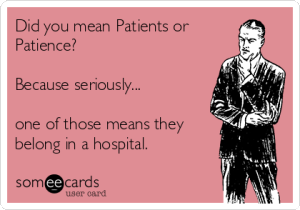
15) Patience/Patients – “Patience” is the virtue of tolerance. “Patients” are people receiving medical treatment.
16) Peak/Peek/Pique – To “peak” is to reach the highest point. To “peek” is to look quickly and secretively. To “pique” someone’s interest or curiosity is to stimulate it.
17) Pore/Pour – To “pore” over reading materials is to be immersed in the study of them. To “pour” is to drop liquid from a container in a steady stream.
18) Principal/Principle – To be “principal” is to be the most significant. A “principal” is a person with the highest authority in an institution. A “principle” is a fundamental truth.
19) Stationary/Stationery – To be “stationary” is to be immobile. “Stationery” is specially printed writing paper.
20) Steal/Steel – To “steal” is to take someone else’s belongings without their permission. “Steel” is a sturdy alloy consisting of iron and carbon.
What are your thoughts on these homonyms? Any others you would add to this list?



Recent Comments