by Naomi L. | September 7, 2015 | Blog, Word of the Week |
Word: banal
Pronunciation: BAY-nl / bə-NAL / bə-NAHL
Part of Speech: adjective
Definition: so lacking in originality as to be obvious and boring
Source: Oxford Dictionaries
Here’s another word for the ordinary stuff in our lives. Sometimes we encounter work that is so unoriginal it comes off as predictable and, consequently, boring. Today’s vocabulary post features one good word to describe such things, a word any serious artist would dread to hear being used to describe their own work. With all the effort we put into making our art original and interesting, it would certainly sting to have it criticized as “banal”, wouldn’t you think?
Something considered “banal” is boring and predictable due to lack of originality. The word arose in the mid 18th century as a reference to feudal service and was used in the sense “common to all”. Originally French, the adjective is ultimately of Germanic origin and is related to the Old English verb bannan, meaning “to summon”.
Used to define things that are ordinary and dull, “banal” stands among other similar adjectives I’ve featured in this segment before, such as “pedestrian“, “prosaic“, and “vapid“. In a way, you could say it’s ironic that there are so many unusual and interesting ways to say “common” and “boring”. So whenever you need a word to describe something boringly plain, feel free to use “banal” or any of its uncommon synonyms. The things in your stories may lack originality, but that doesn’t mean your writing has to! Good luck!
What are your thoughts on this word? Any suggestions for future “Word of the Week” featured words?
by Naomi L. | September 2, 2015 | Blog, Creative Writing |
And once again, we’re back to the silly quirks of English. By now I’ve made quite a few references to the oddities of the English language in a series of “four words” posts on my blog, from words that are often used incorrectly to words that used to mean something different to words that don’t mean what most people think they do. Now for today’s post, I thought I’d have some fun by discussing words that are technically supposed to mean one thing but have been mutated into a different, more common definition by modern usage (although their original meanings are still defended by advocates of traditional, “proper” English).
So just for fun, here are four words that are commonly thought to mean one thing but are actually supposed to mean something else. Enjoy!
Fortuitous should mean “by chance”, not “lucky”
 It’s no wonder how the word “fortuitous” made it onto this list. It has the root fort built into it, so it must be synonymous with “fortunate”, right? That seems to have been the general consensus when the definition “happening by a lucky chance” first came about, but in fact, this word was originally supposed to have a neutral connotation, as in “happening by accident”. The informal positive definition seems to be more common nowadays, however, and this usage has become something of a synonym for “lucky” in modern English (albeit still frowned upon by traditionalists). So if someone tells you about a “fortuitous” event, it was most likely a fortunate occurrence, but the important thing to take away from the story is that it happened by chance!
Momentarily should mean “for a moment”, not “in a moment”
Anyone who has ever taken public transportation such as a train or an airplane is likely to have heard at least once a phrase along the lines of “We will be leaving momentarily.” It is generally accepted that “momentarily” indicates something that will happen “in a moment”, and this is obviously what pilots, conductors, and drivers mean to tell their passengers when their trip is delayed. But “momentarily” traditionally means “for a moment”, as in something that lasts only for a short time, and the former definition of “very soon” is disputed by some as an informal or strictly North American use. Both meanings are acceptable in modern usage, though, so whether you mean to explain that something won’t take long to start happening or to finish happening, “momentarily” should work just fine.
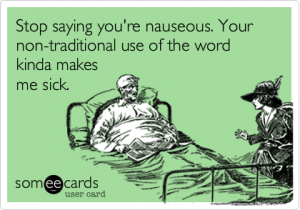
Nauseous should mean “to make sick”, not “to be sick”
Leonard: Now that I’m actually about to go out with Penny, I’m not excited. I’m nauseous.
Sheldon: Ah, then your meal choice is appropriate. Starch absorbs fluid which reduces the amount of vomit available for violent expulsion.
Leonard: Right.
Sheldon: You also made a common grammatical mistake: you said “nauseous” when you meant “nauseated”. But go on.
– The Big Bang Theory (Season 1, Episode 17 – The Tangerine Factor)
Here’s a grammar mistake that’s so common, you’ve almost definitely been making it your whole life without even realizing it. When trying to convey that they feel sick to their stomach, most people go straight for the word “nauseous”. What they really mean to say, however, is “nauseated”, as “nauseous” traditionally refers to something that induces nausea. By this definition, people who are trying to say they feel sick themselves are accidentally saying they make other people sick instead. But fear not; the formerly incorrect use of “nauseous” is so pervasive in modern speech that it’s already been added to the dictionary as the primary definition of the word. So yes, if the questionable meat you ate for lunch is making you queasy, feel free to say you’re feeling “nauseous” or “nauseated”. Either way, people will understand not to get too close.
Sensuous should mean “of the senses”, not “seductive”
Feeling a little hot and bothered? I wouldn’t blame you; think of the word “sensuous” and your mind is likely to jump to images that might render this post NSFW if I were to describe them here. You may want to think again, though, because “sensuous” isn’t exactly interchangeable with “sensual”. In fact, it’s believed that the former word was coined in the 17th century specifically as an attempt to avoid the sexual connotations of the latter. The traditional definition of “sensuous” is “relating to or affecting the senses rather than the intellect”, with no direct reference to physical gratification. Of course, you’d be hard-pressed to find anyone who makes that distinction these days; the use of “sensuous” as a synonym for “sensual” is so common that only hardcore traditionalists try to maintain the original difference (with little luck, I might add). Take note: if you’re going for a neutral connotation, you may want to choose a different word, because the “sensuous” ship has long sailed.
What are your thoughts on these words? Any others you would add to this list?
by Naomi L. | August 31, 2015 | Blog, Word of the Week |
Word: facsimile
Pronunciation: fak-SI-mə-lee
Part of Speech: noun
Definition: an exact copy, especially of written or printed material
Source: Oxford Dictionaries
Robin: Oh, cute dog!
Arthur: No! Tugboat, my other dog, that was a cute dog. This little disappointment is nothing but a cheap facsimile.
– How I Met Your Mother (Season 6, Episode 23 – Landmarks)
How about another unusual word for your list? This week’s vocabulary word is one that I remember hearing only twice in my whole life: once in the indie sci-fi game Transistor and once in the above scene from How I Met Your Mother. I probably should have been familiar with it long ago, though; as I only just learned, I used to hear the abbreviated form of the word all the time: “fax”! To be honest, I feel a little silly for not realizing “fax” was an abbreviation all along, but at least knowing that now should make the full word easier to remember!
A “facsimile” is an exact or highly similar copy of something, usually a written or printed work. Originally spelled fac simile, the word arose in the late 16th century and referred to the making of an exact copy of a written work. This noun is of modern Latin origin and is comprised of the interjection fac (from the verb facere “to make”) and the adjective simile “like”.
Like the shortened form “fax”, “facsimile” can also function as a verb meaning “make a copy of”. The word generally refers to the copying of written materials such as books and manuscripts, though it really applies to anything that can be duplicated. In some contexts, it refers to the reproduction of items of historical value that are as close as possible to the original. So if your characters make a habit of copying things, take note: you may have quite a few good “facsimiles” in your stories!
What are your thoughts on this word? Any suggestions for future “Word of the Week” featured words?
by Naomi L. | August 26, 2015 | Blog, Creative Writing, What If? Writing Prompts |
My apologies; looks like grad school work has me swamped again, so how about a couple more rounds of “What If?” Writing Prompts to tide over my creative writing posts this month? This week’s batch features yet another set of romance prompts. See what new tales you can spin around the theme of love! Enjoy!
 What if… you knew the person you were going to marry someday was already in your life… but you didn’t yet know who it was?
What if… you realized you had a crush on one of your closest friends?
What if… you and your sibling liked the same person?
What if… the person you were destined to be with came into your life the day after you swore never to love again?
What if… you fell in love with someone you had never met in person?
Good luck writing your own romantic stories!
If you have any “What If?” writing prompt suggestions (for any theme), please feel free to share them in the comments below. Ideas I like may be featured in future “What If?” posts, with full credit and a link to your blog (if you have one)! Also, if you’ve written a piece based on an idea you’ve found here, be sure to link back to the respective “What If?” post. I would love to see what you’ve done with the prompt! Thank you!
by Naomi L. | August 24, 2015 | Blog, Word of the Week |
Word: paucity
Pronunciation: PAH-si-tee
Part of Speech: noun
Definition: the presence of something only in small or insufficient quantities or amounts; scarcity
Source: Oxford Dictionaries
Continuing from last week’s theme of advanced forms of common words, today’s vocabulary post features another word that you’re much less likely to see than its everyday counterpart. After all, when was the last time you heard someone refer to a lacking amount of something as a “paucity” as opposed to a “scarcity”? It’s another word that came up in a presentation at the scientific conference I attended, but I have yet to see it much in fiction!
A “paucity” of something is a small or insufficient amount or quantity of it. The word arose in late Middle English and can be traced back through the Old French noun paucite to the Latin noun paucitas, meaning “a small number”. This noun comes from the adjective paucus, which means “few”.
Coincidentally, “paucity” is a word that I’ve used very few times myself, if ever. I read it occasionally in academic writing (such as in papers that describe a “paucity” of a particular species in a region), but in the right contexts, I believe it works just as well in fiction. If your characters often encounter lacking quantities or amounts of the things they need (and you’ve already overused more common words like “scarcity”), you may want to consider writing about the “paucity” of their necessities in your stories! Good luck!
What are your thoughts on this word? Any suggestions for future “Word of the Week” featured words?
by Naomi L. | August 19, 2015 | Blog, Creative Writing, What If? Writing Prompts |
I hope you’re up for some more “What If?” Writing Prompts! For a lighter theme this week, today’s set features more prompts in the humor genre. See what funny tales you can spin around these ideas, and feel free to add more of your own! Enjoy!
What if… you woke up one day to find your life were the setting of a movie?
What if… you set up a camera in your house to find out what your pets do when you’re not home?
What if… you knew an animal that talked… but only when you were both alone?
What if… your school/workplace turned into a circus for a day?
What if… there were a strange disease going around that randomly gave people the urge to sing and dance?
Have fun writing your own silly stories!
If you have any “What If?” writing prompt suggestions (for any theme), please feel free to share them in the comments below. Ideas I like may be featured in future “What If?” posts, with full credit and a link to your blog (if you have one)! Also, if you’ve written a piece based on an idea you’ve found here, be sure to link back to the respective “What If?” post. I would love to see what you’ve done with the prompt! Thank you!



Recent Comments