by Naomi L. | December 8, 2014 | Blog, Word of the Week |
Word: idyllic
Pronunciation: ai-DI-lik
Part of Speech: adjective
Definition: extremely happy, peaceful or picturesque
Source: Oxford Dictionaries
Who doesn’t appreciate words for extremely positive feelings? If I remember correctly, this one caught my eye while I was reading a novel, and I liked it as soon as I learned what it meant. It made sense to me that “idyllic” would stand out as such a lovely adjective; I always enjoy discovering poetic words to describe the beautiful things in life.
Anything considered “idyllic” is extremely peaceful, happy and/or beautiful in nature. This word is the adjective form of the noun “idyll”, a word for “an extremely happy, peaceful or picturesque scene” that’s typically idealized or unsustainable. This word can be traced back through the Latin noun idyllium to the Greek noun eidullion, which is the diminutive form of the noun eidos (“form” or “picture”).
Though I don’t see the word “idyllic” as often as I’d like, it’s definitely an adjective I’d try to work into my writing more often. I’d probably get the best use out of it in my poetry, since I especially love writing about nature, but it could work just as well in prose to describe an idealized scene. Every writer has likely envisioned a utopian setting at one time or another, so if you haven’t used this word yet, you’ll no doubt be able find a place for it in your writing too. Who knows? If you write well enough, your readers may find your work itself “idyllic”!
What are your thoughts on this word? Any suggestions for future “Word of the Week” featured words?
by Naomi L. | December 3, 2014 | Blog, Creative Writing, What If? Writing Prompts |
Happy December! To start off the season, here’s a new batch of “What If?” Writing Prompts for you, set to the theme of holidays. Enjoy, and Happy Holidays to all!
 What if… it were your favorite holiday every day of the year?
What if… Christmas were “cancelled” one year, and it were up to you to bring it back?
What if… time froze for you at the turn of the new year, and the only way to get it back to normal was to fulfill your New Year’s resolution from last year?
What if… you came downstairs late on Christmas Eve to find Santa Claus placing a gift for you under the tree?
What if… Christmas weren’t about giving and receiving presents, but only about being together as a family?
Have fun writing stories about the holiday season!
If you have any “What If?” writing prompt suggestions (for any theme), please feel free to share them in the comments below. Ideas I like may be featured in future “What If?” posts, with full credit and a link to your blog (if you have one)! Also, if you’ve written a piece based on an idea you’ve found here, be sure to link back to the respective “What If?” post. I would love to see what you’ve done with the prompt! Thank you!
by Naomi L. | December 1, 2014 | Blog, Word of the Week |
Word: anhedonic
Pronunciation: an-hi-DAH-nik
Part of Speech: adjective
Definition: unable to feel pleasure
Source: Oxford Dictionaries
Marshall: (during a sword fight with Ted) Ted! If you wanted to be married by now, you would be, but you’re not. And you know why? Because you’re irrationally picky, you’re easily distracted and you’re utterly anhedonic.
Ted: Anhedonic?
Marshall: Anhedonic. It means you can’t enjoy anything.
Ted: The hell I can’t. I’m enjoying this!
Marshall: I know, this rules!
– How I Met Your Mother (Season 1, Episode 8 – The Duel)
The only time I’ve ever heard the word “anhedonic” was in the above dialogue from an episode of How I Met Your Mother. While sword-fighting with Ted to decide who should keep their apartment (it makes sense in context, trust me), Marshall calls him out on his inability to take pleasure in activities normal people enjoy. Perhaps Ted’s counterargument is invalid, given that a sword duel in the middle of a New York apartment hardly counts as a “normal activity”, but that just makes the scene all the more fun to watch.
An “anhedonic” person is someone who is unable to experience pleasure in normally pleasurable activities. The word is the adjective form of the noun “anhedonia”, a term in Psychiatry for the inability to feel pleasure. This noun traces back to the French noun anhédonie, which consists of two Greek roots: the prefix an- “without” and the noun hēdonḗ “pleasure”.
“Anhedonic” may be a good word to describe people who are constantly unhappy, regardless of whether or not it’s an actual psychiatric condition. As for dialogue, because the word “anhedonia” is a Psychiatry term, it would most likely be used by characters of high intellectual achievement. If you write about miserable people or characters such as psychiatrists or doctors (or even lawyers, as is the case of Marshall Eriksen), you may be able to get plenty of use out of this word. Just try not to be “anhedonic” when it comes to your writing!
What are your thoughts on this word? Any suggestions for future “Word of the Week” featured words?
by Naomi L. | November 26, 2014 | Blog, Creative Writing |
Remember those four words I once mentioned that people sometimes use incorrectly? Well, today’s post briefly continues on that topic to discuss four words that originally meant something different from the definitions many people use today. If you can think of more words that fit this category, please feel free to share. I’d love to write about them in the future! Thanks, and enjoy!
Egregious meant “outstanding” before it meant “horrendous”
“Egregious” was the second Word of the Week I ever shared on my blog, and I still think it’s as fun to say now as it was back then. Interestingly, this word used to mean something positive before sarcasm turned it into something negative. The original definition of “egregious” was “remarkably good”, while today it means “shockingly bad”. It’s likely this newer derogatory sense from the late 16th century arose as a twist of irony. Speaking of which…
Ironic meant “paradoxical” before it meant “sarcastic”
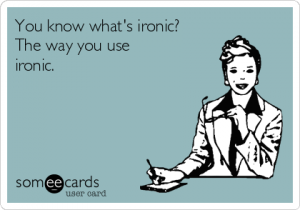 I know I’ve already mentioned this word before, but it’s worth bringing up again here. Many people seem to think that “ironic” is synonymous to “sarcastic”, but while this use is widely accepted nowadays, that wasn’t always the case. An “ironic” event is when something happens that’s the opposite of what would be expected, often to a humorous effect. There’s no harm in pointing out the irony in your life, of course, as long as you understand what it is!
Peruse meant “scrutinize” before it meant “scan”
“Peruse” is another word I’ve written about before in my vocabulary segment. What caught my attention about it was the fact that many people think it means the opposite of what it really does. Over time, the verb seems to have become a go-to word for “scan” or “read through quickly”. However, according to its dictionary entries, “peruse” actually means “read in a thorough or careful way”. So the next time you’re asked to “peruse” an important document or other written work, make sure you do it right!
Virtual meant “almost” before it meant “digital”
Perhaps you always assumed “virtual” meant “digital” from the first time you heard about “virtual reality”, and it came as quite a shock to you when you learned that this word originally meant something different. Or maybe that was just me. Either way, “virtual” wasn’t always the pervasive adjective for computer simulation that it is today. What it has always meant since late Middle English, though, is “almost as described”. There are a few other definitions for “virtual” as well (such as in optics and physics), but since you’re most likely to see it in references to computers these days, the rest may be “virtually” irrelevant!
Have you misinterpreted these words before? What other examples can you think of?
by Naomi L. | November 24, 2014 | Blog, Word of the Week |
Word: mendacious
Pronunciation: men-DAY-shəs
Part of Speech: adjective
Definition: not telling the truth; lying
Source: Oxford Dictionaries
Here’s a word you’re probably not likely to use much, but that I still think is worth knowing. When I first read the word “mendacious” on a flashcard, I couldn’t even begin to figure out what it meant, because it was one of those words that didn’t sound like any other I’d heard with the same definition. Still, I decided it was worth sharing when I recently came across it again. If it comes up in standardized test prep material, it must be coming up in advanced texts too, right?
“Mendacious” refers to that which is untruthful in nature. The word comes from the Latin adjective mendax, which means “false” or “deceitful”. This adjective is related to the noun mendum, meaning “fault”.
There isn’t much else I can say about a word that I’ve only ever read on a flashcard. I imagine that “mendacious” must have been used much more in the past, but has since fallen into the gray area of purple prose. Or maybe I’m just that far behind on my reading. In any case, I’m sure you can find a good place for this word in your writing if you try. As for me, the best I can do with it for now is a poetic description of my craft: What is fiction if not a “mendacious” account of reality?
What are your thoughts on this word? Any suggestions for future “Word of the Week” featured words?
by Naomi L. | November 19, 2014 | Blog, Creative Writing |
Welcome to the November round of Writer’s Reveal! Unfortunately, because Emily Hawker is unable to continue organizing the event, this may also be our last Writers Reveal. So for what could be our closing topic, Melissa of Melissa Writes sent us a prompt centered around publishing.
All writers start somewhere. What is the first ever piece of writing you had published?
Thanks for the prompt, Melissa! Hope you enjoy my take on it!
My First Published Work(s)
What exactly was my first published work? This question is a little tough for me to answer, since it depends on how I would define being “published”. Was it the first piece I wrote that was actually read by someone other than myself? Was it the first story I shared publicly? Or was it the first work of mine that was officially printed? The truth is that I can’t pinpoint one exact piece for any of these cases because I’ve been writing for as long as I can remember. What I can do, however, is list examples that fit into each of these different categories of “publishing”.
So thinking back on my history as a writer, here are some of what I consider my first published works:
 1) School assignments and first books – If being “published” means having any of my work read, then elementary school is definitely where I started. Though I wrote frequently as a child, most of the pieces that made it to readers were the result of narrative assignments for composition classes. One of my favorites was a handcrafted book titled “My Pet”, a first-person narrative told by a girl who owned a pet dolphin. Other works included short stories that were usually only read by my teachers and my parents, several of which are still somewhere in my mom’s archive of our childhood memories. And of course, there was my first attempt at writing a novel when I was ten. Even if those stories weren’t that good, it’s touching to know I’ve had my family’s support from the very beginning, so in terms of having my work read and enjoyed, I’d say I’ve been successful.
2) Fanfiction and online poetry – If being “published” means getting my work out to people who don’t know me personally, then my first published works were probably video game fanfiction stories I shared online. Silly as it may sound, these were essential in my development as a writer because all the positive feedback I received from strangers really helped boost my confidence in my talent. My favorite pieces among these were two novel-length stories set in the Sonic the Hedgehog universe: “Generation Beta“, my first publicly available story over 50,000 words long (and which, after five years, still gets hundreds of hits a month); and “Chaos and Control“, the story on which I’ve worked the hardest in my life and which has become the model for the original novels I plan to publish in the future. Around the same time I was writing fanfiction, I also used to post some of my poems on DeviantART, some of which have since been reposted here on my blog. They may not be printed in any “official” media, but if people out there are reading my stories and poetry, I already consider myself a published writer.
3) College thesis and Reader’s Carnival submission – If being “published” means having my work available in print, then my first real publication was my undergraduate thesis. This was also the first non-fiction work of mine that was made publicly available. It’s not exactly what I imagined my first book would be, but the thesis about West Atlantic reef fish evolution sitting on my shelf is still something to be proud of. As for a creative piece, I have a sonnet published in the October issue of Reader’s Carnival, which just went into print this month, so that’s something to be excited about too! It may not seem like much now, but hopefully these will prove to be stepping stones to a whole career of my printed works!
These are just some examples of what I would consider to be my first published works. There have been many “firsts” throughout my writing history, but they’ve all played an important role in my growth as a writer, and for that I value every single one. Here’s to many more publications to come! Thanks for reading!
What was your first published work? How would you define being “published”?
This has been a special topic post for Writers Reveal, a monthly blog swap among several talented writers. Be sure to check out the other blogs participating in the event. Thanks for reading!
Other bloggers in Writers Reveal
Melissa Khalinsky: Melissa Writes
Becky Fyfe: Imagine! Create! Write!
Ashley Howland: Ghostnapped
Emily Hawker: You Learn Something New Every Day
Lee-Anne Walker: Is it just me?



Recent Comments