“Peruse” is an example of a word that I almost never see because it’s a formal variant of a common word. Even in the few times I have seen it, there was at least one instance in which it was being used satirically. Still, I figure it’s worth knowing, especially for stories that call for a more sophisticated level of language. Why mention that a character is simply “reading” when it’s possible to imply a little more with a different word?
To “peruse” something is to read it carefully and thoroughly. The word evidently arose in the 15th century and originally had a definition along the lines of “use up” or “wear out”. It possibly shares its origin with the Anglo-Norman French verb peruser “examine”, as both contain the Latin prefix per-, meaning “thoroughly”.
Maybe it’s more of a testament to the type of material I’m used to than anything else, but I rarely see the word “peruse” as more than just a flowery synonym for “read”. Of course, that isn’t to say it shouldn’t be taken seriously when context calls for it. After all, it doesn’t have the exact same meaning as its common counterpart, for this verb implies a specific type of reading. In addition, it can also be used to mean “examine carefully or at length”. Some writers (myself included) may feel inclined to avoid this word for fear of risking purple prose or confusing readers who think it means “glance over”, but if you like to use formal words in your writing, this is definitely a good one to know. Hopefully your audience will enjoy “perusing” your stories!
What are your thoughts on this word? Any suggestions for future “Word of the Week” featured words?
Those familiar with my blog know that Wednesdays are dedicated to topics regarding creative writing. Today, I’m going to step a little outside the box (not too far, don’t worry) to share a little more of my nerdy side and talk about my newest obsession: VOCALOID. There’s a lot I could tell you about this newfound love of mine (enough to fill another series of posts, in fact), but the point of bringing it up now is simply to focus on what I consider the most interesting aspect of the fandom: creativity through collaboration. So just sit back and listen while I take you on a brief journey through this incredible musical world. Enjoy!
What is VOCALOID?
Before I answer this question, let me ask you one: have you ever heard of a Japanese singer named Hatsune Miku? If not, take a minute to listen to one of her most popular songs: “World is Mine“.
Pretty neat, huh? Now what if I told you that the singer in the video doesn’t actually exist, and what you just heard was nothing more than a computer program synthesizing a human voice? Here’s another video of her singing the same song, but this time in front of a live audience:
Yes, that’s a full house cheering for a hologram! Seriously, how cool is that?
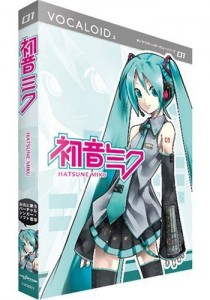
VOCALOID is a software from Yamaha designed to synthesize singing vocals, intended to serve as a substitute for real singers. Each package consists of a character name, a voicebank comprised of phonemes recorded by a real person, and (in most cases) a basic character design. Voice synthesizing is achieved by typing lyrics and melody into the program.
The Vocaloids started being released in 2004 with moderate commercial success, but the software exploded in popularity around 2007 when a Hatsune Miku cover of the Finnish folk song “Ievan Polkka” went viral on Nico Nico Douga (a Japanese video-sharing website similar to YouTube). Since then, VOCALOID has had a tremendous cultural impact, drawing fans from Japan and the Western world alike. To this day, Miku remains the most famous of the Vocaloids and NND plays an essential role in the collaborative creation and sharing of VOCALOID works.
Today, there are dozens of official Vocaloids available in at least six languages (mostly the original languages of Japanese and English), hundreds of fanmade voicebanks (known as UTAU), thousands of VOCALOID-related songs, and tons of derivative media ranging from video games to live concerts. There’s no doubt about it: VOCALOID is a global phenomenon.
Why is VOCALOID so popular?
Honestly, I’ve been asking myself the same question ever since I became a fan. I heard my first VOCALOID song (“World’s End Umbrella“) in 2010 through a reference from a friend, and YouTube must have remembered that because it gave me a recommendation for my second song (“Witch Hunt“) in mid-2013. The funny thing was, though I absolutely loved the latter, I had no clue yet what I was listening to. It was only in November 2013 that I really got into the fandom and started to learn more about the Vocaloids. Fast-forward half a year: I now have days’ worth of VOCALOID videos logged in my YouTube history and a playlist consisting of over 300 songs. Yeah.
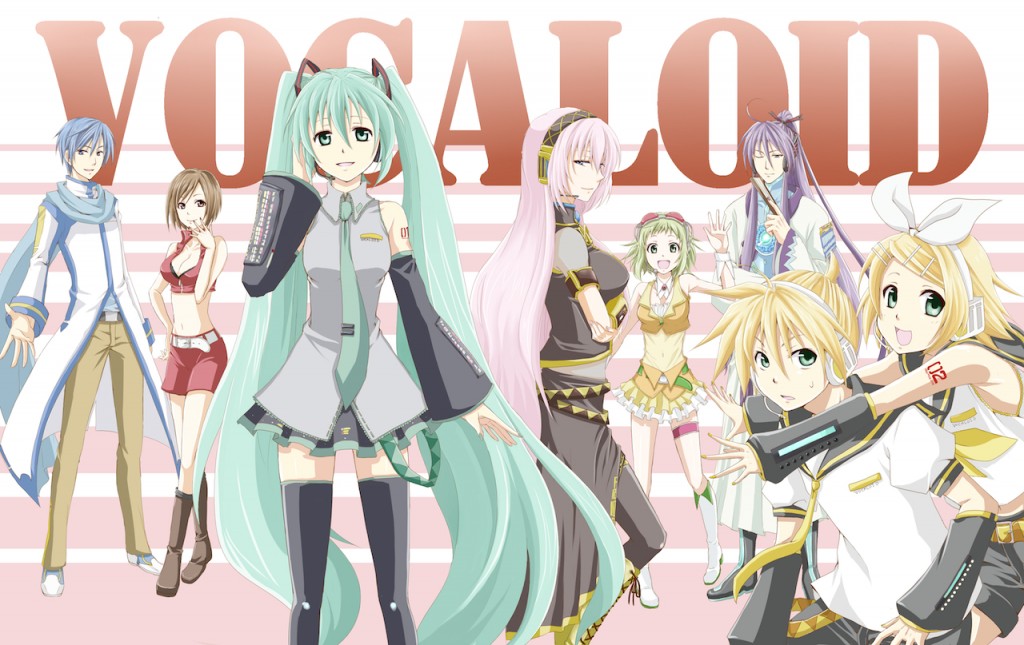
The eight most popular (and my favorite) Japanese Vocaloids. In order from left to right: KAITO, MEIKO, Hatsune Miku, Megurine Luka, GUMI, Kamui Gakupo, Kagamine Len and Kagamine Rin (Source unknown; image found on Zerochan)
So what is it about this fandom that’s kept me and countless others hooked for so long? Is it the endless assortment of awesome music? Is it the variety of characters with unique voices and personalities? Or is it the originality of the whole idea? If I had to bet on it, I’d say it’s a combination of all three, plus something extra special.
My theory is that what keeps VOCALOID going strong is the amount of creativity it takes to sustain the fandom. What starts out as a “singer in a box” becomes a character in stories told through music, a subject of visual art and a virtual presence on the stage of a sold-out concert. But what makes all this truly amazing is that the entire fanbase is built on a foundation of collaborative effort. In other words, to keep the Vocaloids “alive”, their fans usually work together.
Creativity, Collaboration, Empowerment
If there’s one song that sums up what the VOCALOID fandom is all about, it’s probably “Existence Imagination“. This is the product of the collaboration of 13 people using nine Vocaloids. The song showcases them at their best individually, in pairs and as a chorus, and the lyrics are essentially the characters happily saying they will always be there to give their voices to the creativity of their beloved songwriters. It’s all-around awesome. Hear for yourself:
The success of a VOCALOID producer is generally measured by the popularity of their uploaded works on NND, and this often relies on more than just good music. Because of this, many of the best VOCALOID videos are born from the combined effort of at least two people. One of my favorite teams of producers consists of three people: Hitoshizuku-P (music and lyrics), Yama△ (mixing) and Suzunosuke (illustration). Pretty much every project to which all three of them contribute is gold. Here’s a great example, the first video in a popular series of theirs using the famous “Vocaloid Eight”: Bad∞End∞Night.
The fun thing about VOCALOID is how interactive it is, in that it leaves about 99% to the imagination. Absolutely nothing is canon, right down to whether or not the Kagamine twins are actually related. All the developers provide is a voice and a basic character design; everything else (personalities, relationships, etc.) is left entirely up to the fans. And this opens the door to a flood of creative ideas.
So many possibilities have been constructed around the Vocaloids that it’s easy to forget they’re each nothing more than a voice and a drawing. Fans collectively build their personalities through music and visual art to create the characters we know and love, and I believe there’s a sense of empowerment to be found in that. The developers may have created the Vocaloids, but the fanbase brought them to life. I imagine that the real fun of attending a VOCALOID concert is knowing in the back of your mind that the lovable turquoise-haired girl smiling and waving from the stage only exists because you and everyone else around you helped make her real, and for those couple of hours, you feel special in the belief that she is singing to you. So in a way, even the fans who simply enjoy the music created by others are working together to keep the domain thriving.
Obviously, VOCALOID isn’t for everyone. Most people understandably prefer the voice of a real person to that of a machine, and many just don’t get the novelty of virtual singers. But where VOCALOID lacks in the reality department, it certainly makes up for in originality, creativity and inspiration. Sure, several fans of the Vocaloids claim to wish they were real, but honestly, I’m sure deep down we all love them for exactly what they are, and even more for what they give us. Producers and fans alike, everyone in the fandom is united by a mutual love of VOCALOID. And doesn’t that make it just as special as any other form of art?
Thank you for following me on this tour! I hope you’ve enjoyed learning about the Vocaloids and the power they have to inspire creative collaboration. As always, thanks for reading, and if you really enjoyed the music featured in this post, welcome to the wonderful world of VOCALOID!
Have you ever felt so grateful to someone that you just had to go all out to show them how happy you were? If so, what you gave them was an “effusive” thank-you for their kindness. And who wouldn’t appreciate that? Such a heartfelt display of gratitude reveals a warm side of human behavior, so it’s only natural that some writers would want to show that side of their characters too, right?
An “effusive” act is one that expresses heartfelt gratitude, pleasure or approval. This word shares its origin with the verb “effuse” (“talk in an unrestrained, excited manner”), which comes from the Latin verb effundere “to pour out”. This verb is made up of the preposition ex “out” and the verb fundere “to pour”.
Being a scientist, it’s likely that I’ve seen this word as much in its geological context as in its behavioral sense. In Geology, “effusive” refers to a type of igneous rock that forms from rapid cooling of molten rock on the Earth’s surface (as opposed to intrusive rock, which forms from slow cooling underneath the Earth’s crust). Most fiction writers would probably make better use of the first definition, but this one is still worth knowing if you tend to write a lot of scientific terms. Either way, “effusive” is a good word to keep on your vocabulary list, even if the only use you can find for it now is to describe the level of gratitude you’d like to show your most supportive readers!
What are your thoughts on this word? Any suggestions for future “Word of the Week” featured words?
Welcome to another round of Writer’s Reveal! This month’s topic was sent to us by Rhianna of A Parenting Life, who suggested the prompt “a tale about siblings with a magical twist”. Here’s a short story I wrote based on that idea. Hope you enjoy! Thanks for the topic, Rhianna!
Playing with Magic
“My turn, my turn!”
Amy reached her arms out for the toy in her elder sister’s hands, but she pulled it away.
“Wait! Just one more.”
“No, Brenda! You had him a long time! It’s my turn!”
“Fine…”
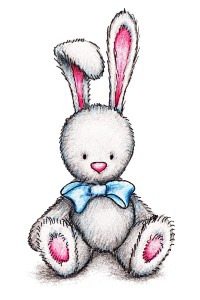
With a sigh, Brenda handed over the toy. It was an old plush rabbit, covered in gray fur that had once been white and sporting a blue ribbon around its neck. The younger girl laughed as she squeezed it with all the strength a five-year-old could muster.
“Careful, Amy!” Brenda frowned at her little sister. “Don’t hurt him! Remember what Grandma said.”
Amy seemed reluctant to loosen her hold, but she obeyed nonetheless. After rising to her feet, she closed her eyes, whispered into the rabbit’s ear, and spun around once on her toes. When she opened her eyes, she was draped in an opulent pink dress. Brenda rolled her eyes.
“A princess again?” the eight-year-old sighed. “Pick something else already!”
“But I like being a princess!” said the younger girl. “It’s my favorite!”
“Don’t you wanna try something different?”
“Like you?” Amy pointed at the fairy wings on her big sister’s back. Brenda nodded.
“Yeah! He can make you anything you want!”
“OK, show me something better than a princess!”
The five-year-old handed the toy back to her sibling and sat back in her seat at the tea party table. Brenda rose from her chair and followed the same procedure as her sister, closing her eyes and whispering in the rabbit’s ear before spinning on the spot while hugging it tight. When the older girl stopped and opened her eyes, Amy fell into a fit of giggles at the sight of the furry ears and tail that had appeared out of nowhere.
“Kitty!” she laughed. “That’s funny! I wanna try too!”
Brenda took a bow as her sister applauded. Before she could return the rabbit to Amy, however, there was a loud click and the front door started to open. The girls froze, knowing this could only mean one thing: their mother had come to pick them up early!
The sisters glanced at the door before turning to each other with panicked looks on their faces. What would she say when she saw them? There was no time to wish themselves back to normal; they would just have to face her and hope their grandmother could explain everything.
Brenda dropped the rabbit and stood up straight with Amy just as their mother appeared in the doorway. The woman immediately looked her daughters up and down as she walked in, but to their surprise, she didn’t seem to mind the dress or the cat ears at all.
“Hello, girls!” she said with a smile. “Did you have fun with Grandma today?”
The children nodded, maintaining innocent expressions while secretly trying to make sense of their mother’s indifference. Just then, their grandmother walked into the living room with a tray of cookies in her hands and a smile on her face.
“Oh, hello, Martha!” said the old woman brightly. “We weren’t expecting you yet.”
“Hi, Mom”, Martha replied, walking across the room to greet her mother with a kiss on the cheek. “Meeting finished early. Sorry to surprise you like this.”
“Don’t be silly; it’s always a pleasure to have you here! Right, girls?”
Both women turned to Brenda and Amy, who once again nodded without a word. They were still waiting for a reaction to their bizarre appearances.
“So what have you been up to?”
It took the girls a moment to register their mother’s question, but before they could reply, their grandmother spoke up.
“They were just playing with Cottontail. He was keeping them company while I was in the kitchen.”
“How nice!” said Martha as she glanced at the toy rabbit lying beside the tea set. “You know, your Aunt Sara and I used to play with him all the time when we were your age. I hope you’re having just as much fun with him as we did!”
While the children exchanged looks of surprise, their grandmother invited her daughter to stay for tea and cookies. Brenda and Amy enjoyed the rest of their tea party as casually as they could in cat ears and a princess dress, until at last their mother told them it was time to go home.
“Oh, I forgot the tablecloths in the car”, said Martha. “Say goodbye to Grandma, girls. I’ll be right back.”
The moment their mother was out the door, Brenda and Amy turned to their grandmother, and the elder sister asked the question on both their minds.
“Grandma, why can’t Mommy see us?”
The old woman smiled. “For the same reason only Mommy and Aunt Sara could see each other, or why only my brother and I could see each other. That’s just how Cottontail works. Now you should change back before your mother gets here.”
The sisters did as they were told, having Cottontail return them to normal before bidding their grandmother farewell. A minute later, Martha had returned a stack of dry-cleaned tablecloths to her mother and was ushering her daughters out the door. As they walked behind their mom to the car, Amy whispered to her sister.
“Brenda, do you think Cottontail could make everyone see us?”
The older girl shook her head. “I don’t think so. Only brothers and sisters see each other, that’s what Grandma said.”
“Too bad. I kind of wanted Mommy to see me as a princess.”
Brenda wrapped an arm around her little sister and laughed. “I’m sure she already does, Amy. I’m sure she already does.”
This has been a special topic post for Writers Reveal, a monthly blog swap among several talented writers. Be sure to check out the other blogs participating in the event. Thanks for reading!
This is one of those words I learned in elementary school, and every time I see it, I’m reminded of my first impression of it. I’m sure I wasn’t the only student in the class who initially thought it was some sci-fi verb that meant something along the lines of “turn into an alien”. Of course, what I didn’t realize at the time was that the term “alien” has a much broader definition than the extraterrestrials we know so well from science fiction, and that root is the key to understanding what this verb really means.
To “alienate” someone is to figuratively push them away to the point where they feel isolated. The word comes from the Latin verb alienare, meaning “to estrange”. This word stems from the adjective alienus, which means “foreign” or “belonging to another”.
Additional meanings of the word “alienate” include the complementary definition “cause (someone) to become unsympathetic or hostile”, as well as the legal definition “transfer ownership of (property rights) to another person or group”. I myself much prefer the most common meaning mentioned above, but these extra ones are certainly worth noting too, especially if you write plenty of legal terms and/or emotionally heavy scenes. It’s up to you which definition you want to use; what matters most is that it happens exclusively among your characters, while you avoid “alienating” your readers with poor quality writing!
What are your thoughts on this word? Any suggestions for future “Word of the Week” featured words?
After a whole series of long posts, I think now is a good time to unwind with a short one. Lately I’ve written quite a bit of poetry, and I find it’s a format that I really enjoy working with. So continuing on the same line as my flash fiction post, here’s a brief list of reasons I believe poetry is an art that every writer should try at least once. Note that this list is based entirely on personal experience, so if you disagree with any points or would like to add some of your own, feel free to weigh in! Enjoy!
Why Writing Poetry is Good for You
1) It’s a form of free writing. True, all creative writing can be considered “free”, but even the simplest stories still need to follow a basic structure to be complete. Poems, however, don’t really come with universal rules. They can cover any subject matter. They don’t have to tell a story. They don’t have to rhyme. They don’t even have to make sense! All you need is a simple idea, and your imagination is free to run with it until it becomes a full piece. It’s wonderfully liberating to write without the restrictions of prose. And who knows? You may just learn something about yourself in the process. I usually do.
2) It’s a gateway for inspiration. Sometimes writing a short piece without inhibitions is just what you need to find inspiration for a longer work like a short story or a novel. Creating poetry has given me extra motivation for stories, and some ideas have even been converted from the former to the latter format during writing. Though many of my poems are written just for fun, they also help me break creative blocks and open the door to new and greater ideas, even if (or especially when) that was never my intention. Take note: if you often suffer from writer’s block, a good poem or two may be the spark that will get you back on track.
3) It’s an emotional release. This is one of the main reasons I write poetry. Sometimes I have so many emotions built up inside me that I just have to set them free somehow, and poetry is usually a great release for those feelings. More than once, I’ve managed to relieve negative emotions by turning them into a poem. So if you’re ever feeling down, try using your feelings as poetic inspiration. It may not solve your problem, but at least you may feel better afterwards.
4) It exercises the mind. I’m sure many prose writers who try their hand at poetry find that it’s not as easy as it may seem. Writing poems is quite different from writing stories, and that means it requires a different way of thinking. You have to train your mind to get into a rhythm, to feel the flow of the words and see the imagery in the lines. Stanza poems can be especially tricky because of the added challenge of rhyme, but even free verse poetry takes real skill to write well. If poetry isn’t your niche, you may enjoy it for the challenge of trying something different, and for the lessons it can teach you to help improve your writing in your regular format.
5) It’s relaxing. If for no other reason, write poetry because it feels good! Poems can be a lot of fun to write, especially when you don’t put pressure on yourself to make them perfect. If you like poetry simply for the beautiful art it is, then write for the fulfillment it brings you, and let the above reasons naturally make it all the more enjoyable. Have fun!
What about you? Do you write poetry? If so, why do (or don’t) you enjoy it?
J.C. Wolfe is a fiction writer, biologist, and aspiring novelist of science fantasy and romance. A natural-born American and graduate in Marine Ecology from a university in Brazil, J.C. now writes for a living in California while spending free time blogging and penning stories and poetry.
J.C. Wolfe is a participant in the Amazon Services LLC Associates Program, an affiliate advertising program designed to provide a means for sites to earn advertising fees by advertising and linking to Amazon.com.


 “My turn, my turn!”
 1)
1) 

Recent Comments