by Naomi L. | October 1, 2014 | Blog, Creative Writing, What If? Writing Prompts |
Here are some more “What If?” Writing Prompts for you. Similar to the set of romance prompts I shared a while back, today’s prompts focus on the general theme of love and peace. See what you can do with these and other like ideas. Even if you can only bring them to life in stories, it’s always worth a try to imagine what the world would be like if such ideas could become reality! Enjoy!
 What if… our religion was each other?
If our practice was our life?
If prayer was our words?
What if the Temple was the Earth?
If forests were our church?
If holy water—the rivers, lakes and oceans?
What if meditation was our relationships?
If the Teacher was life?
If wisdom was self-knowledge?
If love was the center of our being?
(Source: “What If?“, a poem by Ganga White; submitted by Rebecca Braun)
What if… Romeo and Juliet had lived, and the feud between the Montagues and the Capulets could have been resolved without the need for death?
(Source: continuation of my train of thought on alternative Romeo & Juliet endings)
What if… wars could be resolved without the need for physical combat?
What if… less people judged each other based on race/gender/orientation/etc. and more people made an effort to accept others for who they are?
What if… there were no such thing as “forbidden love”?
Good luck creating your own stories about the triumphs of love and peace!
If you have any “What If?” writing prompt suggestions (for any theme), please feel free to share them in the comments below. Ideas I like may be featured in future “What If?” posts, with full credit and a link to your blog (if you have one)! Also, if you’ve written a piece based on an idea you’ve found here, be sure to link back to the respective “What If?” post. I would love to see what you’ve done with the prompt! Thank you!
by Naomi L. | September 29, 2014 | Blog, Word of the Week |
Word: vernacular
Pronunciation: vər-NA-kyə-lər
Part of Speech: noun
Definition: the language or dialect spoken by the ordinary people of a country or region
Source: Oxford Dictionaries
Richard: You guys see me as a dad?
Joey: Oh yeah!
Chandler: No!
Joey: (seeing the look on Chandler’s face) Nooooo.
Chandler: You’re just clearly not familiar with our young person’s vernacular. See, when we say “dad”, we mean “buddy”. We mean “pal”. […] No no, seriously! Joey’s my dad. Monica’s my dad. I’ve even got some dads down at work.
– Friends (Season 2, Episode 20 – The One Where Old Yeller Dies)
The first (if not the only) instance in which I can remember hearing the word “vernacular” was in an old episode of Friends. After Joey lets slip that Monica’s boyfriend Richard is like a father to him and Chandler, the latter tries to cover up the mistake by insisting it’s a slang word for “friend”. Naturally Richard doesn’t buy this lie, but that doesn’t make him telling the guys he’s leaving to have a romantic evening with their other “dad” any less funny.
The “vernacular” of a particular region is the dialect normally spoken by its people. With a modifier, “vernacular” refers to the terminology used by a specific group of people or those who engage in a particular activity. The word comes from the Latin adjective vernaculus, meaning “domestic” or “native”. This adjective has historical roots in the noun verna, which means “house slave”.
Interestingly, the word “vernacular” isn’t exclusive to language; it can also refer to architecture that is “concerned with domestic and functional rather than monumental building”. Note that in both these contexts, the word can function as either a noun or an adjective. An example of the latter would be “vernacular literature”, in which case the word means “spoken or written using one’s mother tongue”. Whether you choose to use it formally (as in the above definitions) or informally (as in the dialogue example), this can be a great word to include in your stories. At the very least, your readers may find it easiest to relate to your writing through your “vernacular”!
What are your thoughts on this word? Any suggestions for future “Word of the Week” featured words?
by Naomi L. | September 24, 2014 | Blog, Creative Writing, What If? Writing Prompts |
Time for another set of “What If?” Writing Prompts. The theme of this week’s batch is mystery and suspense. I don’t have nearly enough experience writing in these genres, so I could definitely have some fun trying out these prompts! I hope you can too! Enjoy!
What if… you found a wedding ring under your bed… that wasn’t yours?
(Submitted by: Doug Langille)
What if… you thought that strange noise in the house was your cat… only to discover your cat was in the room with you the whole time?
What if… you found an old letter hidden in a library book?
What if… that kind elderly neighbor of yours were keeping a dark secret?
What if… you woke up one day to find that nobody could see or hear you?
Good luck spinning twisted tales full of mystery and suspense!
If you have any “What If?” writing prompt suggestions (for any theme), please feel free to share them in the comments below. Ideas I like may be featured in future “What If?” posts, with full credit and a link to your blog (if you have one)! Also, if you’ve written a piece based on an idea you’ve found here, be sure to link back to the respective “What If?” post. I would love to see what you’ve done with the prompt! Thank you!
by Naomi L. | September 22, 2014 | Blog, Word of the Week |
Word: lethargic
Pronunciation: lə-THAHR-jik
Part of Speech: adjective
Definition: sluggish and apathetic
Source: Oxford Dictionaries
I can’t pinpoint an exact moment when I may have heard the word “lethargic” for the first time. It’s one of those words that I happen to come across from time to time, as much in test prep lists as in literature. After recently stumbling upon it yet again, I actually wondered how I had neglected to add it to my vocabulary segment sooner. It is, after all, a word that I could so often use to describe myself…
To feel “lethargic” is to lack energy and enthusiasm. The word can be traced back to the Greek adjective lēthargos, meaning “forgetful”. This adjective is comprised of two roots: the noun lḗthē “forgetfulness” and the adjective argós “not working”.
“Lethargic” is one of those words I would keep on a reference list for describing human nature. Everyone has those days when they feel slow and uninterested in anything, so it stands to reason that fictional characters would have those days too. If you choose to write characters who fit this type, you’re bound to draw readers who can relate. Just try to avoid feeling too “lethargic” yourself to write the stories! Good luck!
What are your thoughts on this word? Any suggestions for future “Word of the Week” featured words?
by Naomi L. | September 15, 2014 | Blog, Word of the Week |
Word: gratuitous
Pronunciation: grə-T(Y)OO-i-təs
Part of Speech: adjective
Definition:
- uncalled for; lacking good reason; unwarranted
- given or done free of charge
Source: Oxford Dictionaries
Like other words I find interesting, “gratuitous” has two almost completely different meanings. I tend to see one definition more often than the other, though, probably due to the substantial amount of time I spend surfing through TV Tropes. You may be familiar with such “gratuitous” devices as foreign languages and violence, and if you encounter them all the time, you understand exactly what earned them this infamous label.
Things or actions deemed “gratuitous” are those which are provided freely and/or without good reason. The word comes from the Latin adjective gratuitus, meaning “given freely” or “spontaneous”. This adjective in turn stems from the noun gratia, which means “favor” or “thanks”.
For fiction writers, it’s practically mandatory to know what “gratuitous” means. We need to have a clear understanding of whether certain details in our work really are essential to the plot or if we simply threw them in for the sake of coloring the story (usually in an attempt to please the audience). In the latter case, it’s probably best to discard such unnecessary details. Set those “gratuitous” tropes aside and you’ll be able to tell a good clean story! Good luck!
What are your thoughts on this word? Any suggestions for future “Word of the Week” featured words?
by Naomi L. | September 10, 2014 | Blog, Creative Writing, Tropes |
You know when you’ve finished watching a movie/TV show or reading a novel, only to suddenly realize hours later that there was something odd about the plot? Well, what you experienced was a trope known as Fridge Logic, that peculiarity in a story that only hits you in a moment of idle thinking. It’s an interesting concept with which I’m becoming increasingly familiar, so today’s creative writing post briefly covers what it is and what it means for fiction writers. Enjoy!
Why a fridge?
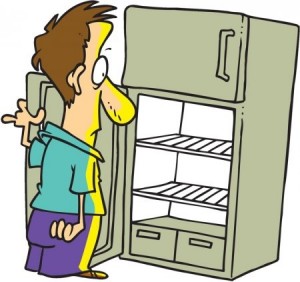
Huh, empty. Like the hotel room in that– Wait a minute…
No, this trope doesn’t necessarily have to do with an actual refrigerator. According to TV Tropes, the term “fridge logic” can technically be traced back to Alfred Hitchcock, who once referred to a particular scene in his film Vertigo as an “icebox scene”. In the words of the director, it’s the kind of scene that “hits you after you’ve gone home and start pulling cold chicken out of the icebox”. Basically, Fridge Logic refers to a special kind of plot hole that you don’t notice at first because you were so caught up in the story that you didn’t bother to think about consistency at the time.
So what does this mean for you as a writer? It means that no matter how well you try to get away with a plot hole in your work, anyone anywhere at any time is bound to find it. Of course, how much that really matters is a subject for another time.
The Other Sides of Fridge Logic
That moment of clarity that hits you at the fridge doesn’t always have to be a bad thing. Sometimes what you realize is the cleverness embedded in a certain story element. This is known as Fridge Brilliance. It usually refers to a part of a story that you didn’t care for at first, only to come to appreciate it after you’ve finally recognized the true meaning behind it. And that, in my opinion, is pretty darn cool.
Another form of Fridge Logic covers the other side of the spectrum, when something you didn’t really notice at first becomes terrifying in hindsight. This is referred to as Fridge Horror. As noted on its TV Tropes page, there are two kinds of Fridge Horror: the horrifying story elements that went over our heads as kids but that have become blatantly obvious to us as adults (Frozen-By-Time), and those that reveal themselves after we take the time to really think about their implications beyond the immediate story (Quickthaw). Look for these at your own risk: remember, anything awful you see in a beloved work of fiction cannot be unseen!
Fridge Logic has the obvious risk of slightly taking away from an otherwise good story, but you can’t deny that it can be tons of fun to discuss once you’ve experienced it. Plot holes should usually be avoided altogether, but if you absolutely must include some, try to hide them well enough that they only become clear in hindsight. At least then you’ll be giving your readers something extra to discuss after your story is over! Good luck!
Have you ever experienced Fridge Logic before? What sorts of plot holes have you found in your favorite works of fiction?



Recent Comments