by Naomi L. | June 3, 2013 | Blog, Word of the Week |
Word: lugubrious
Pronunciation: lə-G(Y)OO-bree-əs
Part of Speech: adjective
Definition: looking or sounding sad and dismal
Source: Oxford Dictionaries
I had absolutely no idea what this word meant the first time I heard it. In fact, if anyone had asked me back then to guess the definition, I might have said that it probably had to do with slime or gooeyness of some sort. Of course, this seems like a rather silly guess when you consider that one of the earliest memories I can recall of hearing this word in context was watching Pain greet Hades as “Your Most Lugubriousness” in the 1997 Disney film Hercules. Eternally ablaze the god of the underworld may have been, but slimy he most certainly was not. But what else was he for sure? Dismal.
When something is described as “lugubrious”, it has a mournful and gloomy air to it (e.g. lugubrious ballads). This definition comes from the word’s root in the Latin verb lugere, meaning “to mourn” or “grieve”. It’s worth noting, however, that of several different synonyms for the word “glum”, “lugubrious” is possibly the heaviest. While a “sullen” person is naturally ill-humored and “melancholy” is a somewhat chronic form of sadness, anything “lugubrious” is dismal to the point of exaggeration. This may explain why it’s one of my best friend’s favorite words; his sense of humor sometimes involves slightly melodramatic descriptions of his own melancholy observations!
What are your thoughts on this word? Any suggestions for future “Word of the Week” featured words?
by Naomi L. | May 27, 2013 | Blog, Word of the Week |
Word: incorrigible
Pronunciation: in-KOR-i-juh-buhl
Part of Speech: adjective
Definition: not able to be corrected, improved, or reformed
Source: Oxford Dictionaries
Kurt von Trapp: I’m Kurt. I’m 11. I’m incorrigible.
Fräulein Maria: Congratulations.
Kurt: What’s “incorrigible”?
Maria: I think it means you want to be treated like a boy.
– The Sound of Music (1965)
Clearly the above dialogue cannot serve as a trustworthy source of information, as the enchanting character of Fräulein Maria (immortalized by the very talented Julie Andrews in The Sound of Music) was only humoring the mischievous young Kurt von Trapp. Instead, it can be inferred from context that a former governess to the von Trapp children simply believed the boy to be a lost cause (and rather insensitively made that opinion apparent to him).
“Incorrigible” is a word used to describe a person or their tendencies that are supposedly difficult (if not impossible) to correct from their undisciplined state (e.g. an incorrigible flirt). This definition shouldn’t be difficult to memorize, since it stems from the Latin adjective incorrigibilis (in- “not” + corrigere “to correct” + -ibilis “-able”), or literally “not correctable”. I myself find it easy to remember because of my familiarity with the word in Portuguese (my second language): incorrigível, which translates directly as “uncorrectable”.
Personally, I prefer to use “incorrigible” in my writing when referring to a character with a more harmless type of behavior, as in the aforementioned examples of flirting and playful mischief. For a more serious connotation, I would probably go with a synonym like “hardened” or “habitual”; despite having a similar definition, these adjectives tend to fit better with nouns of a darker sort (incorrigible gossip, hardened criminal, habitual liar). Take care with your choice of words when writing; it could make all the difference in setting the tone of your scene!
Note: not to be confused with “encourageable”, which may or may not be a real word, but which is definitely what I understood the first time I watched The Sound of Music!
What are your thoughts on this word? Any suggestions for future “Word of the Week” featured words?
by Naomi L. | May 20, 2013 | Blog, Word of the Week |
Word: erroneous
Pronunciation: i-ROH-nee-əs
Part of Speech: adjective
Definition: wrong, incorrect
Source: Oxford Dictionaries
Billy Flynn: “Amos accused me of having an affair… so I told him that the charge was erroneous.”
D.A. Harrison: Objection, Your Honor! Mr. Flynn is twisting this evidence to draw conclusions that are specious and…
Flynn: Erroneous?
Harrison: Exactly!
– Chicago (2002)
I’ll be honest: I almost never use this word in my own writing. The reason is that I consider it a little too “advanced” for most of the stories I like to create, and if I were to ever include it in a narrative, it would probably be within a dialogue involving characters who are politicians or lawyers (as in the above example, taken from the 2002 musical film Chicago). Basically, it’s a fancy way of saying “wrong”, and a character who might use such a word in place of its simpler counterpart would logically be of a more well-educated and studious type.
So why did I choose to include “erroneous” in my Word of the Week list? I just think it’s a good word to know, and even if you wouldn’t use it yourself, it never hurts to have a few extra vocabulary words under your belt. Need a little more convincing than that? No problem; here’s some brief etymology for you, then.
The word “erroneous” is derived from the Latin verb errare, meaning “to stray” or “err”. It should be fairly obvious, therefore, why this word fits so well into legal contexts, as it works to describe a deviation from the requirements of the law without identifying it as strictly “illegal”. Sounds like a handy tip for writers of legal thrillers, right?
So there’s another word to consider for your writing. I hardly use it, but obviously that doesn’t mean you couldn’t put it to much better use than I ever could. Have fun!
What are your thoughts on this word? Any suggestions for future “Word of the Week” featured words?
by Naomi L. | May 15, 2013 | Blog, Creative Writing, Tropes |
Do you ever find yourself reading a book or watching a movie and noticing certain elements in the story that you’re sure you’ve seen before in the plots of other works of fiction? Or better still, do you ever find yourself talking about stories from these media and mentioning said elements in the form of a question that starts with, “You know that thing where…”?
Chances are there’s a trope for that.
What is a trope, you ask? Well, it’s not entirely easy to explain, as the definitions may vary slightly based on opinion. The simple definition is that tropes in fiction are devices that have become common enough throughout their respective media to have established themselves as conventions in the minds of the audience, and thus are reliable to writers as useful tools in creating fiction. A slightly more complex definition expands on this simpler one to also include examples of such conventions in real life, as in behind the scenes or even real-world events. Of course, a much more thorough explanation can be found on the website’s homepage itself, so instead of launching into a long and tedious description of TV Tropes and its endless supply of examples, I’ll simply provide a brief account of my own experience with the site and leave the option of following the link provided to your own discretion.

Follow the link in this logo at your own risk.
One of my first visits to this site was when I was looking up information about a certain Disney movie (I want to say it was Tangled, but my memory fails me). What I found was an abundance of tropes used throughout the film that could be easily recognized as conventions present in the plots of other stories (Character Development, Non-Human Sidekick, Happily Ever After, etc.). I was so intrigued by this new resource I had discovered that it wasn’t long before I started referring to it for examples of tropes in other fiction works – films, TV series, literature – learning more about these devices with each page I opened.
So why would I say this site will ruin your life? Because there’s a very good chance that at least once (and probably on your first visit), you’ll fall into the same trap I did: the web of tropes. On virtually every TV Tropes page, there will be a link that catches your eye, leading you to another page with more interesting information and new links, which in turn lead you to other pages with their own intriguing links… until the next thing you know, it’s an hour later and you can’t remember which page you originally meant to read without checking your browser tabs or history for a reminder. How did that happen?
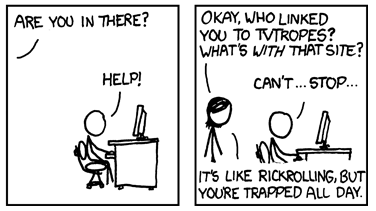
In case you need a visual aid, my experience with TV Tropes (and that of countless others) can be summed up in this webcomic. (Courtesy of xkcd)
Here’s an example of one of my typical TV Tropes sessions: I start by opening the page of a classic Disney film, let’s say Beauty and the Beast. One of the listed tropes is the famous True Love’s Kiss, complete with a brief explanation of how the instance in this particular movie is more of a variation than a straight example, which sparks my curiosity to read about other examples in different works. A moment later, I’m reading this trope’s description on its own page when… Wait, what in the world is a Dead Unicorn Trope? Obviously I go to that page to find out, only to realize in two seconds that I’ll first need to know what a Dead Horse Trope is in order to understand the unicorn variation, but this one interestingly turns out to be a common cause of a phenomenon known as Seinfeld is Unfunny… Several pot holes later, I’m back at the True Love’s Kiss page reading about how it’s a subcategory of a greater trope known as the Magic Kiss, leading me into another chain of links through the site. After another half hour, I go back to reading the list of tropes in Beauty and the Beast, where I soon find another trope that intrigues me, and the whole thing starts all over again.
But you know what? I love every minute of it, because even if I know TV Tropes will ruin my life on one hand, in a way, it also enhances my life on the other.
TV Tropes is an excellent resource for anyone who appreciates works of fiction, and especially for writers of such works. Learning about the various devices used in media and how they function in their respective plots teaches us how to analyze fiction critically, allowing us to develop a keener understanding of the elements that make up a story. This is particularly important for writers, because we more than anyone else should have as thorough a knowledge as possible in the workings of the stories we wish to create. How can we expect to write good fiction if we don’t have a decent understanding of the myriad of tools at our disposal?
So yes, by pulling you into its vortex of interesting content, TV Tropes may easily ruin your life. But in the end, if you somehow emerge with a refined outlook and even a new respect for the fiction you already love, then wouldn’t you really just be exchanging it for a better life?
by Naomi L. | May 13, 2013 | Blog, Word of the Week |
Word: egregious
Pronunciation: i-GREE-jəs
Part of Speech: adjective
Definition:
- outstandingly bad; shocking
- (archaic) remarkably good
Source: Oxford Dictionaries
“It is pronounced i-GREE-jəs.”
– Captain Jack Sparrow, Pirates of the Caribbean: At World’s End (2007)
“Egregious” may very well be one of my favorite words. I’m not even entirely sure why; I just really like the sound of it. Say it with me: “egregious”. Doesn’t that sound pretty cool? No? OK, maybe it’s just me.
Nowadays, to call something “egregious” is to insult it, as you’re basically referring to it as noticeable in a bad way (e.g. egregious errors). Interestingly enough, though, this word actually used to mean something good, that is, it was used to describe what was outstanding in a positive sense. So how does a word go from being complimentary to being derogatory?
One word: sarcasm.
It’s believed that at some point in the late 16th century, the normally positive word “egregious” started being used in a sarcastic manner. Over time, this negative use must have become the norm, thus giving origin to the more unfavorable definition that we now know today.
It may be worth mentioning, though, that traces of the archaic meaning may still exist today. For instance, I recently asked my dad for his opinion on the word “egregious”, and I was surprised to learn that to him, it had a positive meaning: something along the lines of “honorable”. This is because he had learned from his father that the Italian word egregio (oh yeah, my dad is European, by the way) is used in formal correspondence to mean “dear” or “distinguished”, as in Egregio Signore (Dear Sir). Pretty neat, huh? At least, I think so!
Bonus fun fact: “egregious” has roots in the Latin adjective egregius, which basically means “standing out from the flock” (ex– ‘out’ + grex-/greg– ‘flock’). At least that’s one thing these two polar definitions have in common!
What are your thoughts on this word? Any suggestions for future “Word of the Week” featured words?
by Naomi L. | May 6, 2013 | Blog, Word of the Week |
Word: pedestrian
Pronunciation: pə-DES-tree-ən
Part of Speech: noun; adjective
Definition:
- (n.) a person traveling on foot
- (adj.) lacking inspiration or excitement; dull
Source: Oxford Dictionaries
“Pedestrian” was one of my 7th-grade Language Arts teacher’s favorite vocabulary words. It’s one of those interesting words with two very different meanings: on one hand, you could use it to refer to a person strolling in front of your car at the crosswalk; on the other, you could use it to insult a piece of fiction you just read (or any other piece of art for that matter) that you didn’t find particularly exciting.
He told his therapist that he daydreams about running slow pedestrians over with his car.
It amazes me that such a pedestrian novel series could become a worldwide success.
So why is it that this word can have two different meanings with no apparent connection? I myself used to think that the original definition of the English word was just “a person traveling on foot” and that only recently did it come to mean “dull”, but a little research has taught me that this double meaning goes much farther back than that. Apparently, etymology places the root of the word “pedestrian” in the Latin adjective pedester (feminine pedestris, neuter pedestre), which also means both “on foot” and “commonplace”. Only the root of this word (pedes) means just “one who walks” (except in chess, where it refers to a pawn). Who knew?
As for the reason behind the different definitions in Latin, that’s where my knowledge on the subject ends. If I ever do learn more, though, I’ll be sure to update this entry. My apologies!
Anyway, I’m a fan of this word; it’s just common enough to count as colloquial language (though that may or may not be changing in recent times), yet just long enough to pass as an advanced vocabulary word. Overall, it’s simple and fun to use, which is why I thought it would be a good choice to start off Monday’s “Word of the Week” segments. I hope you’ll enjoy them!
What are your thoughts on this word? Any suggestions for future “Word of the Week” featured words?



Recent Comments