by Naomi L. | December 2, 2015 | Blog, Creative Writing |
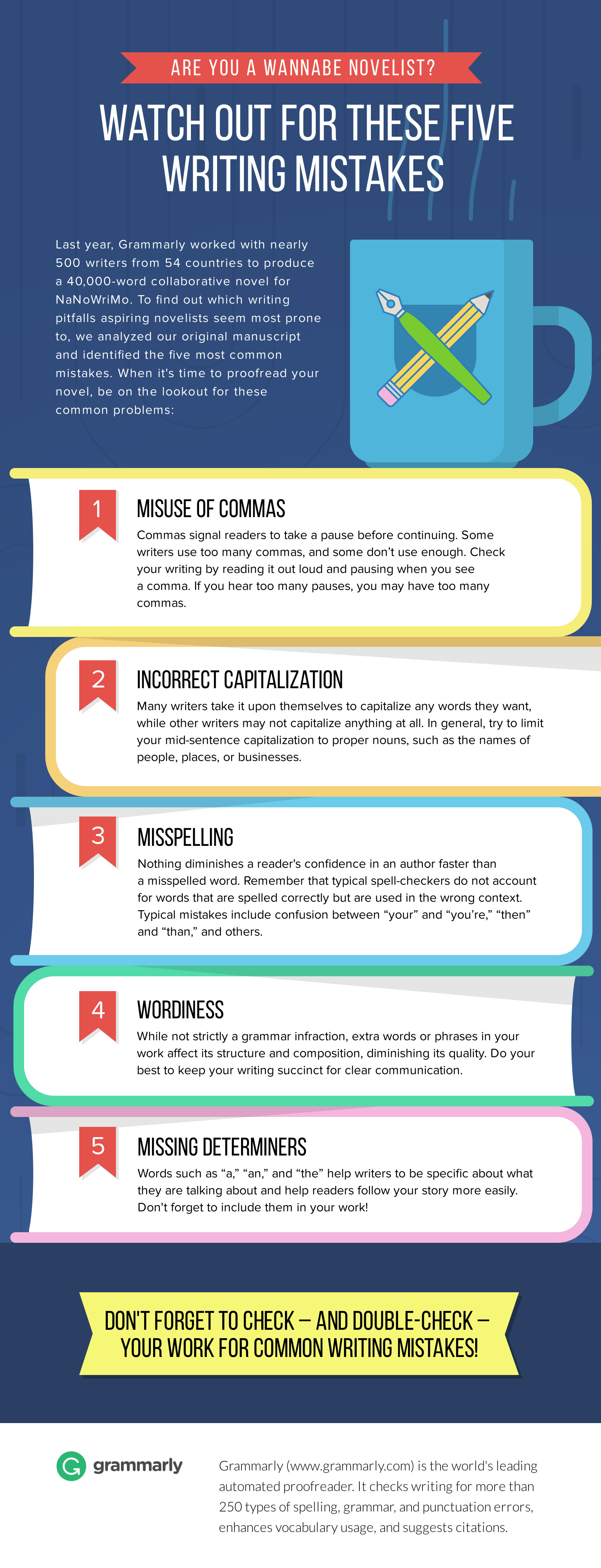
So, did you finish that novel for National Novel Writing Month? If so, congratulations! Now that you have your 50,000 words written, it’s time for the next stage: editing your novel! To help get you started, Grammarly has put together a list of the five most common writing mistakes that came up in last year’s 40,000-word collaborative novel project. Be sure to watch for these mistakes while editing your NaNoWriMo novel! Enjoy!
Today’s creative writing post is brought to you by Grammarly, the World’s Best Grammar Checker. For more information on Grammarly, visit https://www.grammarly.com/grammar-check. Thanks for reading! Happy writing!
by Naomi L. | November 25, 2015 | Blog, Creative Writing |
Done with that NaNoWriMo novel yet? If so, congratulations! If not, don’t sweat it: you still have five more days to reach that 50,000-word milestone. We’re now in the final stretch of NaNoWriMo, which means it’s crunch time for hundreds of participating writers still striving for that winner’s badge. And at this critical stage in the event, I figure now is the perfect time to discuss those voices in every writer’s head: the inner writer and the inner critic.
You probably hear these voices in your mind whenever you write (my voices are so active that I once wrote a poem about them!), but if you’ve been participating in NaNoWriMo, they must have been in overdrive this past month. Knowing when to listen to which voice is a skill that every writer needs to master in order to turn out a decent work, but it can be difficult if they’re both constantly trying to talk at the same time. The truth is that these voices are equally important, so how do you achieve that perfect balance between them?
When to Listen to the Writer
 The writer is the wide-eyed idealist in you. It’s the innocent unbridled spirit that just wants to tell stories without the slightest regard for form and style. Imagine it as the starry-eyed child you once were still living on in your heart and fueling your art. In a nutshell, the writer is pure creativity.
Listen to the writer for ideas and motivation. If there’s a story inside you waiting to be told, let the writer set it free and start it off on its journey to the outside world. Don’t worry so much about the technical aspects of it just yet; the important thing is to get the story out of your system first, before the doubts begin to creep in and slow or halt your progress. When your energy to write begins to waver, the passion and emotion of the writer will motivate you to keep going until your story is complete. The writer’s voice is there to cheer you on and remind you that if you have a story consuming your thoughts, then chances are it’s worth writing.
When to Listen to the Critic
 The critic is your inner skeptic. The polar opposite of the writer, the critic serves as the editor’s voice that balances out the idealistic and ingenuous artist. While the writer is fueled by creativity and emotion, the critic is driven by technical perfection, and if the writer represents the impulsive inner child, the critic represents the levelheaded outer adult who keeps him/her in check.
The best time to listen to the critic is after your first draft is complete. Once the core story is written, you don’t have to worry so much about the critic’s voice holding you back and instead can start letting it push you forward. The purpose of the critic is to find the flaws in your work and figure out how to fix them, whether they’re as simple as grammatical errors or as complex as plot structure. It’s only too easy to resent this voice for all its negative feedback, but if you keep in mind that such comments are nothing personal and simply meant to help you make your work as presentable to the public as possible, you can turn your inner critic from your worst enemy into one of your strongest allies.
The Perfect Balance
Despite all the conflict between them, it’s important to remember that both the inner writer and the inner critic are essential to a writer’s success. The trick to finding the perfect balance between them is to let them complement each other: the writer will drown out the insecurities of the critic, and the critic will polish the rough groundwork of the writer. Learn to listen to both voices equally, and they’ll help you create your greatest works of art! Good luck!
Do you struggle with the voices in your head? Which one do you hear most often: the writer or the critic?
by Naomi L. | November 18, 2015 | Blog, Creative Writing |
When it comes to seeking inspiration for your fictional characters, there’s no better place to find it than in the people you know in real life (a point I’ve already made in another post I wrote last year). Such was the case of many famous authors, whose characters were inspired by the real people in their lives. Writers are often motivated by such figures as teachers, close friends, and comrades-in-arms, and sometimes these people make enough of a lasting impression to earn a full fictional counterpart in a book.
So for a little more inspiration heading into the second half of your NaNoWriMo journey, here’s an infographic put together by Fresh Essays highlighting the most interesting examples of well-known fictional characters based on real people. Enjoy!

Are any of your characters based on people you know in real life? What are your favorite examples of characters based on real people?
Today’s creative writing post is brought to you by Fresh Essays, a professional custom essay writing service. For more information, visit http://www.freshessays.com. Thanks for reading! Happy writing!
by Naomi L. | November 11, 2015 | Blog, Creative Writing |
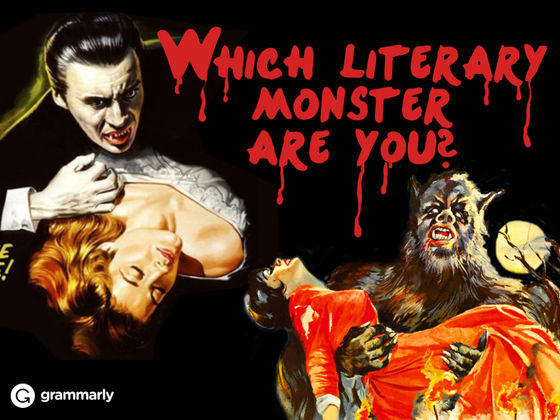
Yes, I know Halloween has come and gone, but it’s never too late to have some fun with a monster quiz, right? A couple of weeks ago, Grammarly shared a Halloween-themed quiz: Which Literary Monster Are You? While you’re working on that 50,000-word novel for NaNoWriMo, why not take a break to find out which famous monster from literature fits your personality? It may even inspire you to write some horror fiction of your own! Have fun!
Here’s my inner literary monster, who just so happens to be one of my favorites: Dr. Frankenstein’s monster! Seems fitting for me, as Frankenstein’s creation is an emotional being who is misunderstood by the people he encounters. That is, after all, one of the reasons I became a writer!
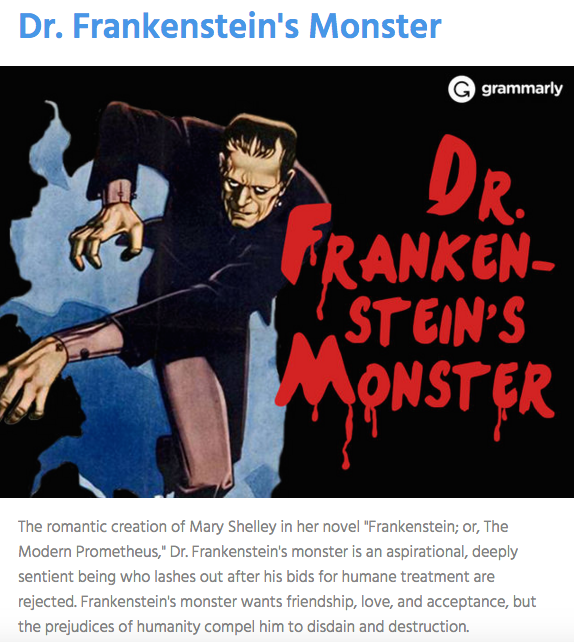
Who’s your literary monster? Feel free to share your result in the comments!
Today’s creative writing post is brought to you by Grammarly, the World’s Best Grammar Checker. For more information on Grammarly, visit https://www.grammarly.com/grammar-check. Thanks for reading! Happy writing!
by Naomi L. | November 4, 2015 | Blog, Creative Writing |
It’s the first week of National Novel Writing Month, and you know what that means: time to finally sit down and write that novel! Of course, this is much easier said than done, but hammering out 50,000 words in 30 days, daunting as it may seem, is certainly possible. Sometimes all you need to get started on reaching that goal is a bit of motivation.
So to help start you off on your NaNoWriMo journey, here are 10 tips on writing in the form of inspirational quotes from famous authors. Enjoy, and best of luck in this year’s NaNoWriMo!
 1) Be ruthless about protecting writing days, i.e. do not cave in to endless requests to have “essential” and “long overdue” meetings on those days. – J.K. Rowling
2) If you don’t have time to read, you don’t have the time (or the tools) to write. Simple as that. – Stephen King
3) This is how you do it: you sit down at the keyboard and you put one word after another until it’s done. It’s that easy, and that hard. – Neil Gaiman
4) No tears in the writer, no tears in the reader. No surprise in the writer, no surprise in the reader. – Robert Frost
5) The best time for planning a book is while you’re doing the dishes. – Agatha Christie
6) Substitute ‘damn’ every time you’re inclined to write ‘very’; your editor will delete it and the writing will be just as it should be. – Mark Twain
7) Don’t tell me the moon is shining; show me the glint of light on broken glass. – Anton Chekhov
8) There is nothing to writing. All you do is sit down at a typewriter and bleed. – Ernest Hemingway
9) You must stay drunk on writing so reality cannot destroy you. – Ray Bradbury
10) If there’s a book that you want to read, but it hasn’t been written yet, then you must write it. – Toni Morrison
What are your thoughts on these inspirational writing quotes? Any other favorites you would add to this list?



Recent Comments