by Naomi L. | December 4, 2013 | Blog, Creative Writing |
Flash fiction is quickly becoming one of my favorite formats of creative writing. Interestingly enough, I didn’t even know what it was three years ago. I discovered it through my 2011 creative writing course as a format called the “short short story”, and it didn’t take me long to fall in love with it.
Short short stories, also known as flash fiction, are stories with less than the typical short story word count, though exactly how much that is depends on the source. From my understanding, a short story consists of at least 1,000 words; anything shorter is considered flash fiction.
As I soon learned, this style of writing was perfectly suited for me, and I’ve been writing more often in this format over the past few years. I haven’t been familiar with flash fiction for too long, so I can’t really go into an extensive lesson about it. What I can do, however, is list the main reasons why I’ve enjoyed my experience with it so far, and why I think others could enjoy it too. So just for fun, here’s a list of five reasons I love flash fiction.
1) Quick to write, quick to read. Who has the time to read long stories these days? OK, a lot of people do, but for those who don’t have that much time on their hands, flash fiction is a great alternative, for readers and writers alike. While a novel may take days to finish and short stories need time to be fully appreciated, several flash fiction stories can be written and/or read in a single sitting, making them the literary equivalent of “snacks” to the longer stories’ “supper”. Don’t get me wrong: I don’t believe a writer should take any less care with a short short story than with a novel, but when the demand for editing grows exponentially with increasing word count, flash fiction is probably the best place for the less experienced to start.
2) Best of two worlds. When I was introduced to short short stories, I learned that they’re considered a middle ground between poetry and short stories. Since I love both formats, being able to mix them into one has proven an excellent option for me. With the brevity of poetic verse and the structure of short stories, flash fiction encompasses the best of both worlds, and for that, I love it all the more.
3) A challenge for the mind. How do you tell an entire story in so few words? Trying to condense a plot – complete with characters, setting and conflict – is an exercise that I’ve found quite challenging, and it’s really helped me develop my skills as a writer. By challenging writers to cut a story down to the bone, I think flash fiction is great for helping beginners understand the essence of fiction, an essential first step for any aspiring storyteller.
4) Cutting out the “purple”. Another challenge of writing short fiction is having to place significance on every single word of a story. When working with a limit of very few words, there’s no room for unnecessary flowery details. It’s imperative to get straight to the point with only the most basic details, and that makes flash fiction excellent practice for avoiding “purple prose“. Tell a story, period.
5) It’s fun! I think this pretty much says it all. For all the reasons above, I have tons of fun writing flash fiction, and that’s why it’s one of my favorite styles of writing!
What about you? Why do (or don’t) you like flash fiction? Any other points you would add to this list?
by Naomi L. | November 27, 2013 | Blog, Creative Writing, Off The Bookshelf |
Since last week’s post was dedicated to the amazing children’s author Dr. Seuss, I wanted to follow it up with a post about one of his many wonderful books. However, the more I thought about it, the more I realized how hard it would be to choose which book to feature; there are so many good stories by Seuss that it’s almost impossible to choose just one favorite. Eventually, though, I settled on one of the books I find most inspiring: Horton Hears a Who!
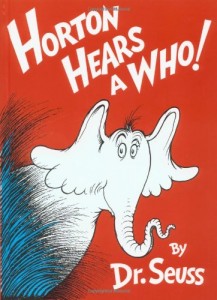
Horton Hears a Who!, by Dr. Seuss
Summary
First published in 1954 by Random House, Horton Hears a Who! tells the story of Horton the Elephant, a resident of the Jungle of Nool, and his quest to help the Whos. After hearing a small yelp coming seemingly out of thin air, Horton discovers the microscopic civilization of Whoville living on a speck of dust. Deciding that every life has value regardless of size, he places the speck on a clover and sets out to find a safe location to keep the Whos out of harm’s way. Unfortunately, being the only one with ears keen enough to hear these tiny people, the elephant has trouble convincing the other jungle residents that Whoville exists, and when they decide to put an end to his crazy antics by destroying the clover, Horton must struggle to save his new friends and teach the people of the Jungle of Nool an important lesson: “a person’s a person, no matter how small”.
Review
Horton the Elephant is one of my favorite Dr. Seuss characters, mostly for his kindness and integrity. He stays true to his word no matter what; as seen in the previous story featuring his character – Horton Hatches the Egg – when Horton makes a promise, he has every intention of seeing it through, and that makes him one of the best role models in Seuss’s stories.
I meant what I said
And I said what I meant.
An elephant’s faithful,
One hundred per cent!
– Horton the Elephant, Horton Hatches the Egg (Dr. Seuss, 1954)
Like many of Dr. Seuss’s books, Horton Hears a Who! is more than just a children’s story. It also teaches good lessons, such as the importance of open-mindedness and understanding the issues of isolationism. Horton’s biggest challenge is convincing his peers that something they can’t perceive or fathom actually exists – which, when you think about it, is a story that’s only too familiar in real life. But what’s really interesting about this book is the history behind its lessons. Once strongly opposed to Japan, the author changed his opinions after World War II, and used this book as an analogy for the American post-war occupation, even dedicating the book to a Japanese friend. Overall, the metaphor of two worlds overlapping creates a beautiful message, one that children can certainly understand and appreciate.
Horton Hears a Who! is one of Seuss’s most notable works. From the children’s book to the TV special to the 2008 full-length feature film (which I thoroughly enjoyed; I swear the “We are here!” scene gives me chills every time I watch it), this story is wonderfully imaginative and fun for readers and viewers of all ages. Though they may have been written for a young audience, no one is too old to enjoy the stories of the great Dr. Seuss!
Inspiration
What I always found inspiring about this book was the main character’s determination to help an entire community that he couldn’t even see. I admired Horton’s devotion to his cause, and the respect he had for all forms of life made him a truly lovable hero. With colorful characters, adventure and a heartwarming message, Horton Hears a Who! is one of my favorite Dr. Seuss stories, and one I’ll definitely enjoy for the rest of my life.
by Naomi L. | November 20, 2013 | Blog, Creative Writing, Notable Authors |
I’ve been feeling a little nostalgic lately: looking through my books for old favorites, watching movies from my childhood whenever they’re on TV, even listening to songs from the ’90s once in a while. That’s how I recently had an idea for another post on inspiration, because when I think about my childhood, one of the most prominent figures that comes to mind is the author of some of my favorite classics of children’s literature: Dr. Seuss.
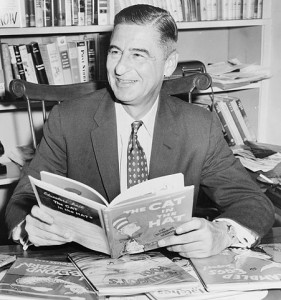
Theodor Geisel in 1957
Bio
Name: Theodor Seuss Geisel
Pen Name: Dr. Seuss
Life: Mar. 2, 1904 – Sept. 24, 1991
Gender: male
Nationality: American
Occupation: writer, cartoonist, animator, publisher, artist
Genres: children’s literature
Notable Works: The Cat in the Hat, Horton Hears a Who!, Green Eggs and Ham
My Favorite Works: The Cat in the Hat, The Sneetches and Other Stories, Horton Hears a Who!, How the Grinch Stole Christmas!
Inspiration
Dr. Seuss was a huge part of my childhood. When I was little, my mother signed us up for the Dr. Seuss book club, so we would get one of his books in the mail every month. By the time I started reading on my own, I had a large collection of fun stories to choose from, such as The Cat in the Hat, Horton Hears a Who! and Green Eggs and Ham. Because of this, my earliest memories of reading were filled with colorful characters and silly rhymes that kept me entertained for hours on end. If I ever wanted to get lost in books, I could always count on Seuss’s imaginative world.
The main reason I find this author so inspiring is because his stories were an important first step into my love of books. Sometimes I wonder if I would have grown to love reading as much as I do today if I hadn’t had the privilege of enjoying Dr. Seuss’s work at such a young age. His books were very easy to read and understand, and that always made reading such a pleasure. In fact, his rhymes and style of writing were so memorable that to this day, my mom and I can quote lines word for word back to each other. In this way, Seuss gave us the gift of memories that we could share for the rest of our lives.
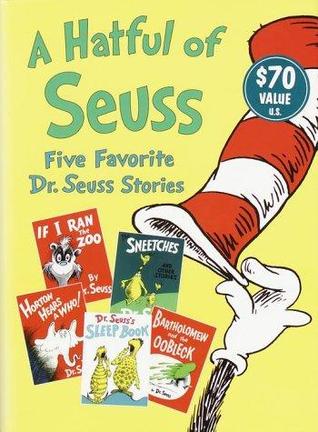
A Hatful of Seuss: Five Favorite Dr. Seuss Stories
But there was much more to these books than simple rhymes and oddly shaped characters with bizarre names. Dr. Seuss had a talent for embedding important lessons in his stories without making them blatantly obvious or patronizing. Moral issues are cleverly hidden behind tales of strange creatures living in unusual worlds: The Sneetches shows us that racism is unjustified; The Lorax shines light on environmentalism and the dangers of corporate greed to the natural world; How the Grinch Stole Christmas! criticizes the commercialization that the holiday season has suffered over time; and even a story as simple as Green Eggs and Ham can be read as a lesson on trying new things in order to form educated opinions. There was almost always something to learn in Seuss’s books, and because the lessons were presented in such a kid-friendly format (complete with his colorful illustrations), it made his stories that much more accessible to children just starting to discover the world around them.
There are quite a few authors I associate with my childhood, but Dr. Seuss is by far one of my favorites. His books inspired me to continue reading beyond the beginner level, and the lessons in his stories have stayed with me into my adult years. Even now, I can’t help but smile as I think about how I once knew The Sneetches by heart and how I still enjoy reading Horton Hears a Who! out loud once in a while. Though authors like Roald Dahl and J.K. Rowling were great inspirations for my writing, Dr. Seuss was a great inspiration for my reading, and in my opinion, there’s no greater gift that a writer can give to children. To the little girl still in my heart, Dr. Seuss will always be a hero.
by Naomi L. | November 13, 2013 | Blog, Creative Writing |
Yes, it’s time for another round of Writers Reveal! Today’s topic comes from the newest member of our circle, Emily Toxward, who sent me the prompt “circling helicopters”. Here’s the short story I wrote based on that idea. Hope you like it! Thanks for the topic, Emily!
Rescue Me
Circle overhead… searching for a lost soul…
My heart is pounding in my ears. The pain is sharp and constant. The air around me is cool on the breeze.
I wait. I’ve been waiting for hours. I may be here for a few more. Is anyone looking for me?
I know I shouldn’t have gone off the trail. But I wanted to be adventurous. I wanted to explore. Just once, I wanted to prove them wrong, show them that I’m not always so afraid, that I can live on the edge too.
And look where it’s gotten me. Maybe they were right all along.
I still think I could have made it if those darn rocks hadn’t slipped. Now I’m lost and trapped, with nothing but the wind and my own breathing to break the silence.
And the occasional whirring noise in the distance, like the one approaching now.
This is the third helicopter to pass in two hours. Or maybe it’s the same one on its third lap around the mountain. It’s hard to tell when it blends into the clouds of the evening sky.
“I’m here!” Yet again, I try to get its attention, waving my arms while trying not to move my injured leg. “Look at me! Please…”
I wince as my foot brushes against the fallen rocks. Yes, it’s definitely broken; my leg doesn’t normally bend that way.
“Help me…” The cold is so overbearing, I can hardly get the words out anymore. Not that they’d hear me anyway. But with a broken limb, my options are limited.
I watch the helicopter pass overhead. Curse these trees! Why couldn’t I have fallen on open ground? I’d have been rescued ages ago!
Wait, what’s that? In the face of a darkening sky and a rising moon, a searchlight now appears under the helicopter. By some miracle, the light finds its way to my patch of earth. Yes! Surely they can see me now!
But will they reach me in time?
The sound of howling suddenly pierces the evening air. Not now, please not now. They’re so close! I can already hear the whirring getting louder again…
The sunlight is fading fast. I’m too exhausted to move anymore. The howling grows louder, but I swear I can see the aircraft turning around. It must be coming back for me… It must…
The world around me grows dark. All I can see anymore is that beacon of hope in the sky. I close my eyes and wait for the rotating blades of salvation to reach me before the mountain beasts do…
Helicopters circle overhead, all day searching for a lost soul to rescue. It doesn’t matter if this one’s for me; the next one will find me for sure.
This has been a special topic post in Emily Morgan’s Writers Reveal. To learn more, just follow the button below to her site, and be sure to check out the other blogs participating in the event. Thanks for reading!

Other bloggers in the Writers Reveal
Emily Morgan: Emily Morgan Writes
Melissa Khalinsky: Melissa Writes
Jodi Gibson: JFGibson
Becky Fyfe: Imagine! Create! Write!
Josefa: Always Josefa
Rhianna: A Parenting Life
Ashley Howland: Ghostnapped
Emily Hawker: You Learn Something New Every Day
Emily Toxward: Have A Laugh On Me
by Naomi L. | November 6, 2013 | Blog, Creative Writing |
All native English speakers are familiar with this problem: words and phrases that appear similar in spelling, pronunciation or meaning, but that actually have distinct definitions. This, of course, can cause some confusion when writing. After all, it’s not always easy keeping track of the right words for the context we want, and even the most proficient writers make mistakes. But nobody’s perfect, right?
 To help you avoid some common (and a few uncommon) grammar pitfalls, here are 25 examples of words and phrases you may be getting mixed up in your writing. Almost all of these items were taken from The Hodges Harbrace Handbook, an excellent resource for beginning and advanced writers alike. Be sure to check it out if you can! Write wisely!
1) accept/except
It’s easy to confuse these words because they sound so similar, but they have very different definitions. “Accept” is a verb that means “to receive with consent”; “except” is a preposition that means “other than”. “Except” is also a verb meaning “to exclude”.
I accept all apologies, except those that aren’t heartfelt.
2) affect/effect
These words are so easy to mix up that I always stop and double-check if I’m using the right one before I move on. “Affect” is a verb meaning “to make a difference to”; “effect” is a noun meaning “result of a cause”. As a verb, “effect” means “to cause”.
The effect that book had on my friend’s life did not affect my opinion of it.
3) among/between
Here’s an example of two words that seem similar in meaning, but that aren’t usually interchangeable because their uses depend on context. Generally speaking, “between” is exclusively for referring to two entities, while three or more should be referred to using “among”.
Between the two of us, I don’t see any love among the three band members.
4) anymore/any more
Who among us hasn’t once mistakenly inserted a space where it wasn’t necessary (or omitted one where it was)? I’m sure we’ve all had our doubts about the difference between “anymore” and “any more”. As one word, “anymore” means “any longer”, while as two, “any more” is used with a negative to mean “no more”.
Do not give me any more problems, or I won’t have the patience to deal with you anymore.
5) can/may
Did anyone else’s parents use to answer the question “Can I?” with “You can, but you may not”? No? Just mine? OK, then. Basically, by answering sarcastically, my parents were teaching us the proper way to ask if we were allowed to do something, as “can” refers to ability while “may” refers to permission.
You can drive 80 miles an hour, but you may not go over the speed limit.
6) coarse/course
Here’s a pair of homophones that are especially easy to get confused because they only differ by one letter. “Coarse” is an adjective that means “rough”, but “course” is a noun that means “route” or “plan of study” (or a verb that means “move without obstruction”).
We’ll need a new course of action if we want to make this coarse piece smooth.
7) complement/compliment
This is another pair of words that sound alike and differ by one letter. Don’t let these verbs confuse you, though. “Complement” means “to complete”, and “compliment” means “to express praise”. Be sure to check which letter you’re using!
I had to compliment her on how well her piece was able to complement mine.
8) elicit/illicit
This mistake is a little less common, but still possible to make due to similar spelling. “Elicit” is a verb meaning “to evoke a response”, and “illicit” is an adjective meaning “illegal”.
She was quick to elicit objections from her peers by talking about her boyfriend’s illicit actions.
9) eminent/imminent
I’ve actually never made this mistake myself because I’m not too familiar with the word “eminent”, but I still think it’s worth mentioning. Though both are adjectives, “eminent” means “distinguished”, and “imminent” means “about to happen”.
For such an eminent artist, worldwide success was imminent.
10) everyday/every day
Oh, those darn spaces, always confusing us! Here’s another mistake we have to watch for, because a single space does change the meaning behind the words! “Everyday” as one word means “commonplace” or “routine”, but “every day” as two words means “each day”.
Every day, I have to help my sister deal with her everyday problems.
11) explicit/implicit
This one might not be very common, but it’s still an important mistake to note, because even though these two adjectives seem similar, they have opposite meanings. “Explicit” means “stated clearly”, while “implicit” means “expressed indirectly”. Make sure you’re not saying the opposite of what you mean!
By using explicit details, the director makes the message of the movie implicit.
12) farther/further
These adverbs may seem interchangeable, but which one you should use actually depends on context. Both are comparatives of “far”, but “farther” is used to refer to geographic distance, while “further” is used to mean “more”.
We’ll need further assistance if we’re to travel farther tomorrow than we did today.
13) fewer/less
I added this example to the list because it’s common for writers to go straight for “less” when indicating lower amounts. Like the cases of “among”/”between” and “farther”/”further”, however, context is important. Though both words mean the same thing, “fewer” is for nouns that can be counted, while “less” is for nouns that can’t.
Since I started outlining my novel, I have fewer blank notebook pages and much less free space on my desk.
14) good/well
Colloquial speech has made it very common for people to mix up the proper uses of “good” and “well”. I can attest to this from personal experience; knowing the difference between “good” and “well” doesn’t keep me from answering “How are you?” with “Good”. But even though they mean the same thing, there’s a difference: “good” is an adjective and “well” is an adverb. Make sure you aren’t confusing them!
A good writer knows how to tell stories well.
15) its/it’s
What’s a list of common grammar mistakes without a few examples of “contraction confusion”? We’ve all been guilty of this error before, but it’s understandable when one apostrophe makes all the difference. “Its” is the possessive form of “it”, and “it’s” is the contraction of “it is”. Careful with that apostrophe!
It’s easy for students to struggle with English and its many grammar rules.
16) lay/lie
This is one mistake I always have to take extra care not to make, because the past tense of one is the present tense of the other! The main difference between these verbs is that one takes an object while the other doesn’t. “Lay” means “to put (something) down”; “lie” means “to rest”.
I have to lay my things on the desk before I can lie down.
17) raise/rise
This is a tough mistake to make, but I’m fairly certain I’ve seen it happen before. Like the previous example, the difference between these verbs is that one is transitive and the other is intransitive. “Raise” means “to lift (something) up”, while “rise” means “to ascend”.
The teacher made me raise my hand and ask permission before I could rise from my chair.
18) sometime/some time
Yes, it’s another case involving a space (sorry for the lame rhyme). Whether you write it as one word or two will alter the meaning of the sentence. “Sometime” as one word means “at an unspecified time”, and “some time” as two words indicates a span of time.
Sometime next month, we’ll be able to spend some time together.
19) than/then
These are two words that I constantly mix up by accident, to the point where I always read the sentence at least three times to make sure I used the right one before moving on. “Than” is a conjunction and preposition used in comparisons; “then” is an adverb indicating a time sequence. Always be sure to double-check!
Back then, he used to say he’d rather listen to underground rock than mainstream pop music.
20) their/there/they’re
Here it is: the famous trio! You didn’t think I’d leave this one out, did you? Self-proclaimed “Internet grammar police” love picking on people for this mistake, and although I sympathize with those who commit the error once in a while, I can’t forgive those who insist on interchanging these words without any respect for the English language. “Their” is the possessive form of “they”; “there” is an adverb referring to location; and “they’re” is the contraction of “they are”. Be careful with your word choice!
They’re going there to retrieve their test scores.
21) to/too/two
Here’s another famous word trio. When one letter makes all the difference, it’s very easy to mix these words up. “To” is a preposition and infinitive marker; “too” is an adverb meaning “also” or “excessively”; and “two” is a number.
Two mistakes in your essay are still too many if you hope to ace this test.
22) weather/whether
This one may seem unlikely, but I swear I’ve seen writers mix up these words before. “Weather” is a noun referring to the state of the atmosphere (and sometimes a verb meaning “to wear away”); “whether” is a conjunction indicating a choice between alternatives. Make sure you’re using the right word!
Whether or not you believe in climate change, you can’t deny that the weather has been strange lately.
23) who/whom
We all know that person who insists on correcting us when we use “who” incorrectly (my family does for sure, because it’s me). Which word you use depends on voice: “who” is used as a subject, while “whom” is used as an object. When in doubt, try rewording the phrase with “he/she” (subject) or “him/her” (object).
To whom it may concern, I’m the one who let the birds out of the cage.
24) whose/who’s
Speaking of “who”, here’s another pair of homophones that are easy to confuse. Even I sometimes have to go back and fix the mistake. “Whose” is the possessive form of “who”, and “who’s” is the contraction of “who is”.
Whose fault is it if we can’t figure out who’s responsible for this mess?
25) your/you’re
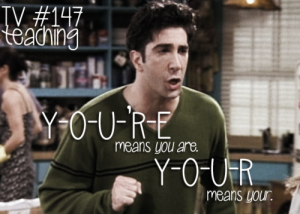
And now for the final pair of easily confused words: the famous “your” and “you’re”. Friends fans, remember that moment when Ross is fighting with Rachel over the letter she wrote him, and points out her grammar error for good measure? Yes, he was drawing attention to a mistake that many people are guilty of making at least once in their writing. But we all know which word is which: “your” is the possessive form of “you”, and “you’re” is the contraction of “you are”. The trick is making sure we’re using the right one!
You’re not going anywhere until your homework is done!
These are just some of the many examples of easily confused words in the English language. Yes, an innocent mistake now and then is forgivable; our grammar is so complex that even native speakers struggle with it from time to time. Still, as writers, we should take care to avoid these mistakes as much as possible. If nothing else, we should be setting a good example for all other English speakers!
What about you? Have you ever confused any of these words and phrases before? What other examples would you add to this list?





Recent Comments