by Naomi L. | June 12, 2013 | Blog, Creative Writing, Notable Authors |
So last week, I talked about a book that I loved as a child: Charlie and the Chocolate Factory. Continuing on the subject of inspiration, I wanted to create another subtopic focusing on authors whose work has inspired me in my own writing, and it seems only fair to start with the same author of the wonderful book I’ve already reviewed. Kicking off the Notable Authors segment of my blog is storyteller extraordinaire and one of my favorite writers of all time: Roald Dahl.
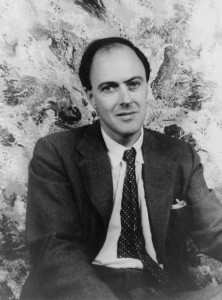
Roald Dahl in 1954
Bio
Name: Roald Dahl
Pen Name: Roald Dahl
Life: Sept. 13, 1916 – Nov. 23, 1990
Gender: male
Nationality: British (born in Wales), Norwegian descent
Occupation: novelist, short story writer, screenwriter, fighter pilot (WWII)
Genres: children’s literature, fantasy, mystery, nonfiction
Notable Works: Charlie and the Chocolate Factory, Fantastic Mr. Fox, James and the Giant Peach, Matilda
My Favorite Works: Charlie and the Chocolate Factory, Matilda, The Umbrella Man and Other Stories
Inspiration
Roald Dahl was my favorite author growing up, and with good reason. Having captivated me at the age of nine with his 1964 novel Charlie and the Chocolate Factory, he quickly drew me into his fantastic world with more children’s books like Matilda, Fantastic Mr. Fox, The Witches and several others. His unique style of storytelling was very entertaining to read, for he always seemed to know exactly how to paint a mental picture from the perspective of a child, which is much more appealing (and less patronizing) than an adult trying to describe the events of a story in a way that children will understand. Reading each of Mr. Dahl’s novels as a kid, I felt as though I were being told a story by someone who understood exactly how I saw the world, and who knew exactly what I wanted to find in the pages of a book. It may seem odd, but whenever I was reading one of his stories, I didn’t see him as just an author; I saw him almost as a friend.
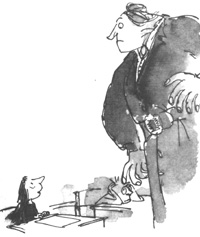
Matilda and Miss Trunchbull, Matilda
(Illustration by Quentin Blake)
Something I always loved about Dahl’s children’s books was the fact that his heroes were usually children. Charlie Bucket, Matilda Wormwood, the unnamed protagonist of The Witches (named Luke Eveshim in the 1990 film), among others, all live incredible adventures before even having reached adolescence. For the preteen me, it was wonderful to read about heroes who were my age; it made me feel like it could just as easily have been me taking a tour through a magical chocolate factory, or developing telekinetic powers, or executing brilliant plans to defeat witches or cruel headmistresses or nasty adults of any sort. That’s another interesting detail about the author’s stories: just as the heroes are often children, the villains are often adults. And honestly, could anything be more relatable to a young reader?
But Mr. Dahl’s brilliant storytelling skills were not limited to children’s fiction. He wrote a fair amount of excellent short stories for older audiences; one such compilation – The Umbrella Man and Other Stories – contains some of the most delightfully creative short pieces I’ve ever read in a book. His autobiography, Boy: Tales of Childhood, includes hilarious accounts of events that I could hardly believe were true stories (my personal favorite is the Great Mouse Plot of 1924, which romantic comedy fans may remember as the story Meg Ryan reads to the children in the bookstore in the 1998 film You’ve Got Mail), but which certainly explain the colorful stories he would go on to write later in his life. With numerous awards and tremendous merit to his name, it’s clear that Dahl was talented at entertaining readers of all ages alike.
Roald Dahl is one of my heroes. He introduced me to a magical world that I could visit anytime I wanted to escape from reality, and he was the first author ever to inspire me to pursue creative writing. His stories have touched me and will remain forever embedded in my heart, and for that, I will always admire him as one of the greatest storytellers whose work I’ve had the pleasure of reading. Thank you, Mr. Dahl, for your wonderful gift! You will never be forgotten.
by Naomi L. | June 5, 2013 | Blog, Creative Writing, Off The Bookshelf |
So I wanted to start a section of my blog focusing on sources of inspiration, that is, what inspires me as a writer and what I hope can inspire others as artists. The first idea that came to mind was a subtopic for the books I’ve read that have motivated me in my writing, sort of like a virtual bookshelf. Then I thought, what better book to start off with than the one that first inspired me to become a writer? So here is a brief review of one of my favorite books as a child: Charlie and the Chocolate Factory by Roald Dahl.
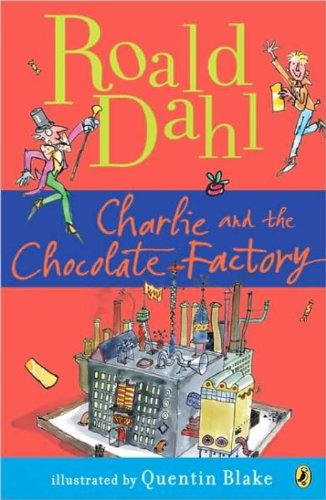
Charlie and the Chocolate Factory, by Roald Dahl
Summary
In case you haven’t yet read the book (first published in 1964) or seen either of the movie adaptations (released in 1971 and 2005), Charlie and the Chocolate Factory tells the story of Charlie Bucket, a kind and honest young boy of very humble origins who has always been intrigued by the mysterious chocolate factory located near his home, run by the legendary Willy Wonka. One day, Charlie’s wildest dreams come true when he becomes one of only five lucky children around the world to find a golden ticket inside a Wonka’s chocolate bar, constituting an invitation from the famous chocolatier himself to visit his factory for an entire day. Fantastical adventures ensue as Charlie and the others follow Mr. Wonka on a magical tour through the strange facility, at the end of which lies a special grand prize for only one very lucky child. How will things fare for our hero and the four terrible brats as they discover the wonders of Wonka’s chocolate factory? It’s the greatest adventure of young Charlie’s life, and he can’t wait to find out!
Review
I first read this book when I was nine years old, at the recommendation of my mother. Though I was no stranger to reading, it was the first book I ever read that was written by Roald Dahl, and consequently, it became the reason he was my favorite author growing up. Charlie and the Chocolate Factory fulfilled a great wish I had throughout my entire childhood: to escape into a magical world far from the realm of reality.
As I read the story, I lived vicariously through the character of Charlie Bucket, who had the amazing opportunity to step out of his ordinary life and spend a day in a land of fantasy. Today, I look at him as an excellent role model for young children: humble, honest and with a vivid imagination. Willy Wonka is a wonderfully eccentric character, likely intended as a personification of the dreamer mentality lost on many of the “normal” adults in the author’s stories; and the four children joining Charlie on his adventure have such ridiculously bratty personalities that it can only make for some hilarious scenarios during the course of the factory tour.
But it wasn’t just the story that I loved; it was the way it was told. Mr. Dahl always had a very creative style of narrating his children’s books that appealed as much to his young target audience as to the metaphorical child in each of his older readers, and Charlie and the Chocolate Factory is no exception. Every time one of the bratty golden ticket winners gets into trouble, the situation is resolved in a unique and comical way as could only come from a mind as imaginative as Dahl’s. The songs sung by the factory’s Oompa Loompa workers are not only funny, but actually teach valuable lessons, though it’s safe to assume the advantages of reading over watching television and the prominent role that parents play in raising spoiled children are already common knowledge. Even the various candies and chocolate delights described throughout the story sound so delicious and inventive, you wish you could reach into the pages and try some for yourself (except maybe the chewing gum).
Inspiration
Though I was already a longtime fan of fiction, this was the first book to make me want to write stories of my own. The joy I felt when escaping into Charlie’s world inspired me to follow Mr. Dahl’s lead and create magical adventures for others to enjoy, and for that, I will always admire him as one of my all-time favorite authors. With its wild twists, eccentric characters and endless supply of phizz-whizzing fun, Charlie and the Chocolate Factory is a great read for the imaginative child in any reader, and especially for the dreamer in every fiction writer. One could expect nothing less from the world’s most scrumdiddlyumptious storyteller!
by Naomi L. | May 29, 2013 | Blog, Creative Writing |
I fell in love with creative writing when I was in the fourth grade, after spending many childhood years reading books and discovering the fun of narrative composition assignments in school. At the age of ten, I decided that writing was something I wanted to do for the rest of my life, and publishing a book was one of those goals I absolutely had to accomplish at least once before I died. Eager to get a headstart on my career as an author, I wasted no time in writing my first novel. As it turned out, however, being a preteen writer came with a major disadvantage: a severe lack of experience.
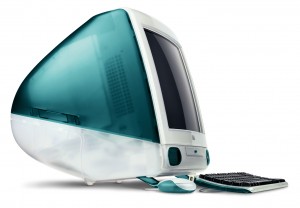
The vintage typewriter of my life: this is the classic iMac on which my very first novel was written.
The final product of my labor was a relatively short tale about a child’s adventure through a dream world, creating imaginary friends along the way to aid her on her quest to develop what she had been missing for years: an active imagination. Though I believed the idea to be a good one, I realized a few years after finishing the story that the execution was subpar due to various mistakes that I hadn’t recognized when I was ten. Of course, I don’t want to bore you with the details of every single one, so instead, here’s a list of five of the most important aspects of fiction writing that I wish I had known when I was working on my first book.
1) Good books don’t get written in a day.
Unless you’re an extremely focused hermit locked in a room with nothing but a desk and a typewriter (or you’re the Flash), you’re not turning out a bestselling novel in less than 24 hours. Now, I didn’t literally expect to write a whole book in one day, but given that the basic outline of a plot was already clear in my mind when I started, I also didn’t expect it to take longer than a week to finish. Instead, I probably spent the equivalent of at least a month’s worth of writing before I finally completed my novel. By creating such unrealistic expectations, I was setting myself up for the disappointment that inevitably hit me after the first week of writing came and went. And disappointment is not an emotion that ten-year-olds are usually prepared to handle well…
It’s worth mentioning, however, that I probably still could have finished my story in less time than it actually took me. So why didn’t I? Because there was one piece of advice I didn’t take into account before I started…
2) Planning is important.
I made the rookie mistake of thinking that a single idea was all I needed before I actually started writing a novel. I thought that as long as I could keep that one idea clear in my head, inspiration would take over and I’d have a full manuscript ready before I knew it. Unfortunately, as I quickly discovered, novels don’t quite work that way. There were several instances during the writing process when I had to stop and even retrace my steps because I wasn’t entirely sure how to move the action forward, or how to fill a gap between two scenes that I already knew were going to happen. I’m not saying I should have spent a year only planning without actually writing anything, but had I taken just a little more time to map out the full course of my story before I dove headfirst into the narrative, I could have saved myself a lot of confusion and tedious rewrites in the long run.
3) Compelling characters are those who are flawed.
During the course of my story, my protagonist created three imaginary friends, each of whom was some sort of fantasy creature with magical abilities of incredible power. Ironically, the only imperfection in each of these characters was the fact that they were perfect. They were all beautiful, intelligent, strong, courageous, and downright wonderful in every way conceivable. In retrospect, they were probably the personifications of the qualities I subconsciously wished or wanted to believe I had myself, with none of the drawbacks.
But there was a major problem with this: my characters were not relatable. Perfection was fine for my own daydreams, but nobody wants to read about impossibly powerful heroes who can save the day without so much as breaking a sweat (outside of comic books, that is). Readers want heroes who make mistakes, who fight for their goals with everything they’ve got and emerge triumphant after struggles that only made them stronger in the end. In other words, readers want to potentially see themselves in their heroes. And my characters didn’t fulfill that purpose. By designing them to be impossibly perfect, I had inadvertently made them every writer’s worst nightmare: boring.
4) Bad things must happen to good people.
Yes, I was one of those idealistic children raised on fairy tales, who believed that good always triumphed over evil, and the heroes should always defeat the villains in every battle, with no exceptions. This was reflected in the climax of my novel: when I finally introduced actual antagonists near the end of the story (another mistake, mind you), a series of fights ensued in which my main characters would always beat the bad guys every time they tried to attack. In the end, the villains were completely defeated, while the heroes were left without even a scratch. As you can imagine, that was a pretty boring scene.
This was probably the biggest flaw of my story: I had failed to create suspense. With every single attack of every single fight ending in the heroes’ favor, the scene that should have been the most exciting part of my novel became too predictable and bland. If, however, I had thrown a few twists into the mix, such as having one of my protagonists suffer a terrible injury that put her at the villains’ mercy, I could have set the scene up for a much more engaging and satisfying conclusion. In short, if anyone was going to care about whether my good guys would win the war, there had to be at least a chance that the bad guys might win a few battles first.
5) Your first book is going to stink… no matter what.
OK, maybe this isn’t true for all writers, but it’s likely true for most (if you’re one of the exceptions, I salute you). Sometimes I think that even if I had known everything else about planning and character development and conflict, my first novel still would have turned out mediocre at best. I was, after all, only ten years old; how well could I really have written a story reflecting important values of life if I had barely even started living mine? But even if I had started my first book in my twenties, I’m sure it still wouldn’t have amounted to a great classic of literature, because to know what to do in order to turn out a brilliant piece of fiction, I first would have had to know what not to do, and there’s only one truly effective way to learn that lesson…
I have absolutely no regrets about my first attempt at writing a novel. Although it was rather lame, I still love it for everything it’s taught me about fiction writing, and the fact that I was able to start gaining this experience at such a young age makes me all the more optimistic about my future as a writer. Today, I’m proud to say that I am once again working on a novel, this time with naturally flawed characters and a storyline filled with due drama and suspense, all planned out well in advance. From here on, there’s only room for improvement.
So what about you? If you’re a writer, have you been through a similar experience? What did you learn from your first mistakes in fiction writing?
by Naomi L. | May 22, 2013 | Blog, Creative Writing |
No, I don’t actually believe in such a concept as “too much love”. If anything, the world could always use more love. But I’m not talking about world issues right now; I’m talking about romantic fiction.
Today’s topic is about the dangers of overusing the phrase “I love you” when writing romance. Now you might be wondering what exactly gives me the credibility to write about such a topic, and the answer is… not very much, except for my own amateur experience writing cheesy romance as a teenager and reading it again years later as an adult. So I’m just gonna talk about that.
 When I was 16, I was a hopeless romantic. Now that I’m in my twenties… I’m still a hopeless romantic, but with a little more wisdom. As I’ve mentioned before, I spent part of my teen years writing medieval fantasy stories, among which was a star-crossed love story between a paladin (light-magic knight) and a necromancer (dark-magic sorceress). This story, so I had hoped, would someday develop into my first published novel. I was rather proud of it at the time I was working on it, even going as far as to share an excerpt of a particularly romantic chapter with friends. However, because my studies were highest on my list of priorities, the story was never finished, instead sitting in my computer as an incomplete novella collecting metaphorical dust over the course of a few years. It was after I started college that I finally rediscovered the piece among my archives, and after rereading my work with a fresh perspective, I finally began to take notice of some elements in the narrative that were – to my disappointment as a perfectionist but my delight as a neophyte at writing – dangerously clichéd.
Now, I won’t be going into excruciating detail about what made my unfinished story trite; I wouldn’t want to bore you with what could easily be thousands of words’ worth of self-criticism. Instead, I want to cover the main cliché in my work that jumped out at me the most: the aforementioned overuse of the phrase “I love you”. At the end of every romantic scene between the main characters, I would have them finish their conversation with those three words before they parted ways. It made sense to me that those should always be the last words they’d hear each other say until the next time they met. So what was wrong with that?
What I didn’t yet realize at the naïve age of 16 was that by having my characters actually say the words “I love you”, contrary to my intentions, I was creating less-than-believable dialogue. I was writing based on an instinct I’ve had my entire life: to always make sure these are among the last words I say to my loved ones before we leave each other’s company. Although this was perfectly normal for me (or perhaps because it was), it took me a while to realize that such a practice is not universally routine. Not everyone is accustomed to speaking the phrase several times in a single day; for many, it’s often just implied, if even that.
This, I realize now, is what I should have made clear with my characters. The love between them should have been implied, without the need for constant spoken confessions. By having them end every conversation with “I love you”, I was inadvertently detracting from the emotion that should have already been established outside of the dialogue: the way they looked at each other, the subtle gestures they exchanged, the littlest details of every kiss. This surely would have made their romantic moments much more believable, and more importantly, it likely would have made the moments that I did have them confess their love verbally all the more powerful. And isn’t that really the ultimate goal of writing romance in the first place?
Though I never did finish this particular love story, I don’t consider a single second spent writing it a waste of time. Leaving it untouched for a while helped me to see it again with the slightly wiser mindset of a young adult, and recognizing my own mistakes taught me about a part of my growth as a writer and a person that I might not have come to notice otherwise. But you don’t need to care about how this subject has affected me; what’s important for you to take away from this topic is a new awareness of how to recognize believable dialogue in romantic scenarios, especially if you plan on writing some yourself.
So if you appreciate romance as much as I do, please feel free to take my advice and learn from my mistakes (or even yours, if you’ve been through a similar experience). In short, writers should take care not to abuse the words “I love you”; if you wouldn’t do so yourself in your real life, you shouldn’t have your characters do so in your fictional works. “I love you” is a beautiful and magical phrase, but it can only remain so as long as it’s handled with the respect it deserves. Please write wisely; true romance enthusiasts everywhere thank you.
by Naomi L. | May 15, 2013 | Blog, Creative Writing, Tropes |
Do you ever find yourself reading a book or watching a movie and noticing certain elements in the story that you’re sure you’ve seen before in the plots of other works of fiction? Or better still, do you ever find yourself talking about stories from these media and mentioning said elements in the form of a question that starts with, “You know that thing where…”?
Chances are there’s a trope for that.
What is a trope, you ask? Well, it’s not entirely easy to explain, as the definitions may vary slightly based on opinion. The simple definition is that tropes in fiction are devices that have become common enough throughout their respective media to have established themselves as conventions in the minds of the audience, and thus are reliable to writers as useful tools in creating fiction. A slightly more complex definition expands on this simpler one to also include examples of such conventions in real life, as in behind the scenes or even real-world events. Of course, a much more thorough explanation can be found on the website’s homepage itself, so instead of launching into a long and tedious description of TV Tropes and its endless supply of examples, I’ll simply provide a brief account of my own experience with the site and leave the option of following the link provided to your own discretion.

Follow the link in this logo at your own risk.
One of my first visits to this site was when I was looking up information about a certain Disney movie (I want to say it was Tangled, but my memory fails me). What I found was an abundance of tropes used throughout the film that could be easily recognized as conventions present in the plots of other stories (Character Development, Non-Human Sidekick, Happily Ever After, etc.). I was so intrigued by this new resource I had discovered that it wasn’t long before I started referring to it for examples of tropes in other fiction works – films, TV series, literature – learning more about these devices with each page I opened.
So why would I say this site will ruin your life? Because there’s a very good chance that at least once (and probably on your first visit), you’ll fall into the same trap I did: the web of tropes. On virtually every TV Tropes page, there will be a link that catches your eye, leading you to another page with more interesting information and new links, which in turn lead you to other pages with their own intriguing links… until the next thing you know, it’s an hour later and you can’t remember which page you originally meant to read without checking your browser tabs or history for a reminder. How did that happen?
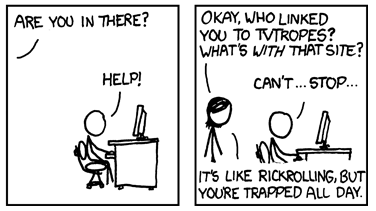
In case you need a visual aid, my experience with TV Tropes (and that of countless others) can be summed up in this webcomic. (Courtesy of xkcd)
Here’s an example of one of my typical TV Tropes sessions: I start by opening the page of a classic Disney film, let’s say Beauty and the Beast. One of the listed tropes is the famous True Love’s Kiss, complete with a brief explanation of how the instance in this particular movie is more of a variation than a straight example, which sparks my curiosity to read about other examples in different works. A moment later, I’m reading this trope’s description on its own page when… Wait, what in the world is a Dead Unicorn Trope? Obviously I go to that page to find out, only to realize in two seconds that I’ll first need to know what a Dead Horse Trope is in order to understand the unicorn variation, but this one interestingly turns out to be a common cause of a phenomenon known as Seinfeld is Unfunny… Several pot holes later, I’m back at the True Love’s Kiss page reading about how it’s a subcategory of a greater trope known as the Magic Kiss, leading me into another chain of links through the site. After another half hour, I go back to reading the list of tropes in Beauty and the Beast, where I soon find another trope that intrigues me, and the whole thing starts all over again.
But you know what? I love every minute of it, because even if I know TV Tropes will ruin my life on one hand, in a way, it also enhances my life on the other.
TV Tropes is an excellent resource for anyone who appreciates works of fiction, and especially for writers of such works. Learning about the various devices used in media and how they function in their respective plots teaches us how to analyze fiction critically, allowing us to develop a keener understanding of the elements that make up a story. This is particularly important for writers, because we more than anyone else should have as thorough a knowledge as possible in the workings of the stories we wish to create. How can we expect to write good fiction if we don’t have a decent understanding of the myriad of tools at our disposal?
So yes, by pulling you into its vortex of interesting content, TV Tropes may easily ruin your life. But in the end, if you somehow emerge with a refined outlook and even a new respect for the fiction you already love, then wouldn’t you really just be exchanging it for a better life?



Recent Comments