by Naomi L. | May 8, 2013 | Blog, Creative Writing |
A college professor started his class one day by handing back the assignment his students had turned in a couple of weeks prior, now complete with his corrections. After returning the essays to their respective writers, he then made his way to the front board and proceeded to address the entire class.
“I hoped I wouldn’t have to do this…” he said disappointedly, and he turned to the board to write a single word-letter pair on it:
You/U
The professor turned back to the class and explained that the correct way to write the word “you” in a paper is Y-O-U, never just the letter U, as he had noticed in some of the essays now sitting on his students’ desks decorated with red ink. He then took the time to write a few more sets of words on the board:
Your/You’re
Their/There/They’re
To/Too/Two
Once again, the professor explained to the class the proper use of the words he had just written. The students nodded along as though they knew all this already, but the red ink lining their essays told a different story. If they really knew how to use these words correctly, why would they write about how “you are appreciation for music”, or how “their is an exponentially growing number of bands today in comparison to the past decades”, as if the verb in that phrase belonged to somebody? His explanation finished, the professor returned to his desk to start the day’s lesson, clearly deeply saddened yet again by the increasing decay of the once beautiful structure of the English language.
I wish I could say I fabricated this entire story. I really do wish it were a product of my own imagination, to make up such a scene as college students tossing incorrect grammar around their essays as haphazardly as a child sprinkling sugar over their breakfast cereal. Unfortunately, I regret to say that this story really happened. Well, the basic event, anyway; I took the creative liberties of a writer who wasn’t actually there to fill in a few blanks. This story was recounted to me by my best friend, who had a (metaphorical) front row seat to the rebuking of his classmates for “butchering the English language”.
To be honest, I wasn’t surprised to hear about the homonym-related spelling mistakes. That’s a common problem that I’ve been seeing since I was in grade school, and though I’d be lying if I said it didn’t bother me, I can’t be too fanatic about fixing it either, so I won’t even focus on that. We all make mistakes; even I’ve caught a fair share of “your’s” in my writing that should have been “you’re” (I certainly wasn’t trying to state that the “welcome” belonged to the person with whom I was chatting). What did shock me was learning that the students in the above story had been trying to pass off the letter U as a word all by itself… in a college essay. I’ve known for a while that traditional grammar is on a decline, but I had no idea it had gotten this bad, at least not yet…
A Bad Influence?
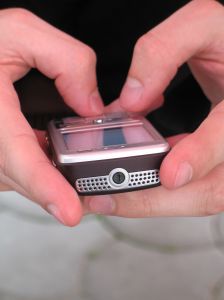 Let me take this moment to say that I am not a so-called “grammar nazi”. I don’t prowl around message boards and comment threads pointing out the technical mistakes in people’s writing that don’t even detract from the content of their posts. I get that there’s a whole other written language for the Internet, the so-called “textese” consisting of abbreviated words and a bare minimum of capital letters that people are trained to understand through extensive use of chat programs and SMS, and that’s fine. The problem is when this language spills over into the “real world”. Abbreviations like “U”, “plz” and “thx” don’t belong outside of text messages and chat conversations, and they especially don’t belong in college assignments.
Now I beg your pardon while I get this one rant out of my system: U is not a word! Not counting official abbreviations, the only real single-letter words in English are A (article) and I (pronoun). When writing in the second person, the correct spelling is Y-O-U. “You should know that U is the 21st letter of the alphabet, and should be treated as such.” That’s the proper way to write. So please, leave your U’s and plzes and thxes online and in your cell phones where they belong, and make an effort to write correctly everywhere else. The English language thanks you.
OK, now that that’s out of the way, time to end on a lighter note…
Don’t Worry, Your Phone is Still Your Friend
Atrocious effects on formal writing aside, did you know that texting actually has its benefits too? I’m not talking about the obvious convenience of sending a message to friends in a second’s notice, but about the ways texting helps to exercise the mind. I know; I was surprised when I first heard this too. But that can’t be right… can it?
- Brevity = brilliance. Means of communication like SMS often come with a character limit, which means long messages need to be written as concisely as possible while still being comprehensible, and that usually takes some clever thinking.
- Breeding a new generation of writers. Texting gives young people more motivation to write; most teenagers today probably wouldn’t bother writing at all without the stimulation of conversation provided by email and texting.
- A different form of spelling practice. Most surprisingly, the practice of abbreviating common words has actually been shown to improve students’ literacy and spelling!
So clearly, chat speak is not as bad as it’s made out to be by many advocates for the English language today. Who knew?
Why am I mentioning this? Partly as a curiosity, but mostly so any major fans of texting reading this won’t think I’m an ignorant monster for bashing one of their favorite pastimes. I just want to clarify that I’m not attacking texting itself; I’m simply defending the practice of organizing different forms of spelling into their appropriate media. In short, U is an understandable and sometimes acceptable abbreviation, but it is not a word. Write wisely!
Oh, and one last thing: no matter how beneficial texting may be for your mind, never text and drive! Just thought I’d point out what should be common sense…
Thanks for reading! And remember: always treat language with respect. Happy writing!
by Naomi L. | May 1, 2013 | Blog, Creative Writing, Featured, Writer's Toolkit |
Every writer who is serious about their craft needs to have a well-stocked writing toolkit at their disposal. Of course, the exact tools may vary among the different artists who choose to use them: a poet may use only small notebooks for jotting down his thoughts, while a short story writer may also choose to keep index cards for organizing her ideas, while a novelist may have a whole bulletin board (or even a room full of them) for keeping track of elaborate plots. Some tools can be seen as universal necessities to all creative writers (such as journals and the aforementioned notebooks), and others seem to be more of a personal preference (such as index cards and exercise books).
In the interest of exploring this array of choices, I’ll be telling about my experience with the instruments in my own writer’s toolkit, starting with a fantastic book of fiction exercises that has proven to be a valuable asset to me: What If? Writing Exercises for Fiction Writers, by Anne Bernays and Pamela Painter.
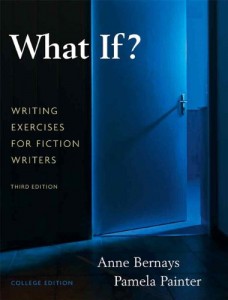
What If? Writing Exercises for Fiction Writers, by Anne Bernays and Pamela Painter
About the Book
I bought this book for the online creative writing class I took through UC Berkeley back in 2011. The copy I own is the third edition, also called the college edition, which was released in 2009. It holds 109 exercises covering 13 different topics, plus 11 short short stories and 14 short stories provided at the end of the book. Also included with every exercise description is an explanation of the objective behind it, as well as the occasional example courtesy of the authors’ students.
The topics (or parts) covered in the book are:
- Beginnings;
- Characterization;
- Point of View, Perspective, Distance;
- Dialogue;
- The Interior Landscape of Your Characters;
- Plot;
- The Elements of Style;
- A Writer’s Toolbox;
- Invention and a Bit of Inspiration;
- Revision: Rewriting is Writing;
- Sudden, Flash, Micro, Nano: Writing the Short Short Story;
- Learning from the Greats; and
- Notebooks, Journals, and Memory.
So what can I tell you about the book? Here are a few key points I’ve learned from my experience.
Pros
The diversity of topics in the book allows you to “custom improve” your writing in the areas you feel need the most work. The explanations are easy to understand, and the student examples are excellent models of the techniques taught through the exercises. For a truly well-rounded experience, a friendly introduction by Bernays and Painter encourages all readers to explore the potential of their writer’s voice and explains the separate definitions of writing like a writer and thinking like one, while the last two sections provide 25 excellent stories to better illustrate the points made throughout the book. Needless to say (oops, Exercise 51: “Word Packages are Not Gifts”),What If? covers a wide enough spread to make it an excellent resource for any fiction writer, as much for the beginner in need of good practice as for the seasoned writer looking to rekindle the fire of inspiration.
But nothing is perfect, right? Now for the downsides…
Cons
The main obvious drawback about using What If? is that it practically requires sharing of completed exercises and subsequent receiving of critique in order for its readers to get the full intended benefits of the book, making it a more popular choice for creative writing workshops and courses as opposed to individual study. Aside from this, readers might find a couple of topics to be lacking in sufficient exercises (Part Seven, for instance, only contains four), which might put off those hoping for a more diverse selection within a certain module. Also, not every written exercise comes with an example, leaving it solely up to the practicing writer to determine the intended approach to the exercise. This is fine for the more independent readers, but for those often looking for extra guidance (like me), it might prove to be a bit of a disappointment.
Still, I honestly don’t think these minor cons do much to outweigh the stronger pros. Yes, What If? is not without its flaws, but overall, I feel it’s a worthwhile read that warrants a place on any writer’s bookshelf.
Summary
Pros
- Wide diversity of topics (13 total)
- Exercise descriptions that are easy to understand
- Excellent student examples
- Friendly and comprehensive introduction
- 25 short stories
Cons
- Requires feedback for full experience
- Limited selection of exercises in some topics
- Lack of examples in some exercises
Conclusion
Why have I chosen to open my Writer’s Toolkit posts with this book? It wasn’t a matter of random choice, but rather one of relevance to my own writing. Many of the pieces I’ve written (and others which I’m currently writing) blossomed from the exercises contained in this book, and because of the enlightenment and fun I’ve had with them so far, as well as my need for critique from other writers, I decided to make a habit of sharing some of my own examples of attempts to complete them.
So whenever a certain piece I share in the future has been inspired by a What If? exercise, I’ll be sure to provide a brief explanation of that exercise for easier reference. However, if you’re a writer and you don’t have this book, I highly recommend that if you have the time (and the funds), you grab yourself a copy of What If? as soon as you can! You won’t be disappointed.
There you have it: the top creative writing book on my shelf, and one of the most useful resources in my writer’s toolkit. I hope you’ll enjoy the pieces I produce from these exercises, and I also invite you as aspiring writers to try them out for yourselves. In fact, if you have writing blogs of your own, by all means, please share links to your own pieces in the comment sections. I would love to read them! In the meantime, please feel free to offer your feedback on my work; I look forward to receiving constructive opinions that would help me to further improve my writing.
Thanks for reading! Happy writing!
by Naomi L. | April 24, 2013 | Blog |
OK, so I’ve already talked about how I started writing and what sort of writing I’ve done in the past. Now, looking back on those topics, I realize there’s one more subject that went only partially mentioned and which I feel deserves a post of its own: the question of why I write in the first place. So just for fun, I’m going to complete my introduction with a brief summary outlining the main reasons I choose to pursue creative writing. In truth, this could probably be considered a generic list for art in any form, so if you’re an artist, maybe you’ll have fun identifying with some (or even all) of the items mentioned below. And if you aren’t, I hope you’ll still have fun catching a glimpse into the mind of someone who is.
So without further ado, here are the reasons I love to write:
1) Writing makes me happy.
This is easily the simplest and most important reason I can come up with to explain why I write. In fact, I don’t even need another reason; every other item on this list connects back to this one. I enjoy writing. If I didn’t, I wouldn’t do it. Doesn’t get much simpler than that, right?
2) It’s a great way to express myself.
Here’s a fun fact about me: I’m extremely shy. Back in school, I could barely bring myself to make eye contact with people, let alone talk to them. I’ve gotten much better at socializing since then, but shyness has still been my main defense mechanism for as long as I can remember; to protect myself from judgment, I avoid conversation with people whenever I can help it. But that doesn’t mean I don’t like to be heard. Writing is my preferred means of communication for various reasons: I don’t have to speak directly to anyone; I have time to organize my ideas before sharing them with others; and I usually don’t have to deal with live conversation when receiving feedback, something I absolutely dread. I feel safe when I write, and that gives me more freedom to be myself.
3) It’s my artistic release.
This one is really more of an extension of the previous item. The only real difference is that as a form of expression, writing is an outlet on a more intellectual level, while as an artistic release, it liberates a deeper energy in me that can’t quite be defined in words (at least as far as I’ve ever been able to tell). It’s the kind of energy that I imagine drives anyone who can call themselves an artist. We create not just because we want to, but almost because we have to, because something deep inside us tells us we should. We can’t rest until our hunger to create is quelled, and even when it is, it doesn’t take long for it to return, sometimes even stronger than before. Or maybe that’s just me.
4) It’s something I can do on my own.
I’m an introvert, which means I draw my energy from the time I take for myself. This makes writing a perfect hobby for me, as it relies heavily on the ideas born from the time I spend alone with my thoughts. Not to mention, one of my favorite solo activities is daydreaming; at least as a writer, I can pass the habit off as a productive pastime, as opposed to just a waste of time.
5) It’s a means of escape from reality.
While the first item on this list may be the most important reason I write, this one is by far the most fun. Let’s face it: to us fiction writers, the world is much more interesting inside our heads. Not that my life is depressing or uninteresting in any way; I just think it’s nice to take regular breaks from the minutia of the real world and let imagination take the wheel for a while. I’ve always felt this way, ever since I was a kid; that’s why I spent so much of my childhood reading books. They transported me to faraway lands full of magic and mystery, and the best part was that I never even had to leave the comfort of my room. The advantage of taking up fiction writing is that this time, I’m in control of the stories and the places they take me. I have free rein to go wherever I want whenever I want, and to me, that’s one of the most liberating feelings in the world.
6) It’s a way to inspire people.
Here’s where I finally start to deviate a little from the more selfish aspects of writing. We all want to leave our mark in this world, be it big or small (though I’m sure most would prefer the former). So how do we do that? Simple: we reach out to people. As a social species, the entire premise of our existence is based on interaction with others of our kind. One could even go as far as to say that this is a fundamental part of the meaning of life (if one subscribes to such a notion, of course). Think about it: without having made a difference in any other person’s life, can we really say that we ever truly existed? This is my motivation for writing: if my words can make a significant difference in just one person’s life, I will have succeeded in leaving my mark. I will have truly existed.
What about you? Are you a writer or an artist of any kind? Why do you enjoy your art? How many of the items on this list apply to you? Can you think of any more you would add to your own list?
by Naomi L. | April 17, 2013 | Blog |
In a previous topic, I told the story of how I got started in the world of creative writing. In the interest of constructing a more detailed description of myself, I would now like to follow up on that subject to talk about the sort of writing I’ve done in the past, such as the types of pieces I’ve created and the genres of writing on which I’ve been focusing. Let me tell you, it’s been quite an interesting journey of self-discovery…
Ancient History
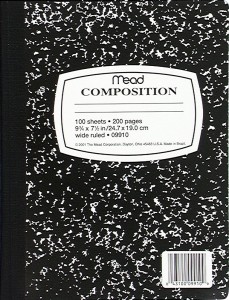
The composition notebook from my elementary school days
As I mentioned in the last post, the first stories I can remember writing were the narrative assignments given out in elementary school. These came with all sorts of different prompts: the world from the point of view of a shoe, an adventure in the rainforest from the perspective of one of its resident animals, an extraterrestrial telling about his visit to Earth. I greatly enjoyed these exercises, and I was even praised by my teachers on several occasions for my creativity. Pretty soon, I found myself looking forward to Composition class as that brief time when I was actually allowed to get lost in my own imagination during school hours. Unfortunately, it turns out I needed much more time than was provided in class to actually finish the stories I started, as many of my narrative assignments weren’t completed on the same day they were given. Maybe I had too many ideas, or maybe I was just a slow writer, but either way, I had much to learn about creating a full piece within a time limit. Still, I had plenty of fun with these prompts, and they certainly inspired me to continue writing outside of school, which led to the next phase in the honing of my craft…
My parents bought a computer for us just before I reached my preteen years. While I don’t recall very much about the first time I actually started using it, I do remember that I was using the word processor software long before I even had a decent grasp of the basics of surfing the Internet. I wanted to create stories, but without the pre-made prompts handed out in English class, I found myself faced with a new challenge: coming up with original ideas.
Because another major interest of mine at the time was video games, I decided I would start off with some short stories centered around a cast of Yoshi characters, somewhat like a spin-off series from Nintendo’s Mario franchise. Though I didn’t know it yet, this was my first shot at a type of creative writing that I would eventually grow to love: fanfiction. Somehow this sort of writing came easily to me; I went on to turn out numerous stories starring several different Yoshi characters, a few more based on the Pokemon franchise, and even a short piece or two based on J.K. Rowling‘s Harry Potter series. Of course, I never actually shared any of these stories, neither online nor with my family. At the time, I was content just to be able to get the many ideas in my head out into a visible medium. They were just for me.
So why did I like writing fanfiction so much? Perhaps it was the convenience of “plug-in” settings and background profiles that appealed to me most; as a preteen with a limited attention span, I wasn’t always willing to go through the often arduous task of creating completely original details for my works. That isn’t to say I never did so; in fact, my first attempt at writing a novel was when I was only ten years old, and though the end result was pretty lame even by my own amateur standards, I was still proud of myself for having created a lengthy piece of original fiction. The trick now was to take the writing skills I’d been told I did have and learn to perfect whatever else was lacking so that one day, I might turn out a novel that would actually be worth reading. But that would be a challenge for much later in my life.
The Dark Ages
Major life changes in my early adolescence prompted me to stop writing as a hobby for some years. The beginnings of novels I had written as a kid sat untouched and incomplete in our classic iMac right up to its last days. Meanwhile, my interest in books persisted through the years; I read many novels as a teenager, most of which were fantasy-themed. Among my favorites were the Harry Potter books and Marion Zimmer Bradley’s The Mists of Avalon saga. But reading wasn’t the only interest of mine to last beyond my childhood…
Another major hobby of mine growing up was gaming. I played many computer and video games through my teen years, and it didn’t take me long to decide which genre was my favorite: the role-playing game (or RPG). My addiction to these games coupled with my love for medieval-themed stories eventually led me to discover the traditional tabletop RPG Dungeons & Dragons, and though I never actually played a real session, I did absorb myself so deeply in learning the structure and details of the game that I soon became inspired to create stories around it even without the help of other players.
At last, I was writing stories again, this time with a medieval fantasy theme. Among these were a series of short pieces about the adventures of four friends in the world of D&D, as well as an incomplete novella depicting a star-crossed love story between a paladin and a necromantress (which in retrospect was rather clichéd and melodramatic; in fact, I actually plan to use it as a reference in future topics for examples of what not to do when writing). While this collection didn’t yet reflect the peak of my potential as a writer, it did serve as a stepping stone back into my old passion for creative writing, and that alone made it worth all the effort I put into it.
Renaissance
The RPG phase of my writing passed right at the point in my life when I was graduating from high school and entering my freshman year of college. Interestingly enough, my chosen major was not in creative writing (as most of my family probably expected), but in my other passion: biology! For years, while I was studying to become a scientist, I continued to pursue writing as a hobby, turning out several short stories based on my interests in my spare time. But creating for myself wasn’t enough for me anymore; I wanted to take my craft to the next level. If I was going to follow my childhood dream, I needed outside help to learn how to improve my craft. Fortunately, my dad had the perfect recommendation.
In 2011, I enrolled in a six-month online creative writing course through UC Berkeley Extension: “Exploring Your Creative Writing Potential”. In this class, I learned about several different forms of writing – from poetry and short short stories to scripts and novels – and I experimented by creating a piece for every single module. Throughout my experience in the course, I came to discover a lot about myself and my potential as a writer: my strengths and weaknesses, which formats I enjoyed the most, techniques I didn’t yet know I could handle, etc. As far as I’ve determined, I love novels and short stories, I show promise with short short stories and (to my great surprise) book reviews, and I struggle most with first-person essays. Basically, my true creative potential lies in fiction writing.
Modern Age
And now? Well, you’re looking at it. After years of writing creatively for fun, I’m finally ready to start taking my craft more seriously, and this blog is the next step in the pursuit of my childhood dream. As an aspiring writer, I plan to combine my passion for creative writing with my knowledge in biology to create science fiction and fantasy novels, though I’d also like to turn out shorter pieces of assorted genres while those books remain in the works. In the meantime, writing regularly for a blog seems like a great way for me to keep up the practice and continue to learn everything I can about creative writing. But even if it weren’t, I’m still having fun, and in the end, that’s all that really matters.
That’s the history of my writing: what I’ve written and what I hope to write in the future. Now how about you? What sort of writing/creating have you done in the past, and what do you create (or hope to create) now?
by Naomi L. | April 10, 2013 | Blog |
“A journey of a thousand miles begins with a single step.”
– Lao Tzu (604 BC – 531 BC), The Way of Lao Tzu
OK, I went with a cheesy quote to start off my introductory posts. So sue me. I know it’s a little lame, but hey, at least it’s true, and it certainly applies here.
Every journey has to begin somewhere, right? Mine as a creative writer started in my childhood, though the exact moment is difficult to pinpoint. I guess it depends on how one would define the real beginning of the journey: if it was the time I first started reading, it would be before my preschool days; if it was when I read the first book that inspired me to create stories of my own, it would be when I was about nine years old; if it was the first time I actually took a shot at writing a short story, it was sometime in my elementary school years. All I know for sure is that the moment I decided I wanted to be a writer, I knew I was making a choice that I was going to stick to for the rest of my life. So far, so good.
According to my parents, I started reading at a time when I was still sleeping in a crib. Most children my age were put to bed with toys; I was put to bed with books. Of course, it didn’t take my parents long to discover that I was mostly using them as a staircase to escape the crib, but that’s not the point. What’s important is that I was exposed to literature at a very early age, and for that, I will always be grateful to my mom and dad. Many of my childhood memories are filled with the stories I used to read in the countless books I collected over the years. My parents had always told me that anything I wanted from the toy store had to be earned first… except for books, which they would always buy for me the moment I asked. Because of this, there is a huge selection of books on which I can look back with fondness. But there is one in particular that holds a special place in my heart as the story that first sparked my desire to become a writer myself: Roald Dahl‘s magnificent and highly-acclaimed children’s novel, Charlie and the Chocolate Factory.
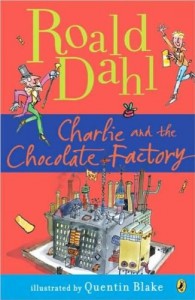
Charlie and the Chocolate Factory, by Roald Dahl
When I was nine years old, my mother came to me with a book recommendation. “I read this when I was a kid”, she told me as she handed me a paperback copy of Charlie and the Chocolate Factory. “I think you’ll love it too.” So I read it, and sure enough, I soon found that – like many of the things my mom says – she was right. I fell in love with the author’s wonderfully imaginative world, filled with intriguing characters and wild adventures that kept me hooked until the very last page (he wasn’t known as the world’s most scrumdiddlyumptious storyteller for nothing). When I reached the end and finally managed to put the book down, I realized that in a way, I had been left in the same state as after finishing one of my mother’s home-cooked meals: satisfied, yet disappointed that it was over. I wanted more.
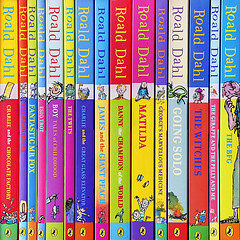
So the following Christmas, I received a whole collection of children’s literature by Roald Dahl, from short books like Fantastic Mr. Fox to longer novels like Matilda. To my immense delight, every story I read pulled me deeper into the world of fantasy and imagination in which I’d been longing to live for years, and still I wanted to explore even further. Soon, I was losing myself in other fantasy stories, such as J.K. Rowling‘s Harry Potter books (which, I’m proud to say, are from my generation) and Eoin Colfer‘s Artemis Fowl series.
And then I realized: maybe I didn’t always have to rely so heavily on someone else’s stories to take me to that world. Maybe I could get there myself, by telling my own stories. Yes, I thought, that’s exactly what I’m going to do: I’m going to make up stories and put them in books so I can share them with the whole world! I’m going to be a writer.
With my heart set on that goal, I started writing my first stories as narrative assignments during composition class in school. Of course, to say I wrote stories may be a bit of an overstatement, since I never actually finished most of them due to lack of time. Clearly I still had a lot to learn about brevity in writing… That’s probably why I soon took to writing stories on the computer instead; now I had all the time in the world to be as creative as I wanted. Trouble was… I couldn’t really finish the novels I started there, either. That was possibly my first lesson in the concept of planning before writing… but more on that subject another time. The point is, my early preteen years were when I first started seriously considering creative writing as a possible career path, and for that, they may well have been the most defining years of my entire life.
 So now what? Clearly, my journey hasn’t ended yet. But I’ll spare you the obvious “it’s only beginning” line, not just because it’s terribly cliché, but because it isn’t even true. I’ve been writing fiction for years (what, exactly, is a subject for next week), long before the blogosphere even emerged as an array of outlets for creativity and individuality, and much less as a potential source of income. No, my journey is not just beginning here, nor do I expect it to end here; this blog is actually one of those more common but lesser known “intermediate stages”, somewhat like the train stations between Point A and Point B that are never mentioned unless something happened at them that’s important to the traveller’s story as a whole. Hopefully this will be an important point in my story, but only time will tell. Of at least one thing I’m certain: with countless hours already invested in my craft, I won’t be giving up on my dream of becoming a successful writer any time soon.
So that’s my story, or at least the first part. But enough about me for now. So what about you? Are you an aspiring writer too, or any other type of artist? How did your journey begin?





Recent Comments