by Naomi L. | July 27, 2015 | Blog, Word of the Week |
Word: sardonic
Pronunciation: sahr-DAH-nik
Part of Speech: adjective
Definition: grimly mocking or cynical
Source: Oxford Dictionaries
In this ever-growing world of cynicism and acerbic commentary, one can never know too many words for dark humor. I’m sure we all know someone whose sense of humor is somewhat bitter or sharp, so this week’s vocabulary entry is for those of you who need a word to define the behavior of those scornful jokers in your life and in your fiction. Enjoy!
A “sardonic” act is one that is cynical or mocking in a grim way. The word arose in the mid 17th century and comes from the French adjective sardonique, which in turn can be traced back to the Greek adjective sardónios, meaning “of Sardinia”. This adjective is an alteration of the adjective sardánios, a word Homer used to describe laughter as “bitter or scornful”.
There isn’t much I can say about the word “sardonic”, except that I definitely know a few people who fit the description. With all the witty people in my family, I’ve been on the receiving end of quite a few “sardonic” actions, and I’d be lying if I said I hadn’t at least considered doing some of them myself. Cynicism is a common part of life, and while I wouldn’t recommend pursuing it as a lifestyle, I will admit that it helps makes fiction interesting and relatable. If your characters tend to be cynical or bitter in their sense of humor, feel free to add some “sardonic” acts or comments to your stories! Have fun!
What are your thoughts on this word? Any suggestions for future “Word of the Week” featured words?
by Naomi L. | July 22, 2015 | Blog, Creative Writing |
English is a funny language. One of my favorite quirks about it is the way words can be changed completely with just a simple alteration. Sometimes you can add or subtract one letter (as in “peas”, “pleas”, and “please”). Sometimes you can swap letters in a word (as in turning a “dog” into a “god”) or between words (as in turning a “barn door” into a “darn boor”). And sometimes, all it takes to alter a word is to change the way you say it. I don’t know about you, but I think that’s pretty neat.
So just for fun, here’s a list of 20 words that completely change in meaning when pronounced differently. Enjoy!
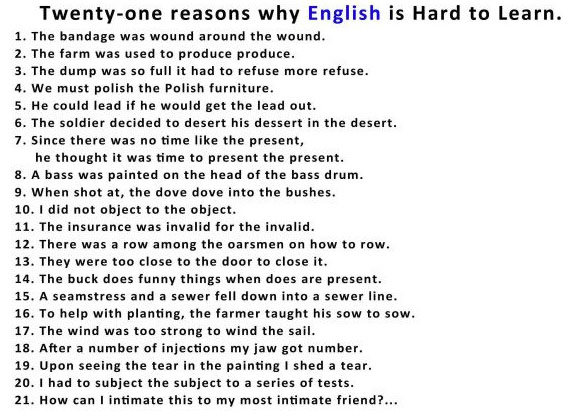 1) Bass – A BAS is a type of freshwater fish. A BAYS is a sound, voice, or musical instrument of the lowest possible range.
2) Close – To be KLOHS is to be nearby. To KLOHZ is to shut something that’s open.
3) Content – To be kən-TENT is to be satisfied or peacefully happy. KAHN-tent is whatever is contained within something.
4) Defect – A DEE-fekt is a flaw or shortcoming. To di-FEKT is to switch sides in a conflict.
5) Desert – To də-ZƏRT is to abandon someone or something. A DE-zərt is a dry and barren area of land.
6) Dove – A DƏV is a type of seed- or fruit-eating bird. DOHV is the past tense of “dive”.
7) Entrance – An EN-trəns is an access point or the act of entering a place. To en-TRANS is to capture someone’s attention by filling them with wonder and delight.
8) Intimate – To be IN-tə-mit is to be closely acquainted and familiar with someone. To IN-tə-mayt is to imply or hint at something.
9) Invalid – An IN-və-lid is a person weakened by sickness or injury. To be in-VA-lid is to be void, untrue, or otherwise not valid.
10) Lead – To LEED is to show the way, to be in charge, or to be superior. LED is a type of soft metal.
11) Object – An AHB-jekt is a material thing. To əb-JEKT is to express disagreement or disapproval.
12) Polish – To be POH-lish is to be of or related to Poland. To PAH-lish is to rub the surface of something until it becomes smooth and shiny.
13) Present – To be PRE-zənt is to be in a particular place. A PRE-zənt is a gift; the PRE-zənt is the period of time happening now. To pri-ZENT is to give something to someone.
14) Project – A PRAH-jekt is an enterprise planned to achieve a particular goal. To prə-JEKT is to move or extend outward.
15) Refuse – To ri-FYOOZ is to express unwillingness to do something. RE-fyoos is matter discarded as trash.
16) Row – A ROH is a group of people or things in a straight line. To ROH is to propel a boat through water with oars. A ROW is a noisy quarrel.
17) Sow – To SOH is to plant seeds in the earth. A SOW is an adult female pig.
18) Tear – To TEHR is to rip something. A TEER is a drop of salty water secreted from the eyes.
19) Wind – WIND is the natural movement of air in the form of currents. To WYND is to move around something in a twisting or spiral course.
20) Wound – A WOOND is an injury typically involving cut or broken skin. WOWND is the past tense of “wind” (WYND).
What are your thoughts on these words? What other words would you add to this list?
by Naomi L. | July 20, 2015 | Blog, Word of the Week |
Word: effigy
Pronunciation: E-fi-jee
Part of Speech: noun
Definition: a sculpture or model of a person
Source: Oxford Dictionaries
There’s a funny story to how today’s Word of the Week made it onto my vocabulary list. I actually learned the word “effigy” a long time ago from studying vocabulary flashcards, but I had forgotten it until recently when it came up in a conversation I had with my best friend. We were talking about the distant future, and he said that if aliens ever uncover his Minecraft Creeper plush toy, they might think it was an “effigy” of something humans believed was a divine being. It does, after all, look uncannily extraterrestrial.
An “effigy” is a likeness of someone in the form of a model or sculpture. The word comes from the Latin noun effigies, which stems from the verb effingere, meaning “to fashion artistically”. This verb is comprised of the preposition ex “out” and the verb fingere “to shape”.
Note that a common use for an “effigy” is as “a roughly made model of a particular person, made in order to be damaged or destroyed as a protest or expression of anger”. In this case, it’s normal to refer to the person whose likeness is being destroyed as being “burned in effigy”. There also seem to be certain restrictions for how to use the word “effigy”: for example, the term usually applies to lying statues for funerary art, but not necessarily standing statues or religious figures. If your stories contain any three-dimensional models made in the likeness of your characters, you may have a few “effigies” scattered throughout your fiction, though whether or not they should be labeled as such is up to you! Good luck!
What are your thoughts on this word? Any suggestions for future “Word of the Week” featured words?
by Naomi L. | July 15, 2015 | Blog, Creative Writing, What If? Writing Prompts |
Here’s another set of “What If?” Writing Prompts for you! Since I love these genres so much, this week’s post features more prompts themed to fantasy and science fiction. See what stories you can write based on these ideas! Have fun!
 What if… the human race were to colonize other planets?
What if… what you thought was a normal vehicle turned out to be a transporter into an alternate dimension?
What if… you discovered that changing the time on your watch changed the time in the real world?
What if… you trained dragons for a living?
What if… you woke up one morning to find your stuffed animals/action figures had come to life?
Enjoy writing some more fantasy and science fiction stories!
If you have any “What If?” writing prompt suggestions (for any theme), please feel free to share them in the comments below. Ideas I like may be featured in future “What If?” posts, with full credit and a link to your blog (if you have one)! Also, if you’ve written a piece based on an idea you’ve found here, be sure to link back to the respective “What If?” post. I would love to see what you’ve done with the prompt! Thank you!
by Naomi L. | July 13, 2015 | Blog, Word of the Week |
Word: licentious
Pronunciation: ly-SEN-shəs
Part of Speech: adjective
Definition:
- promiscuous and unprincipled in sexual matters
- (archaic) disregarding accepted rules or conventions, especially in grammar or literary style
Source: Oxford Dictionaries
Beata Maria, you know I’m so much purer than
The common, vulgar, weak, licentious crowd.
– “Hellfire” (The Hunchback of Notre Dame, 1996)
Oh yes, Disney worked the word “licentious” into a children’s movie. The first time I ever heard this word was when I was a kid and watched the 1996 animated film The Hunchback of Notre Dame. The term “licentious” comes up about halfway through the movie in the song “Hellfire“: while conflicted between his religious virtues and his desire for the gypsy Esmeralda, Judge Claude Frollo tries to justify to himself that he is somehow above the sins committed by the “promiscuous” common people he hates (when in fact that hatred is exactly what makes him far worse than any of them).
A “licentious” person is someone who lacks principles in sexual matters. It also once referred to a disregard for rules and conventions. The word comes from the Latin adjective licentiosus “unrestrained”, which stems from the noun licentia, meaning “freedom”.
Because “licentious” has an archaic definition, it’s possible that its use in the medieval setting of a Disney movie was intended to have the tamer meaning of a general disrespect for society’s rules. Then again, given the context of the song and the second definition’s emphasis on writing techniques, it’s more likely the word was being used in its primary meaning of sexual depravity. Either way, this is a good adjective for describing people without moral principles. If your characters tend to be unscrupulous in their actions, you too may have a “licentious” crowd in your stories!
What are your thoughts on this word? Any suggestions for future “Word of the Week” featured words?
by Naomi L. | July 8, 2015 | Blog, Creative Writing, What If? Writing Prompts |
Since there were quite a few good suggestions from Writer’s Carnival members on the last horror set of “What If?” Writing Prompts, I decided to split their ideas into separate posts. Continuing on the theme of strange happenings, this week’s post features more prompts in the mystery and suspense genres. What bizarre stories can you write based on these ideas? Have fun!
What if… you came home to find that everyone and everything was missing?
(Submitted by: Carol, Writer’s Carnival member)
What if… you were able to walk through your mirror into a land where everything is exactly the opposite of this one?
(Suggested by: Travis “TJ Bar”, co-founder of Writer’s Carnival)
What if… you kept seeing someone out of the corner of your eye, but every time you turned, no one was there?
What if… you kept waking up in the middle of the night to a strange noise in your house?
What if… you found a box in your attic containing special items and instructions to find a hidden treasure?
Good luck writing some mysterious and suspenseful tales!
If you have any “What If?” writing prompt suggestions (for any theme), please feel free to share them in the comments below. Ideas I like may be featured in future “What If?” posts, with full credit and a link to your blog (if you have one)! Also, if you’ve written a piece based on an idea you’ve found here, be sure to link back to the respective “What If?” post. I would love to see what you’ve done with the prompt! Thank you!



Recent Comments