by Naomi L. | April 13, 2015 | Blog, Word of the Week |
Word: abysmal
Pronunciation: ə-BIZ-məl
Part of Speech: adjective
Definition: extremely bad; appalling
Source: Oxford Dictionaries
Man, this is bad. And I’ve had my share of bad reviews. I still remember my first good one, though. “Everything else in this production of Our Town was simply terrible. Joey Tribbiani was abysmal.”
– Joey Tribbiani, Friends (Season 8, Episode 21 – The One With The Cooking Class)
While we’re on the subject of vocabulary used on Friends, why not take the opportunity to learn another word from Joey? Interestingly, the first time I remember hearing the word “abysmal” was in a case where it was being used incorrectly. While everyone is reading a terrible review of Monica’s restaurant in the newspaper, Joey comments that among all the negative reviews he’s ever received on his acting, he distinctly remembers his first positive one. However, he quickly makes it clear that he has no idea what the critic meant by “abysmal”, for the comment he thinks is that his performance was the best thing in the play is actually that it was the worst.
Anything considered “abysmal” is awful or of extremely poor quality. This informal word dates back to the early 19th century as the adjective form of the noun “abysm”, a literary term for “abyss”. The latter word comes from the Latin noun abyssus “bottomless pit”, which in turn is derived from the Greek adjective abussos, meaning “bottomless” or “without depth”.
Aside from its common meaning, “abysmal” can also be used as a literary term for “very deep”. This definition is relatively rare in modern use, though, so you may not see it much in this sense except in very specific contexts, such as in poetry about the sea. In any case, it’s safe to assume that whatever is described as “abysmal” is being portrayed in a negative light, so be sure to keep that in mind the next time you need to define something horrible in your stories. The important thing is that your readers don’t consider your work itself “abysmal”! Good luck!
What are your thoughts on this word? Any suggestions for future “Word of the Week” featured words?
by Naomi L. | April 8, 2015 | Blog, Creative Writing |
After starting a set of posts on the comparison between artistic and scientific writing, today I’d like to take a break to discuss a related topic that’s been on my mind for a while: science fiction. With all the brainstorming I’ve been doing regarding science and art, I figured now would be the best time to talk about why I love the intersection between the two so much. So on that note, here is a brief list of reasons why I love science fiction. Enjoy!
1) It reconciles my two great passions: science and art.
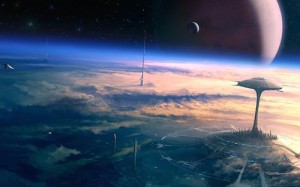 As I’ve made all too clear by now, both science and art fascinate me immensely. I’m incredibly proud to be able to call myself a scientist and an artist, so their crossover area is basically my playground. It stands to reason, therefore, that science fiction is right up my alley. Combining elements of both worlds, sci-fi stories appeal to my artist side for the creative reimagining of our universe and to my scientist side for the exploration of the potential in real scientific theories. For someone like me who practically lives in this intersection, it doesn’t get much better than that.
2) It stimulates real scientific thinking.
One thing I notice whenever a major sci-fi movie comes out is a surge in discussions – both online and off – about how realistic it is. With films like Gravity and Interstellar comes a rise in articles and social media posts by actual scientists explaining the real workings of physics in outer space and pointing out the common inaccuracies in these movies. The same thing happens (albeit to a lesser degree) with stories about other scientific themes such as time travel, dystopian futures, robot uprisings and zombie apocalypses. And I, for one, love having those discussions with my friends and fellow academics. As a writer, I have nothing against a little artistic license, but as a biologist, I encourage the clarification of facts to make sure the truth isn’t buried too far beneath the fiction. As I like to think of it, ignorance is bliss, but knowledge is power.
3) It’s the ultimate “What if?”
I’m sure by now it’s only too obvious that “What if?” is my favorite type of writing-related question. I love imagining what sorts of stories could play out around a single major condition, and no genre can pique that curiosity like science fiction, because changing one detail means altering the entire universe as we know it. What if there’s intelligent life on other planets? What if computers had the intellectual capacity of humans? What if there were a virus that could turn people into zombies? Writing science fiction is like creating infinite parallel worlds with incredible possibilities, all with the power of our minds! How cool is that?
4) It unites people like no other genre can.
Some may not necessarily see this as a good thing, but I’ve always found it interesting how sci-fi has this indomitable power to bring people with similar interests together in a way that no other genre of fiction can. I make no secret of being a so-called nerd and proud of it, so knowing there are tons of people out there who also embrace that eccentric side of themselves is heartwarming. Science fiction offers a unique common ground for those of us who choose to occasionally forget this world and explore the possibilities contained within alternate realities. And if we can share that passion with each other, that makes our love of sci-fi all the more enjoyable.
5) It’s fun to indulge in!
For all the above reasons and more, science fiction is fun, as much to read and watch as to write. I love getting lost in alternate worlds, and sci-fi offers that escape in so many different flavors that I sometimes wonder how I manage to tear myself away from it long enough to face reality again. I could spend hours indulging in these fascinating stories, so if you appreciate science and art like I do, science fiction is definitely the genre for you! Enjoy!
What about you? Why do (or don’t) you like science fiction?
by Naomi L. | April 6, 2015 | Blog, Word of the Week |
Word: negate
Pronunciation: nə-GAYT
Part of Speech: verb
Definition: nullify; make ineffective
Source: Oxford Dictionaries
Monica: (on Richard’s answering machine) “Hi, it’s Monica. I’m just checking in ’cause I got this message from you and I didn’t know if it was old or new or what. So, I’m just checkin’. So let me know. Or don’t, whatever. I’m breezy.”
Joey: Hey, you can’t say you’re breezy! That totally negates the breezy!
– Friends (Season 3, Episode 2 – The One Where No One’s Ready)
Here’s an interesting verb that I’ve heard on my favorite TV series, Friends. After replying to a phone message from Richard, a nervous Monica accesses his answering machine and plays back her message for her friends to see what they think. Unfortunately, they make it clear to her that her message is not nearly as casual as she’d hoped; as Joey points out, by saying she’s breezy, she’s actually cancelled out the breeziness she was hoping to convey to her ex-boyfriend.
To “negate” something is to cancel it out, rendering it null and void. The word comes from the Latin verb negare, meaning “to deny” or “to refuse”. This verb is derived from the adverb nec “not” and the verb aiere “to say”.
Aside from its primary definition, “negate” can also mean “to deny the existence of something”. If you want to get into the technical part of language and grammar, the word also has the sub-definition “to make a clause, sentence or proposition negative in meaning”. I’m most accustomed to its first sense, though, so I would use it in my stories to indicate things that nullify each other. If you often find yourself writing an action that neutralizes the effects of another, “negate” is a good word to remember for your stories! Good luck!
What are your thoughts on this word? Any suggestions for future “Word of the Week” featured words?
by Naomi L. | April 1, 2015 | Blog, Creative Writing, What If? Writing Prompts |
I’m afraid I have some bad news. The thing is, I’m getting a little tired of these “What If?” Writing Prompts, so this will probably be my last post for this segment. It’s hard to come up with these all the time, and I just can’t handle it anymore. Sorry, it’s been fun, but it’s time to move on.
April Fool’s! I know, that was totally lame, but I couldn’t resist. Of course these never get old; I love coming up with new writing prompts every month! But anyway, I realized about a month ago that April 1st would fall on a Wednesday this year, and while thinking about possible jokes for that week’s creative writing post, it suddenly occurred to me that I had yet to include comedy on my list of “What If?” themes.
So without further ado, here’s a new batch of prompts for you, set to one of the hardest genres to write for: humor. I hope you’ll find these ideas fun, and may they inspire you to come up with your own! Enjoy!
 What if… a witch cursed you to speak only in rhymes?
What if… you were lost and the only person around to ask for directions were a mime?
What if… your life became a musical for a day?
What if… an annoying sound played in your head every time you heard someone tell a lie?
What if… you could hear pets say what they really think of their owners?
Have fun writing your own humorous stories!
If you have any “What If?” writing prompt suggestions (for any theme), please feel free to share them in the comments below. Ideas I like may be featured in future “What If?” posts, with full credit and a link to your blog (if you have one)! Also, if you’ve written a piece based on an idea you’ve found here, be sure to link back to the respective “What If?” post. I would love to see what you’ve done with the prompt! Thank you!
by Naomi L. | March 30, 2015 | Blog, Word of the Week |
Word: maelstrom
Pronunciation: MAYL-strahm / MAYL-strəm
Part of Speech: noun
Definition:
- a powerful whirlpool in the sea or a river
- a situation or state of confused movement or violent turmoil
Source: Oxford Dictionaries
Have you ever been to Epcot at Walt Disney World? My family and I used to go there all the time when I was a kid, and the World Showcase was by far my favorite feature of the park. Each country pavilion had its own major attraction, and the one in Norway – before being closed in October 2014 for renovation into a Frozen-themed attraction – was a dark boat ride based on Norse legend, which for its many turns and drops was appropriately named “Maelstrom”.
A “maelstrom” is a sea or river whirlpool of tremendous power. As a metaphor, it indicates a state of great confusion or turmoil. The word is of modern Dutch origin, having arisen in the late 17th century to refer to a mythical whirlpool said to exist west of Norway in the Arctic Ocean. This noun is comprised of the verb malen “to grind” and the noun stroom “stream”.
I think my favorite thing about the word “maelstrom” is how foreign it sounds compared to the rest of my vocabulary. Most of the words I feature in my Word of the Week segment come from Latin or Greek, so it’s refreshing to learn a Germanic word from time to time. Coupled with its association with the ocean and its dual literal and metaphorical definitions, “maelstrom” may be one of the most interesting words I’ve come across yet! If you write tales of the sea or tend to put your characters through chaotic situations, you’re sure to find an excellent place for a “maelstrom” in your stories! Good luck!
What are your thoughts on this word? Any suggestions for future “Word of the Week” featured words?
by Naomi L. | March 25, 2015 | Blog, Creative Writing |
Last week, I started a new series of posts on the overlap of my two favorite topics: art and science. After discussing the similarities and differences between artistic and scientific reading, today I’d like to talk about the next major aspect of this creative intersection: writing. How do art and science compare when it comes to composition? Let’s explore!
How the Art is like the Science
When thinking about what art and science have in common, one of the first similarities to come to mind is the written word. Ideas of any kind are often best communicated through writing, so it’s important to know how to convey one’s thoughts as eloquently as possible. As I previously mentioned about reading, our minds have learned to make sense of prose through a set order, and writers of fiction and non-fiction alike must respect that order if their work is to be understood.
Whether we write artistically or scientifically, we have to know how to grab our readers and hold their interest throughout a given work. A good title will attract an audience that shares our interests. The introductory portion establishes our style and the main idea of the whole piece. We must include a clear objective and the promise of action by the middle of the work, and that action must lead to a resolution of conflict by its conclusion. In art and science alike, everything we write must somehow tie together in the end.
Much like reading, writing is fundamentally the same whether it’s done artistically or scientifically. Yet art and science also differ greatly, and in my opinion, nowhere do these disparities shine brighter than in their composition.
How the Art is unlike the Science
When we write artistically, we have all the freedom in the world to experiment with words and ideas to turn out an interesting piece. We can write about anything from magic and myth to true events in history. We can start in the middle and halfway through jump back to the beginning. We can elaborate on the tiniest details or leave everything but plot up to the reader’s imagination. We can write themes and endings that are either thoroughly conclusive or open to interpretation. The possibilities are endless.
 The same freedoms generally don’t apply to science, however. Because academic papers all have to be comprehensible in the same manner, they come with strict rules and guidelines for how to write them. That isn’t to say that we can’t be creative at all, of course; just that there are far more restrictions to work with than in artistic writing. We’re more than welcome – even encouraged – to demonstrate creative thinking, as long as it’s presented with a title, an abstract, an introduction, materials and methods, results, a discussion, and a conclusion. When the point is to convey our ideas as clearly as possible, organization is key.
Writing prose is both an art and a science at its core, so it’s up to the writer to master the balance between these approaches and know how to make the most of their individual strengths to turn out truly creative works. And that is exactly what I love about creative writing: it appeals to both the artist and the scientist in me! I sincerely hope you can appreciate this beautiful intersection of art and science as much as I do! Thanks for reading!



Recent Comments