by Naomi L. | May 4, 2015 | Blog, Word of the Week |
Word: obsequious
Pronunciation: əb-SEE-kwee-əs
Part of Speech: adjective
Definition: obedient or attentive to an excessive or servile degree
Source: Oxford Dictionaries
Jamie: What do you mean you told him not to go out with me?
Ira: What do I know? I met you one time; you kept showing off your vocabulary!
Jamie: [to Paul] You never told me he didn’t like me.
Paul: Because you were so down on him, I didn’t want to fuel the fire.
Ira: Wait, wait, wait, you didn’t like me?
Jamie: On first impression, you were a little obsequious.
Ira: You see? There, you’re doing it again!
– Mad About You (Season 3, Episode 19 – Money Changes Everything)
The first instance in which I can remember hearing the word “obsequious” was in an episode of Mad About You. During an argument over one of Ira’s bad decisions, Jamie finds out that he initially disliked her for her pretentious use of advanced vocabulary. To make matters worse, she proves his point by calling him out on his overeagerness to please in the most patronizing way possible. But then again, knowing Ira, there’s always the chance Jamie simply used “obsequious” in place of “obnoxious”, either purposely to confuse him or by mistake because her husband’s cousin did have a tendency to be irritating in more ways than one.
An “obsequious” person is someone who is attentive or obedient to the point of excess. The word arose in the late 15th century as a non-depreciatory term and comes from the Latin noun obsequium, meaning “compliance”. This noun is derived from the verb obsequi, which means “to follow” or “to yield to”.
I have yet to work the word “obsequious” into my fiction, but I could definitely see myself using it to describe some of my characters who go out of their way to please others. Although the word didn’t originally have a negative connotation, its modern definition seems to suggest a level of obedience that borders on annoying, which I suppose makes it a sort of formal synonym for “kiss-ass”. If you tend to write characters who are relentless people-pleasers, “obsequious” may be an excellent adjective to use in your stories. With any luck, you may even teach your readers a new word!
Jamie: [muttering] Plenty of people use “obsequious”.
What are your thoughts on this word? Any suggestions for future “Word of the Week” featured words?
by Naomi L. | April 29, 2015 | Blog, Creative Writing, Writer's Toolkit |
Remember that Grammarly quiz I shared last month in celebration of Grammar Day? Well, around the same time, the good people over at Grammarly offered me a free trial of their grammar checker as a gift for the occasion! Naturally, it was the perfect opportunity to try it out and write a review on it for my Writer’s Toolkit segment. After all, even the best writers need a little help checking their spelling and grammar, right?
So without further ado, here is my review of the Grammarly grammar checker. Enjoy!

About Grammarly
Grammarly, or the Grammarly®Editor, is a spelling and grammar checker that automatically proofreads text in English. According to the site’s product page, Grammarly “corrects contextual spelling mistakes, checks for more than 250 common grammar errors, enhances vocabulary usage, and suggests citations”. Aside from its primary function as a proofreader, the editor also features a thesaurus that suggests improvements on word choice and a plagiarism checker that compares text with over 8 billion pages on the Web.
Grammarly offers a few features for free, such as the quick grammar checker on their home page and the Google Chrome plugin that automatically checks any text you type in your browser. The full version can be accessed via premium subscriptions of $29.95/month, $59.95/quarter ($19.98/month), or $139.95/year ($11.66/month).
My free trial of Grammarly lasted for one month, during which time I used it to proofread my stories and blog posts. I also installed the Grammarly plugin on my Google Chrome browser, which for the purposes of this review is considered an extension of the full proofreader on the Grammarly website. Since I work on a Mac, I was not able to test the Microsoft Office add-in.
Pros
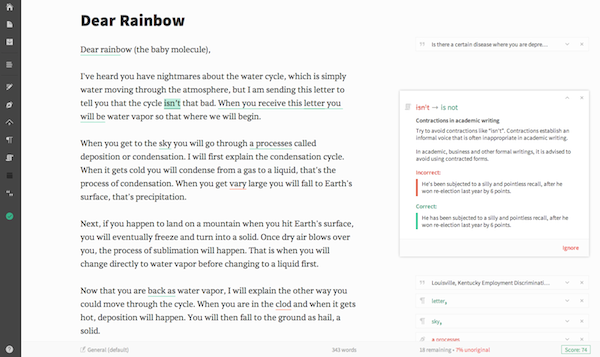
The first thing I noticed when I started using the Grammarly proofreader is that it doubles as a teacher. When the editor catches an error, it doesn’t just tell you that it’s wrong; it tells you why it’s wrong. This is immensely useful for learning about mistakes you didn’t even know you were making so you can avoid making them again. I’ve already learned a couple of grammar rules myself! Explanations include examples of correct and incorrect uses, and a fun little bonus is the score in the bottom right corner that evaluates how grammatically correct your text is overall. It’s like having your own private grammar tutor!
Another handy feature is the vocabulary enhancement thesaurus. The editor flags words it finds too common or repetitive and suggests replacements that may improve the quality of the text. It can also check a document against pages across the Internet to identify possible plagiarism, and while I confess that I only tested this a few times, it seems to work fairly well. Both of these features can be toggled on and off, which makes them optional additions to an already powerful proofreading tool. And yet another bonus is the preset configuration list for types of documents ranging from formal to creative writing, so you can actually teach the editor what sorts of errors you want it to focus on when proofreading your text!
The Google Chrome plugin also deserves an honorable mention, as it brings all of Grammarly’s features to any web page on which you write. When you type into a text box, an icon appears in the corner and automatically updates a number to indicate how many errors are being detected as you type. Hovering over this icon will open a small tab that shows you how many advanced and critical errors are in your text at the moment, and clicking in this tab or on the explanations that appear when you hover over underlined errors will open the Grammarly editor directly on the page, so you can edit your text without having to navigate away. It even seems to learn your writing style the longer you use it. That’s pretty neat!
Cons
It’s worth noting at this point that the gentleman who set me up with my free trial of Grammarly mentioned its usefulness as more of a “second set of eyes” as opposed to a replacement for a professional proofreader. After trying it out a few times, I quickly realized what he meant. The proofreader points out whatever it believes may be an error, but it can’t always take the full context of the document into account. Sometimes it incorrectly marks an alternative grammar choice as an error, and other times it misreads the context and lets a mistake slide. This issue was already thoroughly covered in a review by Grammarist, so I won’t go into detail here. In all fairness, that article was written over three years ago, during which time Grammarly does seem to have improved on its shortcomings, but it still can’t fully compensate for the judgment of a human being. Grammarly is good for catching errors you missed yourself, but if you need to proofread a whole book, your best bet is to hire an editor.
Perhaps the biggest drawback I noticed while testing Grammarly is that it isn’t entirely relevant to my style of writing. This isn’t necessarily a con, per se; more of an observation of how the editor seems to be specifically geared toward strictly formal composition. Most of the documents I pasted into Grammarly were short stories, and while the proofreader was right to catch many of my supposed errors (even when set to “Creative – Short Story”), over 90% of them were left untouched due to being creative choices on my part as opposed to actual mistakes (e.g. character dialogue or first-person narrative intended to sound “real”). Perhaps this is more of a testament to the perfectionist editor in me than to Grammarly’s limited usefulness, but I still think it’s worth mentioning for the benefit of writers as meticulous about grammar as me. If you know exactly what mistakes you’re making, you don’t need to pay for an automatic proofreader to tell you the same thing.
I should also mention that I do much of my writing on an iPad, and though I was able to use Grammarly well on my laptop, I couldn’t access it at all through my mobile device due to incompatibility issues. I can’t say if the editor works on non-iOS devices because I don’t own one, so this is mostly a note of caution to Apple users, but it may apply to anyone who frequently writes on a smartphone or tablet. Until Grammarly comes out with a mobile app, you’ll have to make due with your device’s built-in spell checker.
Summary
Pros
- Grammatical error corrections with explanations
- More thorough than standard word processor spelling and grammar checkers
- Built-in thesaurus for vocabulary enhancement
- Plagiarism checker
- Settings for different types of documents
- Google Chrome plugin for universal use
Cons
- More useful for formal writing than creative writing
- Misses some grammatical errors
- Incorrectly marks some alternative grammar choices as mistakes
- Incompatible with mobile devices
Conclusion
Is Grammarly worth your money? I’d say that depends on three factors: what you write, how often you write, and how proficient you are at editing on your own. If you’re constantly typing up formal documents, articles and emails that require impeccable spelling and grammar, a premium subscription to Grammarly may be just what you need. If, however, most of your writing consists of poetry or stories that experiment heavily with form and style, then a standard free grammar checker may suffice. Use your discretion when deciding how much help you really need to edit your work.
Based on my brief experience with it, Grammarly certainly seems to warrant the respect it gets, and though I may not need it now while my writing is concentrated in the experimental short story format, I may consider attaining a full subscription for future proofreading of my novels and academic papers (both of which are included in the aforementioned preset list). In any case, Grammarly has certainly gained this writer’s attention, and I believe it deserves the attention of any writer looking for a better automated editor than what the standard word processor has to offer. To paraphrase the famous proverb, your grammar is only as strong as your weakest misplaced comma.
Bonus: I used Grammarly to proofread the first draft of this blog post. Before editing and after including vocabulary and plagiarism checking, it came out to 35 critical issues and a score of 91 out of 100. Thanks, Grammarly!
Today’s creative writing post is brought to you by Grammarly, the World’s Best Grammar Checker. I was not compensated for this review. All opinions expressed here are my own. For more information on Grammarly, visit http://www.grammarly.com/grammar-check. Thanks for reading! Happy writing!
by Naomi L. | April 27, 2015 | Blog, Word of the Week |
Word: apocryphal
Pronunciation: ə-PAH-krə-fəl
Part of Speech: adjective
Definition: of doubtful authenticity, although widely circulated as being true
Source: Oxford Dictionaries
And we’re back to the flashcards. I’m sure I’ve heard or read the word “apocryphal” elsewhere before, but when I think about it, the only place I can clearly remember seeing it is on a standardized test prep flashcard. Perhaps if I had made a note of it back then, I could have used it in some of my stories. It does, after all, have a lot to do with fiction.
An “apocryphal” story or statement is one that isn’t confirmed to be true, despite being widely considered as such. The word is the adjective form of the noun “apocrypha”, which means “writings or reports not considered genuine”. This noun is originally Latin and comes from the adjective apocryphus “secret writings”, which in turn is derived from the Greek adjective apókruphos, meaning “hidden” or “secret”.
I almost want to say that there was a time when I thought the word “apocryphal” had something to do with the Apocalypse. Despite the mistake, the relation to the Bible wasn’t such a wrong conclusion, since the Apocrypha refers to “biblical or related writings not forming part of the accepted canon of Scripture”. In its common sense, I suppose “apocryphal” could be a fancy way of referring to rumors, so if your characters like to gossip, this may be a good word to describe their unauthenticated stories! Good luck!
What are your thoughts on this word? Any suggestions for future “Word of the Week” featured words?
by Naomi L. | April 22, 2015 | Blog, Creative Writing, What If? Writing Prompts |
It’s Earth Day, and that means it’s the perfect time to appreciate the wonder that is our natural world. And what better way for writers to get into the spirit of the day than with some nature-themed “What If?” Writing Prompts? In celebration of our beautiful Earth, here’s a fresh batch of prompts for you, the first in this segment set to the theme of nature. Enjoy, and Happy Earth Day!
 What if… every single human in the world suddenly disappeared?
(Source: AsapSCIENCE video – “What If Humans Disappeared?“)
What if… there were a superhero among wild animals who fought against the destruction of their habitat?
What if… the trees in deforested areas could talk?
What if… everyone in the world accepted that climate change is a real and ongoing threat to life as we know it?
What if… all of humanity made an effort to protect the environment and preserve the natural wonders of our Earth?
Have fun writing your own stories about nature and the Earth!
If you have any “What If?” writing prompt suggestions (for any theme), please feel free to share them in the comments below. Ideas I like may be featured in future “What If?” posts, with full credit and a link to your blog (if you have one)! Also, if you’ve written a piece based on an idea you’ve found here, be sure to link back to the respective “What If?” post. I would love to see what you’ve done with the prompt! Thank you!
by Naomi L. | April 20, 2015 | Blog, Word of the Week |
Word: circuitous
Pronunciation: sər-KYOO-ə-təs
Part of Speech: adjective
Definition: longer than the most direct way
Source: Oxford Dictionaries
Today’s Word of the Week was suggested by the mother-daughter writing team Inion N. Mathair, who discovered it while writing their novel Nightwalkers: The Secret of Jessup. Although the word did sound vaguely familiar when Inion requested I feature it here, I confess I had to look it up to remember what it meant. I have to say, these lovely ladies have good taste in vocabulary, because as soon as I read the definition, I realized I could have used this word in some of my own stories already! I have written a few characters who like to take the long way around. Thanks for the suggestion, ladies!
A “circuitous” route or journey is one that’s longer than the most direct possible path. The word comes from the Latin adjective circuitosus, which in turn stems from the noun circuitus, meaning “a way around”. This noun is derived from the verb circumire “to go around”, which is comprised of the adverb circum “around” and the verb ire “to go”.
When I think of the word “circuitous”, the first image to come to mind is a literal road that goes around the straightest way, but I assume it works equally well in the metaphorical sense of a journey that takes longer than the most direct route to a goal. If your characters often tend to avoid the short way to a destination, you can no doubt work a few “circuitous” paths into your stories! Good luck!
What are your thoughts on this word? Any suggestions for future “Word of the Week” featured words?
by Naomi L. | April 15, 2015 | Blog, Creative Writing |
Back to the subject of art and science! Since starting a discussion on this topic last month, I’ve already talked about the reading and writing aspects of the comparison between art and science. Now I’m inspired to get into another topic that has held my interest for as long as I can remember: research. How do these two sides compare when it comes to looking things up?
How the Art is like the Science
Research is a technique that every serious writer must master, regardless of medium. Scientists need to acquire purely factual information to form a solid foundation of credibility for their studies and continuously guide their work toward new discoveries. Journalists have to be aware of all the facts of a story in order to accurately convey the news to their readers/viewers. Even fiction writers and poets draw ideas from real life to paint a vivid image with the details in their stories and poetry. No matter what we choose to write, we should always do at least a little research to make our work believable, and that’s why the best writers do well to keep reference books, articles, and search engines handy at all times.
What makes most literature relatable is that no matter how fantastic the details may be, there’s always some base of truth with which the reader can connect, whether it’s the spectrum of emotions shown by fictional characters or world news that directly or indirectly affects us. As writers, it’s up to us to curate the ideas we want to share with our audience and present them in a way that makes our writing fresh and interesting, for fiction and non-fiction alike.
Research is a universal term for looking up information that we can put to good use. The differences, however, lie in the purposes of this practice…
How the Art is unlike the Science
Artistic writing is widely popular as an escape from reality for the fascinating stories one can only find in fiction. That being said, a writer can’t expect for more than a handful of readers to enjoy their work unless they can somehow bridge the gap between the fictional world of their stories and the real world of their audience. This is where research plays a key role. Writers of historical fiction have to know as many specific details as possible of the past events around which they construct their tales. Science fiction writers should have at least a basic understanding of real scientific principles before attempting to pass their stories off as even remotely plausible. Murder mysteries and thrillers rely on plots that could happen in real life in order to achieve their full effect, and romance novelists need to understand human nature and relationships if they want to make their characters relatable. Research is important for all forms of artistic writing, and fiction writers who master it will find their craft all the more enriching for it.
Scientific writing, on the other hand, thrives on research taken to a whole other level. While research for writing may be optional for many artists, it is unequivocally mandatory for scientists. Not only are we expected to read everything related to our field of interest, but we have to do so before we even think about writing our own work! If I learned anything from my first years as a Biology student, it’s that you can’t expect to make it in the scientific community unless you’re constantly reading. Academic papers, books, news articles, any source of information relevant to your studies can and should be perused. Science is all about the progression of knowledge, and in the modern age of the Internet, new information is emerging faster than ever: every week, in fact, if not every single day. In short, research is an enhancement that artists choose to pursue, but lack of research is a hindrance that scientists cannot afford.
Like many aspects of writing, research is something of an art and a science itself. It may not be easy for every writer to acquire the habit, but once you get the hang of it, you’ll find that research is an invaluable practice that will help you connect with your readers and elevate your writing to wonderful new heights. Best of luck! Thanks for reading!



Recent Comments