by Naomi L. | May 25, 2015 | Blog, Word of the Week |
Word: garrulous
Pronunciation: GA-r(y)ə-ləs
Part of Speech: adjective
Definition: excessively talkative, especially on trivial matters
Source: Oxford Dictionaries
This one’s another word I picked off the vocabulary flashcard stack. Though I haven’t used it much myself yet, I like the word “garrulous” for the way it sounds. It’s kind of a poetic way to define someone who talks too much, which I’m sure we all could have used at least once in our lives. Such “garrulous” acquaintances make great inspiration for chatty characters, don’t you think?
A “garrulous” person is someone who talks in excess, usually about matters of little importance. The word comes from the Latin adjective garrulus, meaning “talkative”. This adjective stems from the verb garrire, which means “to chatter” or “to prattle”.
The word “garrulous” is similar to another adjective I’ve featured in my vocabulary segment before: “loquacious“. The difference between these adjectives is that the excessive talkativeness in “loquacious” is implied, whereas in “garrulous” it’s explicit. Either word is good for defining characters who talk too much, so it’s up to you to decide how apparent you want their loquacity to be. If you know people who can’t stop chattering, then you should have no trouble finding inspiration for a few “garrulous” characters for your stories. Good luck!
What are your thoughts on this word? Any suggestions for future “Word of the Week” featured words?
by Naomi L. | May 20, 2015 | Blog, Creative Writing, Featured |
I love colors. I’ll say it over and over again: I love colors! They’re beautiful. They’re stimulating. Sometimes I even think they’re magical. I love everything about them, from the power they have to evoke emotions to the subtle yet distinct differences they make in a work of art. But my favorite thing about colors is their symbolism, the way they can be used to hide secrets and hint at details of a bigger picture without drawing focus away from the story at hand.
It’s simple enough to use colors in visual art, but what about in writing? Challenging as it may seem, I believe it is possible to create symbolism with words, such as when describing color schemes of character outfits and settings. Color symbolism has fascinated me for as long as I can remember, and while it would take an entire book (or series of books) to get into it all, I’d like to at least scratch the surface today with some of the basics I’ve picked up throughout my experience researching and implementing meaningful colors in my stories. You may want to consider these tips the next time you set a scene; they can help add a vivid new layer to your story! Enjoy!
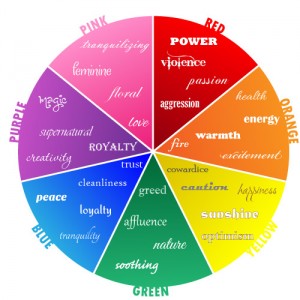
 Red – Red is a bold and passionate color, often symbolizing such strong ideas and images as courage, fire, power, and violence. It’s a color that demands attention, which is why it’s commonly used to signify danger. Use red for passionate or aggressive characters, or for any sort of intense scene, whether it’s the heat of love or the violence of war.
 Orange – Not quite passionate and not quite joyful, orange is a middle ground between red and yellow. It symbolizes energy and creativity, and is used in psychology to stimulate enthusiasm and determination. Use orange for adventurous or creative characters, or when you want to paint some vibrant warmth into a scene.
 Yellow – Yellow is the two-sided coin of colors. On the one hand, it symbolizes happiness, optimism, sunshine, and friendship. On the other hand, it can also stand for cowardice, illness, hazard, and deceit. Golden shades represent wealth and luxury. Use yellow when you want to add hints of joy or caution to a scene. For the best effect, I recommend using yellow ambiguously, such as for characters who seem jubilant and optimistic on the outside but who are fearful or deceitful on the inside.
 Green – Think of green and you’re sure to picture beautiful scenes of nature, complete with lush vegetation as far as the eye can see. Indeed, green is the color of the environment, and it represents such ideas as youth, fertility, health, and rebirth. Abstractly, it also symbolizes jealousy and good luck. Use green for characters associated with natural themes such as environmentalism or the practice of healing, or to hint at fortune or envy in relationships.
 Blue – Blue is my favorite color because it represents all my favorite things. It’s a color that symbolizes intelligence, tranquility, trust, and loyalty. In nature, it’s associated with the sky and the sea, and different shades from turquoise to navy can be used to signify sophistication, knowledge, and integrity. Use blue for characters who are more intellectual than emotional, and for settings fitting an atmosphere of calm and authority.
 Purple – Purple is the color of royalty, and has long represented such themes as nobility, wisdom, honor, and extravagance. Being a relatively rare color in nature, it is often associated with mystery and magic. Lighter shades such as lavender also convey grace and elegance. Use purple as a motif for regal or arrogant characters, mysterious settings, and storylines brimming with fantasy.
 Pink – A soft complement to the bold red, pink is the color that most famously signifies love and romance. Strongly associated with femininity, it represents tenderness, caring, and acceptance. I myself tend to associate the color pink with flowers. Use pink to add a soothing or feminine quality to a scene, or to signify elements of a romantic subplot.
 Brown – Brown is well known as an earth tone, and as such tends to represent stability. Common ideas associated with the color brown include simplicity, comfort, and endurance. Use brown when you want to convey a sense of plainness or tenacity in a scene without having to resort to the blatant dullness of gray.
 Gray – The dull middle ground between white and black, gray is most commonly associated with boredom and depression. On the positive side, it also stands for security, modesty, practicality, and reliability. Use gray for conservative characters or when you want to create a colorless air for a particular setting.
 White – White is the international color of peace, and is often regarded as a symbol of light, purity, and faith. Some even go as far as to associate it with perfection. Note that white takes on a different meaning in Eastern cultures, where it’s associated with death and mourning. Use white when you want to convey innocence in your characters and cleanliness in your settings, or when you want to create strong religious symbolism in your scenes.
 Black – The exact opposite of white, black represents everything that its counterpart doesn’t. Darkness, evil, and death are themes commonly associated with black, but it can also stand for austerity, formality, style, and sexuality. Arguably the most powerful color of all, black has a long history of symbolizing strongly opposed ideas on the spectrum of good and evil. Use black to convey depth in your characters or to add dark themes to a scene. For best results, combine it with other colors to create interesting contrasts of ideas in your stories.
I hope you’ve enjoyed exploring the symbolism of color with me, and that you’ve picked up a few hints along the way! Have fun experimenting with the colors in your stories! Good luck, and thanks for reading!
Do you use color symbolism in your stories? Which colors are your favorites?
References and Further Reading
by Naomi L. | May 18, 2015 | Blog, Word of the Week |
Word: stochastic
Pronunciation: stə-KA-stik
Part of Speech: adjective
Definition: randomly determined; having a random probability distribution or pattern that may be analyzed statistically but may not be predicted precisely
Source: Oxford Dictionaries
How about another scientific word for your list? This week’s vocabulary word jumped out at me while I was reading a paper for an Ecology test, and I realized that although I had already seen it a couple of times, it hadn’t yet occurred to me to include it in my Word of the Week segment. Perhaps that’s because I’ve only ever seen it in academic writing, which makes sense because it’s a statistics term. Still, I think it’s interesting enough to warrant a spot on my vocabulary list. After all, what’s fiction without a few random and unpredictable events?
A “stochastic” event is one that has a random probability of occurring. The word comes from the Greek adjective stokhastikós, which in turn is derived from the verb stokházomai, meaning “to aim at” or “to guess”. This verb stems from the noun stokhós, which means “aim”.
Whenever the word “stochastic” appears in an academic paper I’m reading, it’s always being used to explain a mathematically random pattern observed in the results. Despite its primary use as a statistical term, I believe this adjective could work to describe random non-scientific occurrences as well. If you’re looking for a new and/or advanced word to define the unpredictable events in your stories, “stochastic” may be an interesting alternative to consider! Good luck!
What are your thoughts on this word? Any suggestions for future “Word of the Week” featured words?
by Naomi L. | May 13, 2015 | Blog, Creative Writing, What If? Writing Prompts |
To keep up with my creative writing, I’m sharing a new set of “What If?” Writing Prompts for you to enjoy. This week’s post features another batch of prompts in the paranormal genre. See what sorts of mysterious stories you can write based on these ideas! Have fun!
 What if… the two-hundred-year-old ghost of a former resident were haunting your house?
What if… you lived alone, but kept finding notes scribbled on your bathroom mirror whenever you took a shower?
What if… you had a mirror in which you could see the future?
What if… you could telekinetically manipulate objects based on your emotions?
What if… you held a seance for a departed loved one… that went horribly wrong?
Good luck spinning your own paranormal tales!
If you have any “What If?” writing prompt suggestions (for any theme), please feel free to share them in the comments below. Ideas I like may be featured in future “What If?” posts, with full credit and a link to your blog (if you have one)! Also, if you’ve written a piece based on an idea you’ve found here, be sure to link back to the respective “What If?” post. I would love to see what you’ve done with the prompt! Thank you!
by Naomi L. | May 11, 2015 | Blog, Word of the Week |
Word: sycophant
Pronunciation: SI-kə-fənt / SI-kə-fant
Part of Speech: noun
Definition: a person who acts obsequiously toward someone important in order to gain advantage
Source: Oxford Dictionaries
She turned you into this untrusting, crazy, jealous sycophant! [her friends stare at her] All right, so I don’t know what “sycophant” means, but the rest is right!
– Phoebe Buffay, Friends (Season 4, Episode 18 – The One With Rachel’s New Dress)
Remember that word I wrote about last week? It’s time to put it to good use. The first (and probably only) time I ever heard the word “sycophant” was in an episode of Friends, when the women try to help Ross overcome his irrational fear that he might lose his girlfriend Emily to his ex-wife’s life partner Susan. In an attempt to convince him that he’s being unnecessarily jealous, Phoebe uses an uncommon word that she’s never used before – to humorous effect, as Ross’s jealousy is hardly an indication that he wants to please important people just to get ahead.
A “sycophant” is someone who acts in an excessively obedient or attentive manner toward an important person as a means of gaining an advantage. The word arose in the mid 16th century as a reference to informants, and can be traced back through the French noun sycophante to the Greek noun sukophantēs, meaning “informer”. This noun is comprised of the noun sukon “fig” and the verb phainein “to show”, which may be a reference to the insulting “fig gesture” made toward informers.
To be honest, I have yet to find a good place for the word “sycophant” in my fiction. I do like the sound of it, though, so it would certainly be a good alternative if I were to write a character who relentlessly pleases others for their own gain and wanted to avoid vulgar terms such as “suck-up” and “kiss-ass”. Perhaps I’ll use it in one of my stories someday, but if you tend to create such phonily obsequious characters, you can already start writing a “sycophant” or two into your fiction! Good luck!
What are your thoughts on this word? Any suggestions for future “Word of the Week” featured words?
by Naomi L. | May 6, 2015 | Blog, Creative Writing |
When it comes to writing romance, I tend to draw a lot from personal knowledge and experience. Though I have lived a few interesting stories of my own, the truth is that I learned most of what I know about love from my parents. They’ve been my inspiration for as long as I can remember, and they’re the reason I have so much faith in love today. My love stories feature healthy relationships and happy endings because that’s the reality I grew up witnessing every single day.
So what are the secrets to writing a love that’s true? Here are a few tips I learned from my parents that I love to implement as much in my stories as in my personal life. I hope you can learn some valuable lessons from them too! Enjoy!
1) The best kind of love blossoms from friendship.
 Anyone who has read at least a few of my romantic stories has no doubt noticed that most of the love I write grows between characters who start out as friends. My parents met well before they got together, and I think the reason they get along so well today is because they’ve known from the very beginning that they have enough in common to make things work. Not too much, of course, but that’s where the next piece of advice comes in…
2) The key to everlasting love is mutual respect.
As alike as they seem sometimes, my parents are two very different people. My mom is soft-spoken and attentive, while my dad is loud and passionate. The key to their successful relationship is that they never try to impose elements of their personalities on each other, but rather appreciate each other’s strengths and accept their differences as the dynamic that keeps their marriage interesting. In other words, they avoid making that common married-couple mistake of trying to change each other. Not that they don’t learn from one another, of course, but when they do, it’s thanks to their intelligence and willingness to each be the best spouse the other deserves, which makes for a much healthier kind of relationship. They’ve become better people together not because they felt obligated to, but because they wanted to.
3) It’s important that you make each other laugh. Always.
When I think back on all the times I’ve noticed my parents interacting, I realize that I’ve heard them laugh much more often than I’ve heard them argue. Even when I’d overhear them getting upset about something, it would never take too long for one of them to say something silly that would start them both laughing about the whole thing. And I’m certain that’s what’s kept them together to this day. If I’ve learned anything from observing my parents’ relationship my whole life, it’s that love is only worth holding onto if it brings you much greater joy than sorrow. This may be the most important piece of advice my dad ever gave us: if you’re not laughing anymore, it’s time to jump ship.
4) Marry someone you love talking to.
Something else I’ve always noticed about my parents’ relationship is that they talk to each other about almost everything. Maybe it’s because they have similar yet distinct ways of thinking, so they’re usually interested in what the other has to say. Occasional difficulties in listening aside (mostly on my father’s part), my mom and dad have always been on the same page when it comes to communication. Of course, this made it nearly impossible for me and my sisters to get away with anything, but that just helped us to grow up as well-disciplined and happy children. That’s another important lesson we learned from our parents: to maintain a healthy relationship, communication is a must.
5) Learn to let the little things go and just enjoy life!
 This advice technically applies to anyone, but it’s especially important for committed couples. If you and your significant other get hung up on every little thing in your relationship that upsets you, you’re eventually going to drive each other crazy. That’s why my mom and dad never get stuck on minor issues for very long. When it comes to their arguments, they’re more about the “forgive and forget” philosophy, because they know that in the long run, those little spats are not worth stressing over. Instead, they focus on the important things, they support each other through thick and thin, and they make the most of each other’s company to just enjoy life. Can you really imagine a more perfect love than that?
These are the lessons about love that I’ve learned from my parents, and I’m grateful to them every day for the example they’ve set for my sisters and me. I only hope to experience a love like theirs throughout my life, but for now, I’ll keep using it as inspiration for my romantic fiction, as I hope you can too. Good luck! Thanks for reading!
Dedicated to my parents, the happiest couple I know. Thank you for teaching me what true love really is. Happy Anniversary, Mom and Dad! I love you!



Recent Comments