by Naomi L. | September 15, 2014 | Blog, Word of the Week |
Word: gratuitous
Pronunciation: grə-T(Y)OO-i-təs
Part of Speech: adjective
Definition:
- uncalled for; lacking good reason; unwarranted
- given or done free of charge
Source: Oxford Dictionaries
Like other words I find interesting, “gratuitous” has two almost completely different meanings. I tend to see one definition more often than the other, though, probably due to the substantial amount of time I spend surfing through TV Tropes. You may be familiar with such “gratuitous” devices as foreign languages and violence, and if you encounter them all the time, you understand exactly what earned them this infamous label.
Things or actions deemed “gratuitous” are those which are provided freely and/or without good reason. The word comes from the Latin adjective gratuitus, meaning “given freely” or “spontaneous”. This adjective in turn stems from the noun gratia, which means “favor” or “thanks”.
For fiction writers, it’s practically mandatory to know what “gratuitous” means. We need to have a clear understanding of whether certain details in our work really are essential to the plot or if we simply threw them in for the sake of coloring the story (usually in an attempt to please the audience). In the latter case, it’s probably best to discard such unnecessary details. Set those “gratuitous” tropes aside and you’ll be able to tell a good clean story! Good luck!
What are your thoughts on this word? Any suggestions for future “Word of the Week” featured words?
by Naomi L. | September 10, 2014 | Blog, Creative Writing, Tropes |
You know when you’ve finished watching a movie/TV show or reading a novel, only to suddenly realize hours later that there was something odd about the plot? Well, what you experienced was a trope known as Fridge Logic, that peculiarity in a story that only hits you in a moment of idle thinking. It’s an interesting concept with which I’m becoming increasingly familiar, so today’s creative writing post briefly covers what it is and what it means for fiction writers. Enjoy!
Why a fridge?
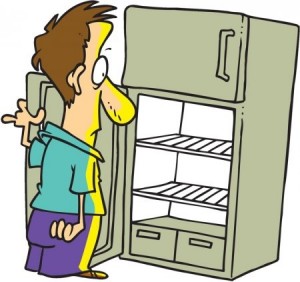
Huh, empty. Like the hotel room in that– Wait a minute…
No, this trope doesn’t necessarily have to do with an actual refrigerator. According to TV Tropes, the term “fridge logic” can technically be traced back to Alfred Hitchcock, who once referred to a particular scene in his film Vertigo as an “icebox scene”. In the words of the director, it’s the kind of scene that “hits you after you’ve gone home and start pulling cold chicken out of the icebox”. Basically, Fridge Logic refers to a special kind of plot hole that you don’t notice at first because you were so caught up in the story that you didn’t bother to think about consistency at the time.
So what does this mean for you as a writer? It means that no matter how well you try to get away with a plot hole in your work, anyone anywhere at any time is bound to find it. Of course, how much that really matters is a subject for another time.
The Other Sides of Fridge Logic
That moment of clarity that hits you at the fridge doesn’t always have to be a bad thing. Sometimes what you realize is the cleverness embedded in a certain story element. This is known as Fridge Brilliance. It usually refers to a part of a story that you didn’t care for at first, only to come to appreciate it after you’ve finally recognized the true meaning behind it. And that, in my opinion, is pretty darn cool.
Another form of Fridge Logic covers the other side of the spectrum, when something you didn’t really notice at first becomes terrifying in hindsight. This is referred to as Fridge Horror. As noted on its TV Tropes page, there are two kinds of Fridge Horror: the horrifying story elements that went over our heads as kids but that have become blatantly obvious to us as adults (Frozen-By-Time), and those that reveal themselves after we take the time to really think about their implications beyond the immediate story (Quickthaw). Look for these at your own risk: remember, anything awful you see in a beloved work of fiction cannot be unseen!
Fridge Logic has the obvious risk of slightly taking away from an otherwise good story, but you can’t deny that it can be tons of fun to discuss once you’ve experienced it. Plot holes should usually be avoided altogether, but if you absolutely must include some, try to hide them well enough that they only become clear in hindsight. At least then you’ll be giving your readers something extra to discuss after your story is over! Good luck!
Have you ever experienced Fridge Logic before? What sorts of plot holes have you found in your favorite works of fiction?
by Naomi L. | September 8, 2014 | Blog, Word of the Week |
Word: irascible
Pronunciation: i-RA-sə-bəl
Part of Speech: adjective
Definition: having or showing a tendency to be easily angered
Source: Oxford Dictionaries
Today’s vocabulary post features one of those words that I need to look up almost every time I see them, because I just don’t come across them often enough to memorize their definitions. The last time I came across the word “irascible” was in this lovely tribute from the Walt Disney Company to the late Robin Williams. The sweetness of the statement (and my sadness over his passing) aside, the word “irascible” caught my eye for two reasons: first, I wasn’t sure I remembered exactly what it meant; and second, if it meant what I thought it did, I wasn’t sure it really applied to the Genie from Aladdin. It may be a while since I’ve watched the movie, but I don’t remember him being the irritable type…
An “irascible” person is someone who is easily irritated or angered. The word comes from the Latin adjective irascibilis, which contains the root verb irasci, meaning “to become angry”. These words stem from the noun ira, which means “anger” or “rage”.
In my opinion, “irascible” reads as a poetic synonym for “irritable”. I have yet to work it into my own writing, but I could definitely have used it in my past stories to describe some of my more short-tempered characters. If your characters have a tendency to snap at any given moment, you may want to consider using this word in your stories. If nothing else, describing them as “irascible” may be the most poetic way to define their bad tempers!
What are your thoughts on this word? Any suggestions for future “Word of the Week” featured words?
by Naomi L. | September 3, 2014 | Blog, Creative Writing, What If? Writing Prompts |
Ready for another batch of “What If?” Writing Prompts? This week’s post features prompts in two of my favorite genres: fantasy and science fiction! Some clever writers over at Writer’s Carnival have offered interesting suggestions for “What If?” prompts, so be on the lookout for their ideas in this segment (two of them are in this post, while non-fantasy/sci-fi prompts will be featured in later posts). Thanks for the submissions, and be sure to keep the ideas coming! Enjoy!
 What if… you woke up in another world?
(Submitted by: Anisa, one of the founders of Writer’s Carnival)
What if… you woke up in the middle of the night to the sun shining through your window?
(Submitted by: Kelleigh, another of the people behind Writer’s Carnival)
What if… non-human animals were secretly more intelligent than people?
What if… you found out the forest near your house was home to countless mythical creatures?
What if… you knew one of your neighbors was an extraterrestrial… but you didn’t know which one?
Good luck exploring the wonderful worlds of fantasy and science fiction!
If you have any “What If?” writing prompt suggestions (for any theme), please feel free to share them in the comments below. Ideas I like may be featured in future “What If?” posts, with full credit and a link to your blog (if you have one)! Also, if you’ve written a piece based on an idea you’ve found here, be sure to link back to the respective “What If?” post. I would love to see what you’ve done with the prompt! Thank you!
by Naomi L. | September 1, 2014 | Blog, Word of the Week |
Word: minutiae
Pronunciation: mə-N(Y)OO-shee-ai / mə-N(Y)OO-shə
Part of Speech: noun
Definition: the small, precise or trivial details of something
Source: Oxford Dictionaries
I can’t spend the rest of my life coming into this stinking apartment every ten minutes to pore over the excruciating minutia of every single daily event.
– Elaine Benes, Seinfeld (Season 8, Episode 3 – The Bizarro Jerry)
The first time I heard the word “minutiae” was in an episode of one of my favorite comedy TV series: Seinfeld. After discovering a complete-opposite version of Jerry, Elaine realizes she’s had enough of the original’s superficial way of life and proceeds to criticize their countless trivial conversations (which, hilariously enough, were exactly what made the show a pioneer in its style of comedy). Naturally, the fact that Jerry replies with yet another anecdote about “nothing” serves to prove her point and further add to the humor of the scene.
“Minutiae” (or “minutia”) are the minor and precise details of something. This plural noun comes from the Latin noun minutia, meaning “smallness”. This word, in turn, is derived from the adjective minutus, which means “small”.
One of the few times I recall using this word in a story was in a context similar to that of the above quote, in that it was intended to draw attention to the boring side of social convention. In this case, the character in the scene had just returned home from a party and was enjoying the peace of solitude after being liberated from the “minutia” of conversations in which she had absolutely no interest. I’m accustomed to seeing the word being used with a negative connotation, but I suppose it’s really a matter of preference. However you choose to work it into your writing, remember that the success of your stories may very well lie in the “minutiae” of the narrative! Good luck!
What are your thoughts on this word? Any suggestions for future “Word of the Week” featured words?
by Naomi L. | August 27, 2014 | Blog, Creative Writing |
Today’s post is dedicated to a special someone with whom I love sharing this interest. If there are two passions responsible for bringing my best friend/boyfriend and me together, they are definitely creative writing and video games. So this week, I’d like to share a bit about our experience with video games and how they appeal to us as a method of interactive storytelling. Enjoy!
Escape into a Virtual World
The major debate of their positive and negative effects aside, we all have our reasons for loving video games. As a writer, one of my personal favorites is escapism, the chance to slip into a virtual world and experience a different life for a few hours at a time. Though it’s true that one can already achieve this through other sources of fiction such as novels and movies, video games bring that experience to life in a way no other medium can. When the real world becomes too boring or stressful, sometimes it’s nice to step into the metaphorical shoes of a fictional character and take back control of life. And while that may not be the healthiest solution to our problems, it certainly provides plenty of creative inspiration.
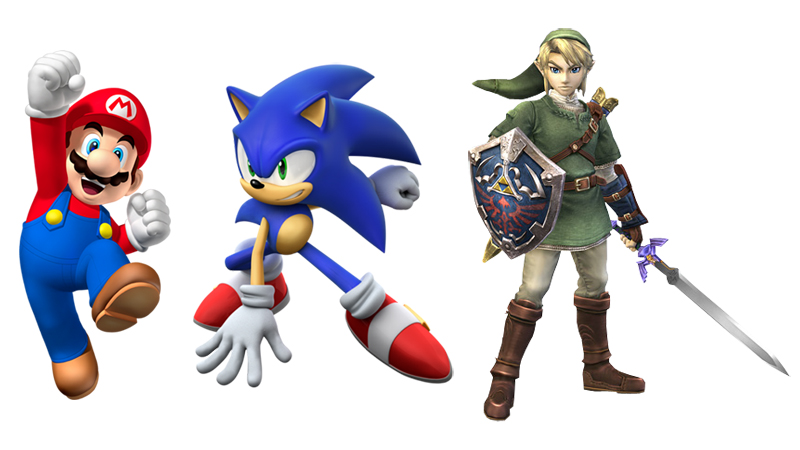
Mario (Super Mario Bros.), Sonic (Sonic the Hedgehog) and Link (The Legend of Zelda)
Growing up, I enjoyed embarking on adventures with Mario, Link and Sonic the Hedgehog, following a linear storyline to ultimately defeat a major villain and save the world. More recently, I’ve slain dragons and undertaken quests in the fantasy world of Skyrim, which offers a much broader terrain in which I’ve gotten lost for hours on end. I’ve defied the very principles of physics in the action/puzzle game series Portal; I’ve battled rebel spaceships in the strategy game FTL: Faster Than Light; I’ve witnessed my best friend construct his own story through the choices he’s made in the sci-fi game series Mass Effect; and we’ve both had our perceptions of reality challenged by the unique 2D/3D-crossover world of FEZ. From childhood to adulthood, my love for adventure games hasn’t changed, for not only do they provide hours of entertainment, but they satisfy my need to be told a good story.
Come for the Action, Stay for the Story
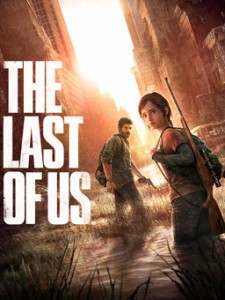
Lately, I’ve been watching my best friend play the remastered edition of The Last of Us, a sci-fi/survival/horror game set in a post-apocalyptic United States. I had heard nothing but wonderful things about this game, including the fact that it had been awarded “Game of the Year” several times over, so of course I was excited when he offered to live stream his gameplay sessions for me. He warned me going in that it would be quite the emotional ride, and I have to say that so far, he’s been proven absolutely right. From the very first cutscene, the game sets up a tragic and at times horrifying sequence of events that is bound to touch the heart of any player willing to fully engage in the plot. Though I do enjoy watching the actual gameplay, I consider the highlight of the game to be the story at its core. As much in action as in narrative, The Last of Us is indeed a video game masterpiece.
While I will give many games a try for the promise of exciting gameplay, I’m prone to lose interest if there isn’t a gripping enough story to go with it. RPGs are my favorite game genre for a reason. Adventure is about exploring, gaining experience, overcoming obstacles toward a set goal and feeling accomplishment when the final mission is complete. And what is all that if not an interactive form of storytelling?
Make Your Own Story
Although video games tend to have a set storyline that a player is obligated to follow, there is the occasional game that offers the total freedom to explore and create your own path. The best example of this is probably Minecraft, a globally popular (read: 40 million players) sandbox game that many have equated with a sort of digital Lego platform. The reason? It’s pure creation. There is no story to follow, no boss to fight (unless you count the completely optional dragon battle in The End), no kingdom to rescue. The game simply provides an assortment of mobile creatures and all the building-block resources you need to craft tools, build structures, fight monsters and basically shape the continuously generating world however you want. It’s just you and your imagination.
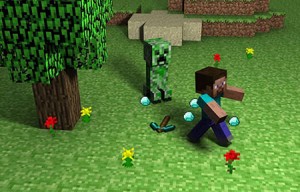
Steve running from a Creeper, the iconic monster of Minecraft
My best friend and I have been playing Minecraft together since the beta versions of 2011. I’ve long lost track of how many different worlds we’ve created and how many adventures we’ve had, but I’ve greatly enjoyed every minute we’ve spent creating together. One thing I love most is how the game brings out our individual characters: he’s more of an architect and an explorer, while I’m more of an artist and a farmer. Our playing styles may be different, but through combined effort, we’ve built cities, hoarded resources, survived monster attacks in the middle of the night and explored every terrain from the highest mountains to the deepest caves. In the world of Minecraft, we don’t need a predetermined plot to have hours of fun. We write our own stories.
Video games have their fair share of pros and cons, but when it comes to the creative aspect, they’re a unique source of inspiration. From writing video game fanfiction to finding ideas for original works, video games have been a big part of my journey as a writer, as they likely will be for years to come. And if nothing else, they make a great outlet for relieving the stress of a creative block!
Are you an avid gamer? Have video games ever helped you in your writing? What games inspire you the most?
Mario and Link belong to Nintendo. Sonic the Hedgehog belongs to SEGA. The Last of Us is a product of Naughty Dog and Sony Computer Entertainment. Minecraft is a product of Mojang. All official artwork is displayed for illustrative purposes only. I own nothing!



Recent Comments