by Naomi L. | August 4, 2014 | Blog, Word of the Week |
Word: verbatim
Pronunciation: vər-BAY-təm
Part of Speech: adjective; adverb
Definition: in exactly the same words as were used originally
Source: Oxford Dictionaries
I must give credit to Beth Teliho of Writer B is Me for reminding me to add this word to my list (even if she didn’t realize it). This is a word with which everyone who writes frequently should be familiar. Some writers often quote the sayings of others word for word, and when they do, they sometimes need to make it clear that said quote is not their own. Fortunately, there’s a word that fits that very need.
To cite a quote “verbatim” is to use exactly the same words as in the original. Likewise, a “verbatim” citation is a word-for-word passage. The word arose in the late 15th century and is rooted in the Latin noun verbum, meaning “word”.
While I rarely read the word in fiction, I have seen “verbatim” come up quite a few times in technical writing. Its Latin origin seems to make it a great word for academic composition, so you may want to consider that if you choose to work it into your stories. Whether you use it as a technical term for citation or a dialogue indicator of a particular character’s intelligence, “verbatim” is indispensable to any prolific writer’s vocabulary!
What are your thoughts on this word? Any suggestions for future “Word of the Week” featured words?
by Naomi L. | July 30, 2014 | Blog, Creative Writing |
As creators who take great pride in their craft, all artists constantly need to address questions about their work, and writers are no exception. “What should I write about?” “Who is my target audience?” “How can I make this particular plot work?” At every turn, we need to be aware of potential issues and solutions so that we can produce pieces of the highest possible quality. True, this isn’t always fun; some questions seem to limit our work, while others seem to pull the brakes on it altogether. Yet there is one question that every writer should ask but that many likely take for granted: the infamous “What if?”
Why ask “What if?”
I have memories from my childhood of my mom getting annoyed by my sister constantly asking “What if this?” or “What if that?” But while all the question ever did in her case was stress everyone out, I later came to realize how useful it could be for my fiction. We discouraged my sister from asking “what if” certain things were to happen in our real lives, and with good reason: it’s a terrifying question! But when I asked the same of my characters’ imaginary lives, countless possibilities emerged.
“What if something unexpected were to happen right here?” Then the characters could react in a way that would help establish important development points. “What if this character were to say something to that one?” Then the latter’s response could serve as a Chekhov’s Gun, concealing a clue that could become important later on in the story. “What if they were to go through the forest instead of around it?” Then they could run into a different set of obstacles that might make the story more interesting. You never know what sorts of ideas will pop up until you dare to search for them!
The Start of Something New
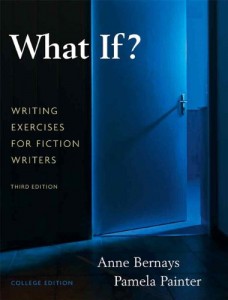
There’s a reason this writing exercise book is titled “What If?”!
“What if?” isn’t limited to stories that are already in progress. Sometimes asking the question can be the beginning of a new work altogether. For example, this was the case of one of my most popular stories: a video game fanfiction I wrote when I was 19, titled Generation Beta. The idea for this story came to me one day when I asked myself, “What if my favorite video game characters were to have a future in which they got married and had children?” That started me thinking about said children: what they would look like, what their names would be, how their personalities would develop as they grew older, etc. The next thing I knew, I had created an entire cast of second-generation characters and a handful of potential plots, so I decided to take my brainstorming a step further and write a whole story around them, which I eventually published online. To this day, Generation Beta remains my most read work of fiction, drawing in hundreds of views every month, and it’s all thanks to one simple question I asked in a moment of idle thinking.
If you’re looking for your next big idea, don’t underestimate the power of “What if?” One of your simplest answers to the question may just be the key to a successful new story!
No Obligations, No Worries
The great advantage of the question “What if?” is that it doesn’t tie you to one specific idea, because all you’re really doing is brainstorming without actually committing to anything yet. If a particular line of thought doesn’t feel right, you can discard it as if it never existed – which it technically didn’t anyway – and just go straight back to where you started to try a different path instead. By repeating this process, you can run with as many ideas as you like until you finally find the one that clicks. Handy, right?
So the next time you feel stuck, take a break and ask yourself “What if?” You never know where your trains of thought will take you, but you can be sure it’ll be well worth the ride! Good luck!
by Naomi L. | July 28, 2014 | Blog, Word of the Week |
Word: acerbic
Pronunciation: ə-SƏR-bik
Part of Speech: adjective
Definition: (especially of a comment or style of speaking) sharp and forthright
Source: Oxford Dictionaries
Today’s vocabulary word is another one pulled from the flashcard pile, but that’s the most common place I’ve ever seen it. Truth be told, I can’t actually recall reading the word “acerbic” in a story before (not that I don’t believe I have, but if I ever did, it’s been a long time since). However, I did see it come up several times while studying vocabulary, and since I found it interesting, I decided it was worth adding it to the list.
“Acerbic” speech is that which is straightforward, presumably to the point of being bitter and harsh. In its archaic or technical sense, “acerbic” indicates a sour or bitter taste. The word supposedly arose in the mid 19th century and comes from the Latin adjective acerbus, meaning “sour-tasting”.
Though I’m still unfamiliar with the word in fiction, I have seen various dictionary examples of “acerbic” being used to describe a particularly sharp manner such as wit or attitude. I’ve also seen it used once as an adjective to directly describe a person, though I can’t yet be sure this is correct. Given that its definition regarding sour taste is considered archaic, you’re most likely to encounter it in its more abstract sense. Keep the word “acerbic” in mind if you like to write characters with brutally sharp wits!
What are your thoughts on this word? Any suggestions for future “Word of the Week” featured words?
by Naomi L. | July 23, 2014 | Blog, Creative Writing, Writer's Toolkit |
I’ve already used my Writer’s Toolkit segment to talk about the advantages of keeping a journal and a pocket notebook. Now to complete the trio of handy note-taking tools, today’s topic covers a utility that every prolific writer (especially novelists) should have under their belt: index cards.
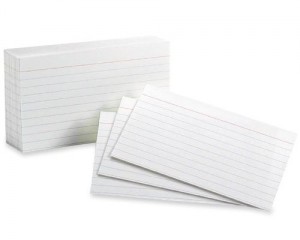
Oxford Ruled Index Cards
There probably isn’t much else I can add about the usefulness of index cards that hasn’t already been covered by the journal and the pocket notebook, so instead I’ll briefly cover the advantages they have over both of these. Like the aforementioned items, index cards are great for taking notes, and while they aren’t quite as convenient to carry around as a pocket-size book, they do have a significant feature that makes up for that: separability.
Notebooks are useful for keeping track of ideas as they come to you; the challenge is sorting through those ideas later. Cutting up pages and sticking pieces together doesn’t seem like a very productive way to go about it (unless you’re into scrapbooking, in which case it may actually be fun). A good alternative, therefore, is to scan through the highlights and note those on separate cards. You can categorize your ideas by topic and sort through them anytime to find the most relevant ones for your current project. Essentially, notebooks are for taking with you to jot down ideas on the go, while index cards are for organizing those ideas in your private workspace. How convenient is that?
While every writer can benefit from using index cards this way, novelists get the most use out of them with an additional purpose. If you’ve ever owned a cork board, you may already be familiar with the concept of pinning notes and pictures in an orderly fashion (if you’re like me, though, they’re probably all pinned haphazardly with no discernible pattern whatsoever). In a similar manner, writers planning out a novel can pin index cards to keep track of character profiles, settings and important plot points, so as to get a clear vision of the story as a whole. For writers who are total scatterbrains, this is an excellent habit to pick up!
Summary
Advantages of Using Index Cards
- Easy to sort ideas
- Categorize topics for quick reference
- Keep track of important plot details
- Visualize novel storyline
Index cards are a great option for many writers, but almost a necessity for novelists. Whether you like to set aside the occasional note for future reference or lay out the entire detailed storyline of an upcoming novel, index cards are a useful tool to help you keep your creativity in order!
by Naomi L. | July 21, 2014 | Blog, Word of the Week |
Word: lackadaisical
Pronunciation: la-kə-DAY-zi-kəl
Part of Speech: adjective
Definition: lacking enthusiasm and determination; carelessly lazy
Source: Oxford Dictionaries
Today’s Word of the Week was suggested by my best friend, who used to work with someone who said it all the time. Apparently he’s a big fan of amusing words, and “lackadaisical” certainly fits into that group. I mean, come on, it has the word “daisy” in it! “Lacka-daisy-cal”! Try and tell me that’s not just a little funny. But what’s even funnier is how well it seems to match its definition.
Describing someone or something as “lackadaisical” indicates a lack of determination and enthusiasm. The word is derived from the archaic interjection “lackaday” or “lackadaisy”, alternative forms of the exclamation “alack-a-day” (“an expression of regret or dismay”). This expression contains the root noun/verb “lack” (“the state of being without or not having enough of something”), which possibly stems from the Dutch and German noun lak “deficiency”.
Speaking as someone who has never used the word “lackadaisical” before, I would probably try to work it into a context where I wanted laziness to come across as something funny. It seems like a word that would fit perfectly in humorous writing, so it’s definitely one I’d keep in mind for comedy. If you enjoy writing silly stories about lazy characters, “lackadaisical” is the perfect word for you!
What are your thoughts on this word? Any suggestions for future “Word of the Week” featured words?
by Naomi L. | July 16, 2014 | Blog, Creative Writing |
Time for July’s round of Writer’s Reveal! Once again, it was my turn to suggest the topic of the month, so the prompt I chose this time was: “the story that changed my life”. Hope you enjoy the topic, and be sure to check out everyone else’s take on this subject. Enjoy!
Five Stories That Changed My Life
 I chose this topic because I thought it would be interesting to see how everyone would interpret it. What exactly constitutes a life-changing story? Is it one that took your life in a different direction than it would otherwise have gone? Is it one that motivated you to pursue your dreams? Is it one that made you look at the world differently? There are many ways to define life-changing stories, and I consider mine to be the ones that inspired me to become the writer I am today.
Now I know the prompt I sent refers to a single story, but when I thought about it, I realized how difficult it would be to choose just one. There are many stories that have played a role in helping me grow as a writer, and I can honestly say that my life would likely have gone a different way were it not for every one of them. So to summarize my journey as a writer and as a person, here are five of the stories that changed my life:
1) The Cat in the Hat – Maybe two years old is too young for anything to be life-changing yet, but reading The Cat in the Hat with my mom is one of the first memories I have of enjoying a good book. Dr. Seuss’s stories sparked my love of reading at an early age, and that was the all-important first step into my passion for creative writing.
2) Charlie and the Chocolate Factory – I’ve loved reading since I was little, but Charlie and the Chocolate Factory was the story that first motivated me to become a writer. Roald Dahl’s colorful worlds and fantastic adventures inspired my imagination, and thanks to his books, I’ve known since I was nine years old that creating stories of my own is what I want to do for the rest of my life.
3) Harry Potter – Wanting to write stories wasn’t enough to make me a writer yet; I had to know how to do it well. J.K. Rowling’s Harry Potter series taught me dozens of excellent storytelling techniques such as character development, plot construction and conservation of detail. These novels are also the reason I decided at age 11 to focus on writing in the fantasy genre.
4) The Mists of Avalon – I first read Marion Zimmer Bradley’s Arthurian fantasy saga at the age of 14, which was a critical point in my personal development. The Mists of Avalon was the series that introduced me to adult themes such as religious fanaticism, political radicalism and feminism, and it did so in a way that made me feel empowered as a woman. These books are what inspired me to create strong female characters, a practice I still keep to today.
5) My parents’ story – This last one isn’t a novel, though I strongly believe it should be. The most inspiring story I’ve ever heard didn’t come from a book, but from my own parents. The story of their relationship is one that has inspired me my whole life, and the best part is that it’s still being written! My parents are the reason I believe in true love, and why I’ve always enjoyed reading and writing romance. It’s not a novel, but it’s still my all-time favorite story!
These are the stories that I believe have changed my life. They may seem simple or insignificant to most, but if they played even the tiniest part in my growth as a writer and a person, then they definitely changed me for the better.
What about you? What are the stories that changed your life?
This has been a special topic post for Writers Reveal, a monthly blog swap among several talented writers. Be sure to check out the other blogs participating in the event. Thanks for reading!
Other bloggers in Writers Reveal
Melissa Khalinsky: Melissa Writes
Becky Fyfe: Imagine! Create! Write!
Ashley Howland: Ghostnapped
Emily Hawker: You Learn Something New Every Day
We’re looking for more bloggers to join our circle! If you’re interested in participating in this monthly roundup, be sure to contact Emily Hawker so she can include you in our email list. Thank you!



Recent Comments