by Naomi L. | October 14, 2013 | Blog, Word of the Week |
Word: numinous
Pronunciation: N(Y)OO-mə-nəs
Part of Speech: adjective
Definition: having a strong religious or spiritual quality; indicating or suggesting the presence of a divinity
Source: Oxford Dictionaries
Today’s Word of the Week was suggested by HD of No Vinyl Mind, who recommended it after reading it in a book (and again online). I admit that I myself was not familiar with this word, for as hard as I thought about it, I couldn’t recall a single instance in which I had ever heard something described as “numinous”. I did like the sound of it, though, so I jumped at the chance to research it and add another word to my vocabulary list. Thanks for the suggestion, HD!
When something is defined as “numinous”, it’s implied that it has some sort of spiritual quality or religious undertone to it. That’s because the word comes from the Latin noun numen (also used as a word in English), meaning “divine power” or “god”. This word arose in the mid 17th century and is supposedly derived from the verb nuere “to nod”, suggesting an original definition along the lines of “divine approval expressed by nodding”.
Now, according to the research I did, “numinous” can also be used to describe what is awe-inspiring, as in what evokes a mystical or sublime sense (as noted on this interesting vocabulary blog, also recommended by HD). Based on this, I’d suggest using the word to describe something so overwhelmingly magnificent that it gives the sense of having a spiritual presence (e.g. “numinous beauty of ancient landmarks”). “Numinous” itself is a fascinating word, so have fun working it into your writing. See what you can find in your own worlds with such divine character!
What are your thoughts on this word? Any suggestions for future “Word of the Week” featured words?
by Naomi L. | October 7, 2013 | Blog, Word of the Week |
Word: opalescent
Pronunciation: oh-pə-LE-sənt
Part of Speech: adjective
Definition:
- showing varying colors as an opal does
- showing many small points of shifting color against a pale or dark ground
Source: Oxford Dictionaries
I love colors. Anyone who knows me well can vouch for my nerdy knowledge of colors names, from vermilion to chartreuse to aubergine. I’ve been called out for describing things as “turquoise” or “cerulean” when “blue” would have sufficed, and I probably recognize enough shades of green to write an epic poem about a tree in midsummer. So when I find a word that covers several different colors at once, I almost instantly fall in love with it. “Prismatic”, “harlequin”, “kaleidoscopic”, all are great adjectives for defining different things that are multicolored. But of this list of synonyms, my favorite is probably “opalescent”.
Anything “opalescent” shows a variety of shifting colors. Naturally, it’s easy to recognize the root noun “opal” in this adjective, a reference to the semitransparent gemstone most notable for its varying colors. The very word “opal” can be traced back to different languages like the French noun opale or the Latin noun opalus. Interestingly, these Latin-based words probably originated from the Sanskrit noun upala “precious stone”, as the first samples of these gemstones came from India.
Why do I consider “opalescent” my favorite “multicolored” word? Honestly, I think it has a lot to do with the fact that the opal is my birthstone (for anyone keeping track, its month is October). Maybe it’s for this reason that I’ve always had a fondness for this stone, or maybe it’s simply for its beautiful array of colors that seem to outshine almost every other type of gem. The opal is my favorite precious stone, and for that, I feel that only the loveliest displays of varying color deserve to be described as “opalescent”.
What are your thoughts on this word? Any suggestions for future “Word of the Week” featured words?
by Naomi L. | September 30, 2013 | Blog, Word of the Week |
Word: benevolent
Pronunciation: bə-NE-və-lənt
Part of Speech: adjective
Definition:
- well meaning and kindly
- serving a charitable rather than a profit-making purpose
Source: Oxford Dictionaries
Everywhere I see bliss, from which I alone am irrevocably excluded. I was benevolent and good; misery made me a fiend. Make me happy, and I shall again be virtuous.
– The Monster, Frankenstein (Mary Shelley, 1818)
Frankenstein was one of the novels I had to read for Language Arts class in the seventh grade. It was my teacher’s absolute favorite book in the world, which is why she would have her students read it every year. Since I was only 12 years old the one time I read it, I can’t say I recall very much from the novel, but if there’s one thing I do remember, it’s that the book was packed with vocabulary words that I had certainly never seen or heard before. Some of these, the teacher would write on the blackboard as the vocabulary word of the day, and of the handful that I still remember, “benevolent” was one of her favorites.
A “benevolent” person is someone who is generally kind and well intentioned in their actions. When referring to an organization, “benevolent” indicates a charitable purpose as opposed to a profitable one. The word comes from the Old French adjective benivolent, which originates from Latin bene volent, meaning “well wishing”. This term is comprised of two roots: the adverb bene “well” and the verb velle “to wish”.
The above quote is from a scene in the aforementioned novel when the monster confronts his creator about the misfortunes provoked by the latter’s abandonment of the former. The creature begs for a companion, arguing that he is naturally good and that his loneliness and suffering were what brought about his evil acts. Based on this example, “benevolent” seems to be a good word to imply a deeper level of innate kindness, much like “altruistic“. Like the poor tortured soul in Mary Shelley’s classic science fiction novel, even a character known to commit terrible acts can still be good at heart (at least until their spirit is broken completely)!
What are your thoughts on this word? Any suggestions for future “Word of the Week” featured words?
by Naomi L. | September 23, 2013 | Blog, Word of the Week |
Word: mellifluous
Pronunciation: mə-LI-floo-əs
Part of Speech: adjective
Definition: sweet or musical; pleasant to hear
Source: Oxford Dictionaries
Amy: (after Leonard leaves while Sheldon is talking) That was rude.
Sheldon: He does it all the time. He’s a cornucopia of social awkwardness.
Amy: Cornucopia. What a mellifluous word.
Sheldon: Let’s make that our word of the day.
Amy: Agreed. And we’ll use mellifluous tomorrow.
– The Big Bang Theory (Season 4, Episode 5 – The Desperation Emanation)
Yes, it’s another example taken from The Big Bang Theory. I know I’ve used quite a few of these already, but what can I say? I love this show, and it does have some great vocabulary words scattered throughout the dialogue. In this example, Amy comments on an interesting word that Sheldon uses to define Leonard, a word they both agree is “musical” enough to their ears to warrant a place on their daily vocabulary list (as is the word they use to describe it).
A “mellifluous” sound is one that’s pleasing to hear, especially when referring to a voice or words. The term comes from the Latin adjective mellifluus, which combines two roots: the noun mel “honey” and the verb fluere “to flow”. It’s believed that the word in English arose in the late 15th century to describe what was sweet and smooth, that is, what seemed to “flow like honey”.
Like many other words used on The Big Bang Theory, I had never heard “mellifluous” until it was used by one of the show’s eccentric characters. Based on what little I know about it, I might use it to describe the sweet voice of a gentle character or the sound of affectionate words exchanged between lovers. According to other definitions, “mellifluous” can also be used to define a smooth style of writing, and might even be considered more applicable to writing while a synonym like “dulcet” (also meaning “sweet”) would be a better alternative for describing sound (I couldn’t find a reliable citation, though, so trust this information at your own risk). To be safe, “mellifluous” should probably be applied to something audible, but it’s really up to you to decide exactly what you want to describe as “sweet and smooth”. Use it however you see fit!
What are your thoughts on this word? Any suggestions for future “Word of the Week” featured words?
by Naomi L. | September 18, 2013 | Blog, Creative Writing, Writer's Toolkit |
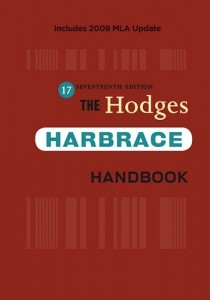
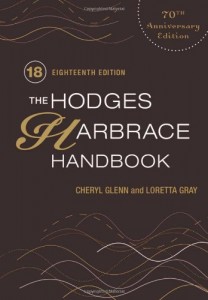
Who among us writers hasn’t found themselves doubting at one time or another whether the grammar in our writing was correct? I myself have at least three doubts regarding the previous sentence in this paragraph! We’ve probably all been in this situation before, getting stuck during the editing process over a comma we weren’t sure was correctly placed or the appropriate formatting for a citation. That’s why today’s Writer’s Toolkit review features a nifty handbook designed to aid writers through the trials of editing and revision: The Hodges Harbrace Handbook by Cheryl Glenn and Loretta Gray.
Book Summary
This handbook was one of the required materials for the online creative writing course I took through UC Berkeley. I currently own the 17th edition, published in 2009 with an MLA update, though at the time of writing this review, an 18th edition has already been released (and you can be sure that more will follow).
Originally published in 1941 by English professor John Hodges as the Harbrace Handbook of English, this book has since evolved into one of the richest English writing resources available today. The contents are organized into seven parts:
- Grammar
- Mechanics
- Punctuation
- Spelling and Diction
- Effective Sentences
- Writing
- Research and Documentation
Parts are subdivided into chapters and color-coded for your convenience (sorry, I couldn’t resist). Also included are a preface by the authors outlining new features and revisions for the current edition, a glossary of usage, a glossary of frequently used terms, and an index.
Pros
The first thing one might notice upon opening The Hodges Harbrace Handbook is the table of contents printed right into the back of the front cover and the first pages. At a glance, it’s clear how thorough this manual is, covering as many topics as possible from grammar and mechanics to proper usage of English in college-level writing. The table provides a quick guide to different sections and chapters, which are colored and numbered for easy reference.
As for the actual content, I find the explanations easy to understand, bearing in mind that the book is geared toward college students and above. To add to the educational experience, practice exercises are included within chapters, as are checklists for certain cases that come up in the editing process. Other notable features are the special boxes interspersed throughout the book: “Thinking Rhetorically” invites writers to consider the impact of their writing choices on their target audience; “Multilingual Writers” notes common areas of confusion for English learners, especially those for whom English is not a first language; and “Tech Savvy” provides helpful tips for using word-processing software, a useful feature for writers of the digital age. The last pages of the handbook include indexes for “Multilingual Writers” boxes, checklists and revision symbols.
One of my favorite details about the most recent editions of The Hodges Harbrace Handbook is the update for writers of modern times. As of the 17th edition, a new chapter titled “Online Writing” is included in the “Writing” part of the guide, and revisions reflect updates to MLA and APA guidelines and an expansion to a chapter on using writing software for business. Because of these updates, I would strongly advise against purchasing any edition of this handbook earlier than the 17th, published in 2009.
Cons
Honestly, this list is pretty short. In fact, the first issue I found with this handbook may have been due to error on my part. There were a couple of questions for which I couldn’t find answers in the handbook, either because I was searching for them in the wrong chapters or because they simply weren’t there. Also, the preface mentions some supplemental materials that are only available when bundled with the handbook at an additional cost. Not exactly a downside, but just a point to keep in mind if you’re looking for a complete learning experience to go with this guide.
Oh, and of course there’s the matter of price. A new latest-edition hard copy goes for over $80 on Amazon, which may seem steep to a student who only plans on using it for a semester. On the other hand, a prolific writer who needs to constantly edit and revise their work would probably find any price under $100 quite reasonable. As with any product, it’s all a matter of whether or not you feel you’d be able to get your money’s worth out of it.
Summary
Pros
- Versatile and thorough guide to the English language
- Well-organized contents
- Easy to understand
- In-chapter practice exercises
- Special boxes for “Thinking Rhetorically”, “Multilingual Writers” and “Tech Savvy” tips
- Extra indexes for “Multilingual Writers”, checklists and revision symbols
- Updated edition for writing in the modern age
Cons
- Possible missing information
- Supplemental materials available at additional cost
- Price ($80+ new on Amazon)
Conclusion
I highly recommend this handbook to any writer who puts as much effort into editing as into writing, if not more. Though I purchased my copy as a requirement for a class two years ago, I have since found it quite helpful when revising my work, and continue to use it today. Whether you’re looking for a complete guide to basic grammar or a full learning experience in the English language, The Hodges Harbrace Handbook is a great resource to keep handy, as much for the student writing for college as for the creative individual writing for life.
by Naomi L. | September 16, 2013 | Blog, Word of the Week |
Word: conflagration
Pronunciation: kahn-flə-GRAY-shən
Part of Speech: noun
Definition: an extensive fire that destroys a great deal of land or property
Source: Oxford Dictionaries
So I was looking through a stack of old SAT vocabulary flashcards when a rather interesting word suddenly jumped out at me. The moment I saw it, I paused and stared at the noun on the front side. “Conflagration”? What is that? I decided it was worth a shot to try and guess the definition, so I resisted the urge to turn the card over while I thought about what this word could mean. The event of being caught in the act of a crime? An offense of some sort? The act of having property taken away? No, wait, that last one is “confiscation”… Anyway, turns out none of my guesses were correct, though that isn’t to say they weren’t close…
A “conflagration” is, in simple terms, a great fire. To name an example, the incident mentioned on the SAT flashcard is the huge fire that resulted from the 1906 San Francisco earthquake. The word comes from the Latin verb conflagrare (translated as “to be consumed by fire”), which is comprised of the roots con- (denoting intensive force) and flagrare (meaning “to blaze”). Notably, this last verb is also the root of the word “flagrant”, meaning “obviously offensive”, which you can see was one of my first guesses for the definition of “conflagration”.
To be honest, I have virtually no memories of reading this word in context until recently, though I’m sure it must have appeared somewhere in my literature and/or history textbooks in grade school. Even if it does come up in a story I’ve read before, it probably didn’t call enough of my attention for me to remember it. That being said, I do think “conflagration” has a certain formal appeal to it, which is why I would most likely use it in non-fiction writing and poetry (especially rhyming poems, as there are tons of other words that end in -tion). I’m sure it would also be a good word to keep in mind for a scene in a thriller that involves a large destructive fire, since synonyms that don’t include the word “fire” seem to be relatively scarce. Either way, you can never have too great an understanding of the forces of nature, so be creative in working this noun into the context of your choice. Whether factual or poetic, “conflagration” is certainly an unusual and interesting word! Have fun!
What are your thoughts on this word? Any suggestions for future “Word of the Week” featured words?



Recent Comments