by Naomi L. | August 5, 2013 | Blog, Word of the Week |
Word: obstinate
Pronunciation: AHB-stə-nət
Part of Speech: adjective
Definition:
- stubbornly refusing to change one’s opinion or chosen course of action
- (of an unwelcome situation) very difficult to change or overcome
Source: Oxford Dictionaries
“Obstinate” is another word I learned thanks to vocabulary flashcards in standardized test prep materials. Until then, I was only familiar with much simpler terms for “stubborn”, such as “hardheaded” and “strong-willed”. To be honest, I was surprised I had no memory of ever seeing this word before, since it seems intermediate enough to fit into the type of writing I usually like to read, but then again, “stubborn” usually works well enough to get the point across.
A person who is “obstinate” is someone who won’t change their stand on an opinion or action even after attempts have been made to persuade them otherwise. Similarly, an “obstinate” situation is one that is hard to overcome or change for the better. The word can be retraced to the Latin adjective obstinatus (“firm, resolved, resolute”), in turn stemming from the Latin verb obstinare (“persist, be determined on”), or so my research has led me to understand.
It’s worth noting that while “stubborn” is a more general term for any person who is naturally resistant to altering their ways, “obstinate” is more appropriate for describing specific cases in which one refuses to back down on a decision, especially when others try to convince them to change it. Also, while there are other synonyms for “stubborn” that may be neutral, this word usually seems to carry a more negative connotation, as in unpleasant behavior or problems that can’t easily be fixed. In light of this information, when describing someone, I would probably suggest using “obstinate” to define unyielding behavior on a particular course of action that might otherwise be atypical for the character in question. In most other cases, “stubborn” and its simpler substitutes would likely work just fine.
What are your thoughts on this word? Any suggestions for future “Word of the Week” featured words?
by Naomi L. | July 29, 2013 | Blog, Word of the Week |
Word: ersatz
Pronunciation: ER-sahts / ER-zahts / er-ZAHTS
Part of Speech: adjective
Definition:
- made or used as a substitute for something else
- not real or genuine
Source: Oxford Dictionaries
Today’s Word of the Week was suggested to me by my mom, who discovered it through her most recent TV obsession: Downton Abbey. Apparently it’s a word that’s been used a few times in the series, and since I had come across it before while studying vocabulary for standardized tests, I agreed that it would be an interesting word to include in this segment.
According to Oxford Dictionaries, there are two similar definitions for this adjective. An “ersatz” product is a substitute for a higher-quality version of that item, while anything else defined as “ersatz” is simply fake. Either way, it’s used to refer to something that isn’t the real thing. Now if you’re thinking this word sounds a little different from all the others featured in my Word of the Week posts before, it’s because this one is the first in the segment to come neither from Latin nor from Greek. “Ersatz” is actually a German noun meaning “replacement”, which also functions as a part in compound words (most notably Ersatzkaffee, or “ersatz coffee”).
So how did this German word seep its way into English vocabulary? “Ersatz” evidently started being recognized outside of Germany during World War I (hence its use in Downton Abbey, or so I presume), as it was used in terms referring to replacement military troops (Ersatz Corps) and substitute products developed during the war. Its transition from a noun in one language to an adjective in the other is due to grammatical differences between English and German; for instance, while a word like Ersatzkaffee is a compound noun in German, English-speakers who easily recognize the second half as “coffee” would logically assume the first syllables make up the adjective describing the familiar noun (which would probably translate to something like “false coffee”).
It’s worth noting that while the word can have either a positive or a negative connotation in German, its English uses generally imply inferiority. As far as how one might use it in writing, my limited experience with the word tells me it likely fits best in historical fiction, as it does have an archaic feel to it (when was the last time you heard someone call something “ersatz” as opposed to just “fake”?) Still, it could also appear in modern dialogue involving academically accomplished characters (such as Leonard’s neuroscientist/psychiatrist mother analyzing Howard and Raj’s friendship as an “ersatz homosexual relationship” on The Big Bang Theory). In my opinion, the word’s historical origins alone make it interesting, so feel free to get creative with it. Whether you choose to use it in a World War-themed novel or a conversation between characters of differing linguistic backgrounds, “ersatz” can be a great word for adding a foreign touch to your writing. Have fun!
What are your thoughts on this word? Any suggestions for future “Word of the Week” featured words?
by Naomi L. | July 24, 2013 | Blog, Creative Writing, Featured, Tropes |
I’m polymerized tree sap and you’re an inorganic adhesive, so whatever verbal projectile you launch in my direction is reflected off of me, returns on its original trajectory, and adheres to you.
– Dr. Sheldon Cooper, The Big Bang Theory (Season 1, Episode 13 – The Bat Jar Conjecture)
Fans of the comedy TV series The Big Bang Theory likely remember this quote from the Physics Bowl episode, when Sheldon reacts to an insult from fellow physicist Leslie Winkle by saying as condescendingly as possible that “he is rubber and she is glue”. However, the fact that he seems to go out of his way to use the most advanced vocabulary possible in his retort only adds to the hilarious running gag of Leslie always managing to beat her rival at a game of wits.
So what lesson should novice writers be learning from Sheldon’s backfired comment? That trying too hard to sound smart often has the opposite effect than what you might expect, that is, it hurts more than it helps.
What is this amethystine composition of which you speak?
Writing that is overly decorated with fancy words and elaborate details is known as “purple prose”. It’s an especially common practice among inexperienced writers, who often believe that to write a really good story (or improve upon an existing dull one), one needs to dress up the prose with as many big words as possible to make their work look sophisticated. Basically, beginners seem to have this grand illusion that great literature is that which stands above the level of everyday speech.
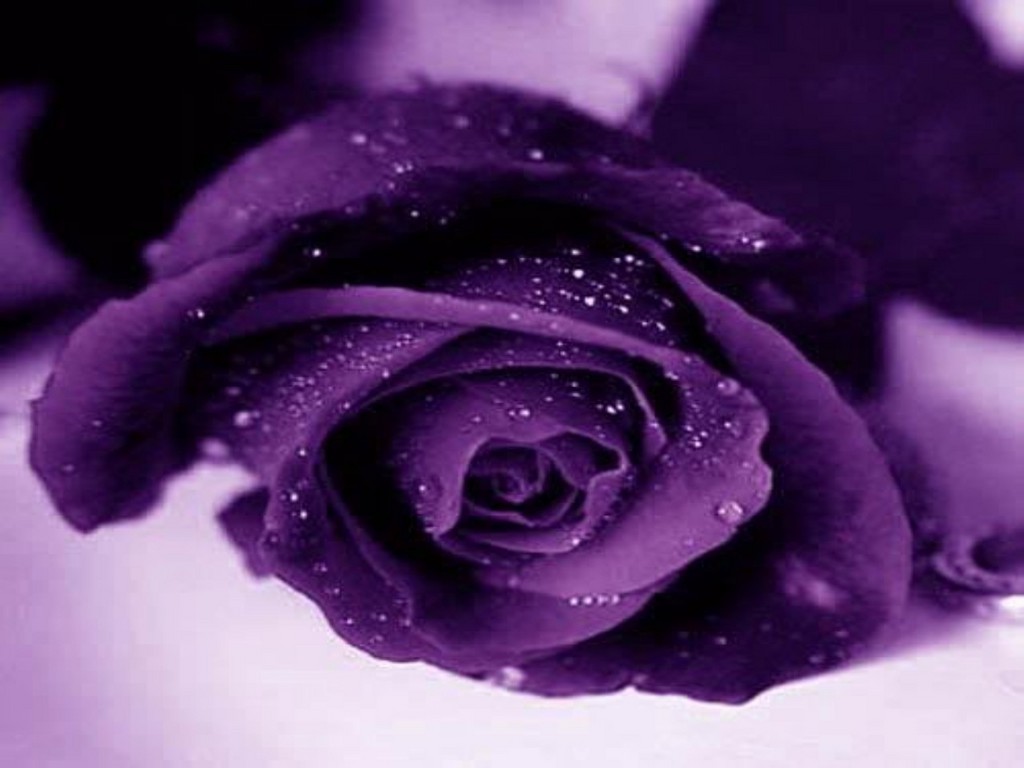
Purple prose: Contemplate this exquisite aubergine blossom of the Rosaceae family
Everyday speech: Look at this beautiful purple rose
But here’s the problem with that logic: everyday speech is the level where most readers are, and more importantly, where they want to stay. Readers today don’t want to bore their way through long descriptions or have to pause at every other page to look up half the words they just read in the dictionary. They want writing that’s simple, that they can understand and find relatable, similar to the language they use themselves in the real world.
So I’ve been writing erroneously… I mean, wrong all this time?
Calm down, and take a second to note that I said “similar to”, not “the same as”. It’s OK to use some higher-level vocabulary and detailed narration in your stories, for when done in moderation and in tone with the style of the work, these can actually add to the quality of your writing. The danger is using these tools in excess, because after you’ve passed a certain point in flowering up your prose, these details will begin to draw attention to themselves and away from the flow of your story. To sum up, a little is fine, but too much is bad. Write with caution.
Now before anyone accuses me of hypocrisy, allow me the chance to admit to this embarrassing fact: I am guilty of writing purple prose. Even if I don’t always choose the fanciest synonyms I can find to replace everyday words, I love decorating my writing with adjectives and adverbs, and I tend to use intermediate-level words where common ones would work just fine. That being said, I used to be much worse. When I first started writing, I had this idea that nobody would want to read stories written in the plain language of a ten-year-old, so even though I was already well-read for my age, I went out of my way to find “bigger and better” words for my fiction. It wasn’t until I started learning about common writing mistakes as a young adult that I realized how flowery my early writing was, and I’ve since been gradually cutting the bad habits of my childhood. So take it from a writer who’s still breaking out of the novice phase: tone down the purple and focus on writing simple prose. Your readers will appreciate it.
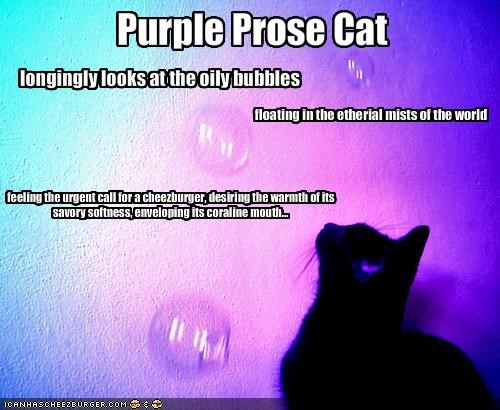 It’s worth noting at this point that as strongly as most experienced writers will argue against this practice, prose style is and always will be subjective. It’s entirely possible for a writer to not only be aware they write such elaborate prose, but actually do it on purpose. So if you’re a beginning writer guilty of this trope, don’t feel bad right off the bat. Maybe your goal is to imitate the exact styles of writers like William Shakespeare, Charles Dickens and Jane Austen, and that’s fine. Just know that unless you’re going for satire, most of the audience who would take your work seriously has probably been dead for a few hundred years.
But I want to be taken seriously today! What should I do?
Don’t worry, the “purple prose bug” is treatable! For those of you aspiring writers who wish to establish yourselves before you try to follow the great authors who bend the rules, here’s a quick list of common purple prose mistakes and how you can avoid them:
1) Excessive detail. Yes, describing the setting of a scene before the action starts is often essential to telling a good story, but please don’t go on for a dozen pages about the hundred different colors in the sky or the history hidden in every brick of every building. Just because authors like J.R.R. Tolkien and Victor Hugo could get away with it doesn’t mean you can. One paragraph should be enough to set your scene, but no more than two.
2) Overly decorated nouns and verbs. If you’re one of the millions of readers who have read all of J.K. Rowling’s Harry Potter books, you may have learned that nouns and verbs should almost always include a “modifying friend”. But Rowling is an exception, a world-famous author of one of the best-selling book series in history, which you are (probably) not. That means she can do whatever she wants with her writing, whereas you should practice creating basic prose before you work too hard to copy her style. Try not to use too many adjectives and adverbs in your writing. Though this may seem counterintuitive, many famous writers would agree that less is more. If you don’t believe so, read a story by Ernest Hemingway or Mark Twain, and you’ll see how writing can be great without the need for too many “attachments”. To quote Twain, “When you catch an adjective, kill it.”
3) Said bookisms. This is one of the most common mistakes made by beginning writers: the constant use of alternative verbs for the word “said”. There’s a general belief that when it comes to writing dialogue, “said” is too plain and overused, so writers should go out of their way to replace it with words like “asked”, “muttered”, “hissed”, etc. As a teenager, I used a lot of these in my writing; I wouldn’t be surprised if I read back a dialogue-heavy scene from one of my old stories and found at least three pages between consecutive uses of “said”. But even famous authors seem to be guilty of this sometimes (I’m given to understand there’s an entire blog devoted to poking fun at the purpleness of Stephenie Meyer’s Twilight series), so don’t feel too bad if you find your own writing full of these bookisms. The important thing is that you know you should fix them. Dialogue should convey tone by itself, no extra tags required.
4) Too much “fancy vocabulary”. Continuing from the example of “said”, some writers tend to try and find as many advanced-sounding synonyms as possible to substitute the common words in their stories. While this may be fine once in a while, you shouldn’t run to the thesaurus for every other word you want to write. Otherwise, you’ll end up sending your readers to the dictionary just as frequently. It’s great to learn new words, but think about it for a second: the more time you put into driving your audience to read another book, the less time they’ll spend reading yours. Try to stick to vocabulary that your readers will understand, and if you must throw in a higher-level word now and then, at least have the courtesy to make its definition clear in context.
5) Exaggerated sentiment. There isn’t a lot I can say here except that this is pretty much a writer’s attempt to manipulate the reader into reacting a certain way to their writing. Going back to the first item on the list, if you throw too much rhetorical writing into your stories, it comes across as you trying too hard to evoke specific emotions from your readers, which more often than not will have the opposite effect. Trust your audience to understand what you’re trying to tell them. If you write it plainly enough, they will feel it.
Purple prose is a dangerous habit of many writers, and while it may be OK for some, most should make a point of avoiding or overcoming it, no matter how difficult this seems. If nothing else, choosing to create simple and clean prose is a sign of respect to your work and your readers, so take care with your style of writing. I’m certainly still trying.
So what are your experiences with purple prose? Have you read stories that you found too flowery for your taste? Were you (or are you) ever guilty of making these mistakes yourself?
by Naomi L. | July 22, 2013 | Blog, Word of the Week |
Word: innocuous
Pronunciation: i-NAH-kyoo-əs
Part of Speech: adjective
Definition: not harmful or offensive
Source: Oxford Dictionaries
Little did he know that this simple, seemingly innocuous act would result in his imminent death.
– Karen Eiffel, Stranger Than Fiction (2006)
If you’ve seen the movie Stranger Than Fiction, you probably remember this iconic quote from the most important plot point in the story of Harold Crick. While resetting the time on his wristwatch after it inexplicably goes on the fritz, the narrating voice in the IRS agent’s head notes the irony that such a normally harmless act is what will lead to the untimely and heartbreaking end of his life’s story (at which point Harold understandably begins to panic).
To call anything “innocuous” – whether concrete or abstract – is to say that it’s harmless. The word is actually a prefixed form of the adjective “nocuous”, meaning “noxious, harmful, or poisonous”, though this stem seems to be used mostly for poetic writing than for modern prose. “Innocuous” comes from the Latin adjective innocuus (“harmless, innocent”), comprised of the elements in- “not” and nocuus “injurious”.
As far as I can remember, the first time I ever heard this word was while watching the movie Stranger Than Fiction. It sounded like an interesting word (though that may have been due in part to Emma Thompson’s lovely British accent), so I made a note to look it up, and have since included it a few times in my own writing. Although it may just seem like a fancy alternative to “harmless”, I find that when used once in a while, “innocuous” can add a certain charming note to a narrative that more common words like “harmless” and “innocent” seem to lack. Too much advanced vocabulary in your stories might be annoying, but using intermediate words in moderation is, in this writer’s opinion, an innocuous act.
What are your thoughts on this word? Any suggestions for future “Word of the Week” featured words?
by Naomi L. | July 15, 2013 | Blog, Word of the Week |
Word: exacerbate
Pronunciation: ig-ZA-sər-bayt
Part of Speech: verb
Definition: make (a problem, bad situation, or negative feeling) worse
Source: Oxford Dictionaries
“Exacerbate” isn’t a word I’ve seen or heard a lot in my lifetime. In fact, I didn’t even discover it until I started studying vocabulary words for a standardized test I took as a requirement for university admissions. The first time I read it on the flashcard, I might have guessed that it had a similar definition to the word that it sounds the most like: “exasperate”. Turns out that’s a common mistake, though these two words are not as unalike as common test prep materials might have you believe…
To “exacerbate” something is to take a bad situation and make it worse. For instance, a movie or play with a terrible script can still be exacerbated by poor direction and talentless actors. The word stems from the Latin verb exacerbare (“make worse”), which in turn is made up of the roots ex- (as in inducement of a state) and acerbus (“harsh, bitter”). Interestingly, this verb can also mean “irritate”, placing it in the same lane as the common word with which “exacerbate” is easily confused. Note, however, that “exasperate” has slightly different roots behind it (such as asper, meaning “rough”), so this shouldn’t be mistaken as a green light to use them as synonyms. The noun “exacerbation” may have meant “provocation to anger” in the past, but for the sake of modern comprehension, it’s probably best to just acknowledge the words in their separate current definitions!
So remember, as much as they may seem similar, these are two different words that are intended to have two different meanings. Take care in your choice of verbs; you don’t want to exasperate your readers by exacerbating your flawed writing with mixed-up vocabulary!
What are your thoughts on this word? Any suggestions for future “Word of the Week” featured words?
by Naomi L. | July 10, 2013 | Blog, Creative Writing, Writer's Toolkit |
I realize I haven’t written a Writer’s Toolkit piece since my review of What If? Writing Exercises for Fiction Writers. For my second post in this topic, instead of a specific book, I’ve decided to write a brief review of the importance of a more general tool that every serious writer should have at their disposal: a personal journal.
Writer’s Journal
I’m sure we all remember the innocent grade school days when the most trustworthy friend we had was that little book sitting in our bedroom, whose sole purpose was to guard our deepest thoughts and feelings. Many of us at one time or another have owned a notebook of some sort that we kept as a diary or journal (I myself kept quite a few during my childhood and adolescence). It was our outlet for the private ideas we couldn’t share with anyone else, an emotional release that left us with the satisfaction of knowing our secrets were still safe from the rest of the world. But for the budding writers among the countless young people pouring their hearts out in secret, that book was so much more. While all the other children and teenagers would keep their journals and diaries as a vent, we writers would keep them as a net to catch the little seeds dispersed throughout our lives that could eventually grow into our stories.
A journal is an important tool for any writer mostly because it serves as a log of the potential story ideas that might otherwise elude us. To give a personal example, during my college years, I kept a journal in my backpack in which I would write the thoughts and emotions I experienced while at my university. The book was a record of my college life, and several of its entries – about which I might otherwise have forgotten – later became inspiration for my fiction writing. Without that journal, I likely would have missed a lot of opportunities to find relatable traits for my characters or interesting scenarios for stories.
But my journals have helped me in an even greater capacity. Writing down my thoughts and being able to read them back objectively has allowed me to gain a better understanding of how I tend to see the world around me, and consequently, learn how I can best channel my ideas into my writing. On top of that, while my fiction pieces are for showcasing my refined writer’s voice, my private journals are for unleashing the raw voice fresh out of my mind that has yet to be shaped into the stories I want to tell. As I’ve come to realize, even creative writing comes with basic rules when intended for other readers, but when writing just for yourself, there are absolutely no limitations except you.
Summary
Advantages of Keeping a Journal
- Intellectual and emotional release
- Keep a record of possible ideas for future stories
- Objectively observe and understand the voice(s) in your head
- Unleash your raw creativity without inhibitions
Based on my experience (as well as similar accounts from other more established writers, including authors to be mentioned in future Writer’s Toolkit posts), I highly recommend keeping a personal journal as a good exercise for any writer. Sure, many of us probably don’t have the time to fill half a dozen journal pages (or even one) every day, especially in these modern times of ultra-busy lives filled with a hundred daily tasks that leave us exhausted by the time we get a chance to crawl into bed. Still, it’s good practice to set aside at least a few minutes every day to jot down some key observations of recent events, no matter how simple. Remember, even if your thoughts don’t seem particularly interesting at the time of writing, you never know if they could prove useful in the future!
Thanks for reading! Now, if you haven’t already done so, go and start your journal! Happy writing!



Recent Comments