by Naomi L. | January 24, 2014 | Flash Fiction, J.C. Wolfe's Writing |
(What If? Exercise: Read the description here.)
In my backpack is a fifth-generation iPod Nano. Its casing is a shiny cobalt blue, and its design is thin and sleek. The glass screen is partially cracked, and its click wheel is slightly worn from hours of flipping through its hundreds of songs. On the back is a personalized engraving, etched in by laser over the Apple logo and the camera lens: “Don’t ever stop singing.”
The iPod was a Christmas present from my boyfriend and best friend in the world. He and I met through our common interest in creative writing, but one of the passions we share is our love of music. Interestingly, we both generally dislike the modern mainstream pop that constantly blares on the TV and radio stations, but he was the one who introduced me to the Indie genres. The sweet sound of music layered with true emotion opened me up to an artistic world that I didn’t even realize existed. For the past few years, my boyfriend has been sharing so much new music with me, and I can never get enough. He even shares some of his own compositions with me, songs that really showcase his musical potential. In turn, he can never seem to get enough of my voice, ever since I first sang for him. He and I agree that music is a gift, a passion best experienced with someone you love.
The Christmas before we became a couple, my friend sent me a present through the mail. I was shocked to discover an Apple iPod Nano inside the box, intended as a replacement for my four-year-old iPod Mini, which was on its last legs. I couldn’t thank him enough. Now I would once again be able to enjoy hours of music at a time, the music he loved to send me. He had asked me to open the box in front of him over Skype, so that after he saw my reaction, he could tell me to turn the iPod over. It was then that I saw the engraving. I was so moved; it was such a personal and thoughtful gift.
To this day, I cherish my iPod. I carry it with me whenever I go out, and I listen to it every time I take the bus to college. I was disappointed in myself for letting its screen break when I dropped it once. Still, I take care never to misplace it, for if I ever lost it, it would be like losing a special connection to my best friend.
Between his home in the United States and mine in Brazil, my boyfriend and I currently live over 6000 miles apart. But as long as we have music, we’ll always be close. All I have to do is turn on my iPod, and wherever I go, he’s right there with me.
This piece is based on What If? Exercise 73: “Things You Carry”. The exercise is to choose an object you carry in your pocket or your bag that’s special to you, describe it in detail using less than 100 words, and then tell the story behind it in at least 200 words. The objective is to demonstrate how much emotional attachment and significance can be connected to everyday objects. I hope you enjoy what I’ve written. Thanks for reading!
Back to the story
by Naomi L. | October 11, 2013 | J.C. Wolfe's Writing, Poetry |
I’m lying in his arms.
The world is gone.
It’s just the two of us.
As I lay with my head to his chest,
I feel his heartbeat.
Mine grows faster.
I hear his slow breathing.
My breathing quickens.
I sense him drifting off to sleep.
And I smile as I let him.
Such passion…
Such pleasure…
How did I come to be here?
Even now, I can’t recall
How fortune delivered me
Into his arms.
Fate has smiled kindly at me.
I sense his heartbeat growing calm.
His breathing is slow and steady.
His eyes are closed.
With a racing heart,
Rapid breathing,
And a bright smile,
I turn to face him.
I lean forth
And softly kiss his chest.
I raise my head
And gently kiss his neck.
I raise myself a little higher
And sweetly kiss his cheek.
Then I lean in close to his ear,
And while he dreams peacefully,
I whisper my confession,
My reality, to him…
“I love you.”
by Naomi L. | October 9, 2013 | Blog, Creative Writing, Featured |
The new Romeo & Juliet movie is coming to UK and US theaters this Friday (which I admit makes me totally jealous, since there’s no set release date for where I live yet). In the spirit of celebrating one of William Shakespeare’s most famous plays, today’s topic is centered around this classic tale of love, fate and tragedy.
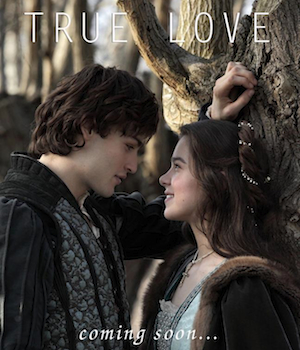
Douglas Booth and Hailee Steinfeld as Romeo and Juliet
Now I’m going to make a confession: I absolutely love this story. I love any story about forbidden love (as long as it’s well-told), and being the epitome of such a tale, Romeo & Juliet may be one of my favorites. In fact, I love it so much that I’ve read scenes several times over (yes, I read Shakespeare for fun, believe it or not), have actively sought out a fair share of adaptations, and have even used it as inspiration for my own romantic fiction.
But don’t mistake me for a silly fangirl. For the longest time, I believed the common interpretation that Romeo and Juliet were no more than two immature teenagers who recklessly rushed into a superficial relationship at the ultimate expense of their families and the rest of Verona. It wasn’t until I started researching in-depth analyses of the story (again, for inspiration) that I came to understand what I was missing in Shakespeare’s timeless classic, and what most modern readers/viewers might be missing too.
So to set your impressions straight before you head out to see this movie, here is a list of five points in Romeo & Juliet that you probably never noticed before. Get ready to see another side of this story!
(Warning: the following list contains possible spoilers for Romeo & Juliet. If you’re one of the few people on the Internet who are not familiar with this tragic story, proceed with caution. Or you can just read a full summary of the plot here.)
1) Rosaline is an important character
Before Romeo meets Juliet and falls desperately in love with her, he actually has his sights set on a different girl: Rosaline. In fact, his very first appearance in the play has him moping to his cousin Benvolio about the unrequited love he claims to feel for this unseen lady, and he even agrees to crash the Capulet ball with his friends just for the chance to see her.
But other versions of the story tend not to place very much importance on Rosaline. Most adaptations don’t even give her a face, and some exclude her character altogether, instead providing a different explanation for the Romeo character’s depression before he meets his Juliet (e.g. West Side Story: Tony longs for excitement in his life, which he finally discovers upon meeting Maria). This common alternative likely stems from the assumption that Rosaline’s only purpose in the original story is to lure Romeo to the ball so he can cross paths with Juliet, a plot point that can be easily worked around (continuing from the previous example, Tony first encounters Maria at a local dance that he only agreed to attend as a favor to his best friend).
Yet Rosaline actually plays a much greater role than a mere plot device. While pining for her, Romeo has a preconceived notion of what it means to be in love, and acts according to the lessons he’s learned from the hackneyed romantic poetry he likes to recite when thinking of her. At the first sight of Juliet, however, he abandons every thought of his former clichéd infatuation in favor of a much deeper passion that sparks some incredibly beautiful and original love poetry from his own heart (which, when you think about it, may have been Shakespeare’s way of saying “Take that!” to the poets before his time). To put it simply, the switch from Rosaline to Juliet is essential to highlight the main characters’ true feelings for each other by showing the audience the difference between Romeo thinking he’s in love and Romeo actually being in love.
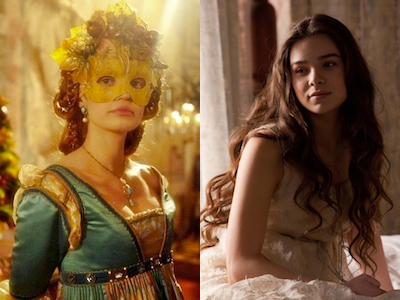
Seriously, did Rosaline ever stand a chance against Juliet?
What you’re probably thinking: He takes one look at Juliet and forgets about Rosaline just like that? Damn, Romeo is so superficial!
What you should be thinking: Wow, Juliet inspires such beautiful passion in Romeo! He must really love her!
2) Mercutio’s Queen Mab speech is a warning
One of the many famous monologues in Shakespeare’s works is the Queen Mab speech delivered by the bold Mercutio in Act 1, Scene 4 of Romeo & Juliet. This is the scene in which he teases Romeo for pining after Rosaline and tries to break his illusions of love by delivering a lecture about the dreams of men and how they can ultimately lead to ruin. Sound familiar?
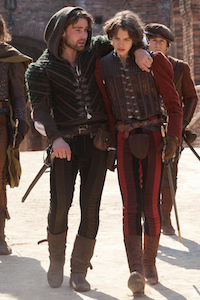
“True, I talk of dreams,
Which are the children of an idle brain” (1.4.97-98)
Mercutio starts by talking about Queen Mab, the mythical fairy queen who rides through the night bringing pleasant dreams tailored to every sleeping individual. But as he goes on, the lighthearted speech quickly takes a morbid turn into a downward spiral through darker visions of depravity (from lovers dreaming of romance to soldiers dreaming of killing), until finally culminating in a bitter yet accurate portrayal of society. Instead of taking from the speech a lesson about realism and the twisted nature of humanity, however, the idealistic Romeo simply disregards his friend’s words as another of his many mischievous taunts, silencing him with a single exasperated comment, “Thou talk’st of nothing.”
Like Romeo, modern audiences might be inclined to dismiss the Queen Mab speech as unnecessary rambling that contributes little to the rest of the story. Indeed, the monologue’s main purpose is to illustrate Mercutio’s wit and roguish nature, but it can also be interpreted as a critique against the romantic ideals that drive the play’s entire plot. In a way, Mercutio’s speech is foreshadowing the tragedies that will occur over the course of the story, and while it isn’t necessarily important, it certainly adds an interesting subtext to the themes of Romeo & Juliet.
What you’re probably thinking: Man, Mercutio really likes to hear himself talk!
What you should be thinking: Mercutio knew a thing or two about realism. Romeo probably should have listened…
3) Paris and Lady Montague even the score
Remember that part near the end of the story when Romeo kills the Count Paris in the Capulet tomb, and that other part when Montague says his wife died of grief after their son was banished from Verona? No? Then you must be familiar with any version of Romeo & Juliet other than the original play itself.
The fact is, most adaptations of this play tend to exclude the deaths of Paris and Lady Montague because they don’t contribute very much to the plot. The latter even goes virtually unnoticed, her offstage death being summed up in only two lines. So why would the playwright even bother killing these characters off in the first place?
Because it’s only fair. Before Romeo and Juliet famously take their own lives at the end, two other important characters suffer dramatic deaths in the middle of the story: Mercutio and Tybalt. But wait, wasn’t Mercutio on the Montagues’ side? Yes, but he was not a member of their family, as Tybalt was of the Capulets’. Mercutio was actually from the third noble family in the play: the Prince’s. This means that after all four of these characters die, the House of Capulet would technically have suffered the greatest loss.
Unless one more family member were to be lost from each of the other two houses. Enter Count Paris and Lady Montague. Paris, though aligned with the Capulets, is another kinsman to the Prince, and ends up being killed in a fight with Romeo during his visit to Juliet’s tomb while she’s faking her death. A little later, after the bodies are discovered in the tomb, the Prince calls forth the heads of the feuding households, at which point Montague accounts for his wife’s absence by explaining that the news of her son’s banishment ended up killing her.
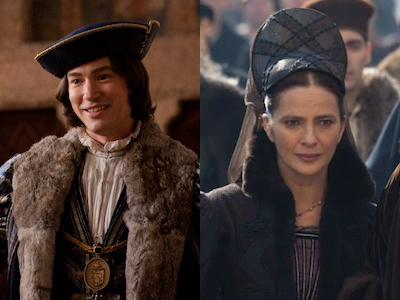
Surprise: one of them might not survive the movie this time. Guess who.
Final death toll:
- Capulets – 2 (Juliet and Tybalt)
- Montagues – 2 (Romeo and Lady Montague)
- Prince – 2 (Mercutio and Paris)
Conclusion: everyone loses, but at least in perfect balance.
What you’re probably thinking: Six people die by the end of the story? Shakespeare was twisted! No wonder most newer versions cut out these deaths!
What you should be thinking: Wow, every house loses two loved ones? How sad!
4) The poison and the dagger are symbolic
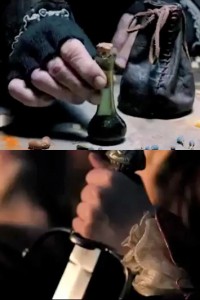
Romeo: “Thy drugs are quick. Thus with a kiss I die.” (5.3.120)
Juliet: “O happy dagger,/ This is thy sheath. There rust and let me die.” (5.3.169-170)
If there’s one thing for which Shakespeare was notorious, it was his innuendos. Plenty of his works contain their fair share of double entendres and the like, and Romeo & Juliet is no exception. However, instead of covering every example in the play (which would take a while, especially for scenes involving Mercutio), let’s just skip ahead to the one hidden in the famous double suicide ending.
You know how Romeo kills himself by drinking poison when he thinks Juliet is dead, and then Juliet stabs herself with Romeo’s dagger after she finds his body? Well, guess what: those two items are not random, but were carefully chosen to secretly represent the lovers’ intimate relationship. Romeo’s weapon of choice comes in a cup, which is a symbol of femininity. In contrast, Juliet uses a blade, a symbol of masculinity, to take her own life. In this way, their deaths are meant to reflect the intimacy they shared in life, thus completing the play’s theme of love ending in tragedy.
Or it’s all just another product of Shakespeare’s deviant mind, depending on how you choose to read into it.
What you’re probably thinking: Shakespeare must have been a misogynist, to have Juliet suffer a much more painful death than Romeo.
What you should be thinking: Even their deaths symbolize their intimate love. Shakespeare was clever with metaphors.
5) Romeo & Juliet is a coming-of-age story
Now I know what you might be thinking: how can Romeo & Juliet be a coming-of-age story if the entire plot only happens over four days? Perhaps it’s not a coming-of-age story in the traditional sense, as the teenage protagonists never actually reach adulthood, but their characters do mature throughout the course of the play, from the moment they meet to their untimely end.
At the beginning of the story, Romeo and Juliet are little more than naïve adolescents, both fairly inexperienced in life and in love. As soon as they first cross paths, however, they quickly propel each other toward the maturity of adulthood. Upon meeting Juliet, Romeo sheds his superficial conceptions of romance to become one of the most truly passionate lovers in all of English literature, and it is this passion that drives his actions for the rest of the play. Juliet, in turn, draws strength from her love for Romeo to develop into a confident and levelheaded young woman, making shrewd observations (“You kiss by th’ book”) and logical decisions that balance out her lover’s spontaneity. The intense love that outweighs the hatred around them makes their marriage all the more pure, and their loyalty to one another drives them to choose an eternity together in death over a miserable life alone. In short, though modern interpretations mistake these young lovers for foolishly infatuated teenagers, in-depth analyses reveal the true qualities of their complex characters, bringing to light the real depth of Shakespeare’s classic story of “death-marked love”.
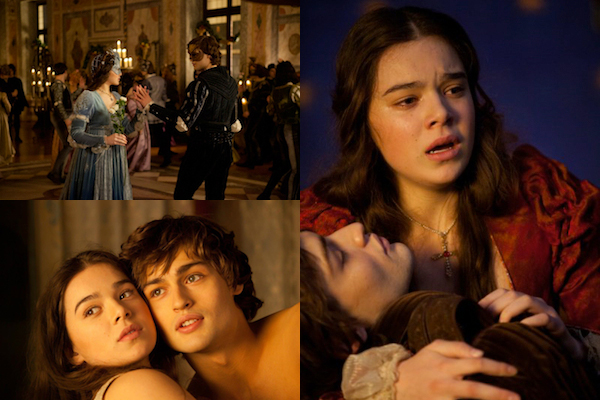
“For never was a story of more woe
Than this of Juliet and her Romeo.” (5.3.309-310)
What you’re probably thinking: They rushed into marriage after less than a day and then killed themselves because they couldn’t live without each other? Romeo and Juliet were so immature!
What you should be thinking: They were so young and they experienced such a grand romance. Romeo and Juliet were truly in love!
All caught up on these secret details?
Great! To leave you on a high note, here is the official trailer for the 2013 release of Romeo & Juliet (the original UK trailer can be found here). Enjoy!
[youtube=http://www.youtube.com/watch?v=Gp9yaZcrtnU]
Reasons I have high hopes for this movie:
- A screenplay adapted by Downton Abbey creator Julian Fellowes
- A stellar cast featuring talents such as Hailee Steinfeld, Douglas Booth, Ed Westwick, Damian Lewis and Paul Giamatti
- Good chemistry between co-stars Hailee Steinfeld and Douglas Booth
- Shot entirely on location in Verona and Mantua, Italy
I hope you’ve enjoyed reading about the secrets hidden in Romeo & Juliet! I understand that many will disagree with some of these points, but honestly, I think that’s part of the beauty of this tale: that it can be interpreted in so many different ways. To some, it’s a tale of love thwarted by fate; to others, it’s a warning about the dangers of being too impulsive. In any case, I’m sure we can all agree that this classic story has greatly endured the test of time, and will probably continue to intrigue admirers of Shakespeare and inspire the romantic at heart for generations to come.
On a final friendly note: kids, trust me when I say you do not want a romance like Romeo and Juliet’s! Yes, this is a beautiful story and a great one to read and learn from, but the story you want to live is that of Grandma and Grandpa, who had a life and grew old together. It’s important to know the difference!
Oh, and if anyone from the UK or US happens to watch this film, please let me know if it’s good. I’m very much looking forward to it. Thanks for reading!
(Disclaimer: All images and video in this blog post are courtesy of Swarovski Entertainment and Amber Entertainment. For news about the film, follow them on Facebook and Twitter. I own nothing; I’m just a fan hoping to spread the love. Thank you!)
by Naomi L. | September 27, 2013 | J.C. Wolfe's Writing, Poetry |
 Visions of beauty are they.
Open petals,
Vivid colors,
Strong leaves.
In full bloom,
In the prime of their life,
They are her pride and joy.
She smiles at their beauty.
She speaks highly of their blooms,
Coloring her home
And bringing light into her world.
Such beautiful flowers
Are her beloved orchids.
But what would flowers be
Without a caretaker?
Their petals would droop.
Their colors would fade.
Their leaves would wilt.
The very life in them would vanish
Into the memory
Of an ephemeral spring.
For it is she who provides comfort,
She who waters them,
She who talks to them,
And she who urges them to live.
They would be nothing
Without her care,
Without her encouragement,
Without her affection.
The orchids may be
The most beautiful flowers,
But they owe their life to her
For her nurturing love.
Happy Birthday to my wonderful mother! Thank you for all the love and care you’ve given me my whole life; I wouldn’t be who I am today without you. I love you!



Recent Comments