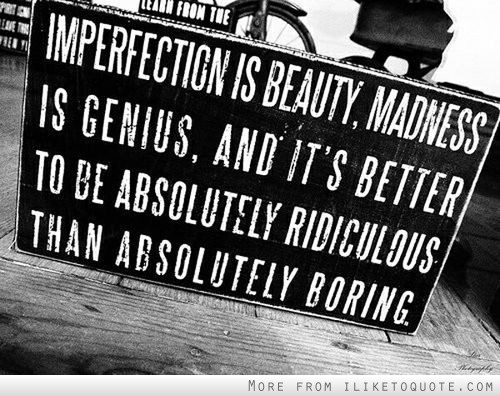
The theme for this week was beauty, and the quote I chose is one commonly misattributed to Marilyn Monroe:
Imperfection is beauty, madness is genius and it’s better to be absolutely ridiculous than absolutely boring. – Marilyn Monroe (?)
This quote is often credited to Ms. Monroe in lists of inspirational celebrity sayings, but the truth is I haven’t yet been able to confirm its true source. Still, bumper-stickery as it sounds, I thought it would make great inspiration for a short poem about my favorite kind of beauty: individuality! Enjoy!
Don’t Be Boring, Be Beautiful
Don’t be perfect,
Because perfection is dull.
Be imperfect,
And see the unique beauty all around you.
Don’t be sane,
Because sanity is overrated.
Be a little crazy,
And discover the genius ideas in the world.
Don’t be serious,
Because seriousness is grim.
Be ridiculous,
And enjoy the excitement in life.
Don’t be boring.
Be imperfect,
Crazy,
Ridiculous,
Beautiful.
Because imperfection is beauty,
Madness is genius,
And it’s better to be
Absolutely ridiculous than
Absolutely boring.
Remember that word from Rango that I shared a while back? Well, today’s vocabulary entry features the other uncommon word from the name of his theater group! We’ve already learned from the context of this scene that a “thespian” is an actor, though its name also implies that said group of actors has another talent. It seems in a show put on by a group called “Madam Lupone’s Terpsichorean Troupe of Traveling Thespians”, the Inbred Rodents could have expected to see some dancing too!
Anything described as “terpsichorean” relates to dancing, while a “terpsichorean” is a dancer. The word arose in the early 19th century and derives from the name of the Greek and Roman goddess Terpsichore, the Muse of lyric poetry and dance. The name Terpsichore is originally Greek and literally means “delighting in dancing”.
Same as with the word “thespian”, “terpsichorean” takes its name from a figure in Greek lore, though in this case she was a goddess and a Muse as opposed to a poet. Notably, the name Terpsichore was used in the 18th century to denote a female dancer, and since the 19th century has evolved into a word referring to all dancers or the art of dance in general. Also similarly to “thespian”, “terpsichorean” is classified by Oxford Dictionaries as a “formal or humorous” word, possibly making it a good choice for satirical writing. If your characters often engage in the art of dancing, “terpsichorean” is an excellent word to keep on your list!
What are your thoughts on this word? Any suggestions for future “Word of the Week” featured words?
Are we already halfway through 2016? How did that happen? Time is an evasive little thing, isn’t it? Anyway, we’re going into July now, so I figured now is the perfect time for a quick break to assess the progress on my 2016 reading goals. How am I doing so far? Let’s see!
My Reading Goals
At the beginning of the year, I set a goal to read ten books for the Goodreads 2016 Reading Challenge. I even shared a couple of blog posts in January detailing which books I wanted to read this year. It seemed like a reasonable goal for me; I wanted to push myself to start reading more fiction again and finally take up those untouched books sitting on my shelf, but I also couldn’t set the bar too high for fear of falling behind due to school. Ten books a year is fewer than a book a month, and while that may not seem like much to truly avid readers, it’s proven to be an excellent starting point for me, as I’m already more than halfway to my goal!
I plan to write an in-depth post on my 2016 goals at the end of the year, but for now, here’s a quick recap of the books I’ve read so far, am currently reading, and still plan to read:
You come down here to console me. That is charming of you. You find me consoled, and you are furious. How like a sympathetic person! You remind me of a story Harry told me about a certain philanthropist who spent twenty years of his life in trying to get some grievance redressed, or some unjust law altered – I forget exactly what it was. Finally he succeeded, and nothing could exceed his disappointment. He had absolutely nothing to do, almost died of ennui, and became a confirmed misanthrope.
Yes, I’m aware I’ve been going through an E-word streak this month, and no, I never thought I’d find a connection between a gothic novel and a cartoon based on a video game franchise. In The Picture of Dorian Gray, Basil Hallward confronts Dorian about his indifference over the death of his fiancé, to which Dorian calls him out on his “selfishness” using Lord Henry’s philosophy on the underlying hypocrisies of sympathy that have driven others to boredom and depression. Meanwhile, in Sonic Boom, Dr. Eggman is disappointed to find that capturing one of Sonic’s best friends didn’t have quite the effect he was hoping for, including Sonic’s despair over failing to keep all his friends safe. Ironically, while pointing out the lack of dissatisfaction in their listeners, both Dorian Gray and Dr. Eggman seem to be exhibiting “ennui” themselves!
“Ennui” is a feeling of dissatisfaction and listlessness that comes from a lack of excitement or occupation. The word arose in the mid 18th century and is originally French, having derived from the Latin phrase mihi in odio, meaning “it is hateful to me”. This word shares its origins with the English verb “annoy”, which also stems from the Latin phrase in odio “hated”.
The meaning of “ennui” seems to differ slightly depending on context. Sometimes the word appears to be synonymous with boredom, though in truth it primarily refers to a state of depression brought on by a sense of boredom (such as in Dorian Gray’s story of the philanthropist turned misanthrope by melancholy tedium) or uselessness (such as in Dr. Eggman’s plan to upset Sonic by making him feel incompetent as a hero). From my understanding, “ennui” works well as a middle ground between boredom and depression, though I suppose it fits anywhere on that spectrum. If your characters ever find themselves feeling bored or useless to the point of becoming listless or discontented, “ennui” may be the perfect word to define their state of mind!
What are your thoughts on this word? Any suggestions for future “Word of the Week” featured words?
As promised, here are some new “What If?” Writing Prompts for you to enjoy! This week’s theme features another set of prompts in the paranormal genre. What sorts of bizarre tales can you spin from these ideas? Have fun!
What if… every time you had a dream about someone you knew, it meant that person had one week left to live?
What if… the ghost of a relative haunted your family’s home, but only you could see and hear them?
What if… the planchette of your friend’s ouija board started moving on its own whenever you went to visit?
What if… you suspected someone you knew of being possessed by a spirit?
What if… you saw a will-o’-the-wisp while you were out camping with your friends?
Good luck writing more stories of the paranormal!
If you have any “What If?” writing prompt suggestions (for any theme), please feel free to share them in the comments below. Ideas I like may be featured in future “What If?” posts, with full credit and a link to your blog (if you have one)! Also, if you’ve written a piece based on an idea you’ve found here, be sure to link back to the respective “What If?” post. I would love to see what you’ve done with the prompt! Thank you!
Oh yes, it’s time for some more current events in my Word of the Week segment! The United Kingdom made waves around the world last week with the news that the majority of its population voted “Leave” in the EU referendum that took place on June 23. If you’ve been following the news before and after this event, you may recall seeing a certain portmanteau floating around the headlines. Of course, having such a huge impact on the UK and the entire world, it’s kind of hard not to hear any talk about the “Brexit” right now!
“Brexit” (originally “Brixit”) is a term for the (once hypothetical but now very real) departure of the United Kingdom from the European Union. The word was coined in 2012 as a blend of the words “British” (or “Britain”) and “exit”. This term probably followed the same pattern as the term “Grexit” (“Greek”/”Greece” + “exit”), which was coined earlier in the same year.
Before the referendum, you may have only started hearing about “Brexit” if you’re into financial news, as the vote to “Leave” would have an especially significant impact on both the UK’s and the global economy. Since it just happened a few days ago (and I’m really terrible about keeping up with political news), there isn’t much else I can contribute to this topic myself, so for your information and entertainment, I refer you instead to John Oliver’s “Brexit” video. On a final note, if you happen to write fiction about up-to-the-minute current events, then I’m sure you can find a good place for the “Brexit” in your stories!
What are your thoughts on this word? Any suggestions for future “Word of the Week” featured words?
J.C. Wolfe is a fiction writer, biologist, and aspiring novelist of science fantasy and romance. A natural-born American and graduate in Marine Ecology from a university in Brazil, J.C. now writes for a living in California while spending free time blogging and penning stories and poetry.
J.C. Wolfe is a participant in the Amazon Services LLC Associates Program, an affiliate advertising program designed to provide a means for sites to earn advertising fees by advertising and linking to Amazon.com.

 What if… every time you had a dream about someone you knew, it meant that person had one week left to live?

Recent Comments