by Naomi L. | June 22, 2016 | Blog, Creative Writing |
When it comes to looking for creative inspiration, sometimes you needn’t look farther than your own family. Plenty of my characters and stories have been inspired by my family members (you know who you are), but today I’d like to honor someone special by focusing on the inspiration that can be found in some of our oldest and most beloved relatives: grandparents!
So for today, here are three creative writing themes that can be found in the loving relationships shared with our grandparents! Enjoy!
 1) Family Love
There’s no love like family love, and speaking from experience, grandparents have a lot of that to offer. My grandparents always treated me and my sisters like the greatest treasure of their lives when we were growing up, and that love remains strong with us today, even if most of our grandparents no longer are. In fact, some of my favorite love stories and poems to write aren’t even about romance, but family. It’s the most unconditional kind of love you can find, so if you were lucky enough to be spoiled by your grandparents growing up, I highly recommend using that experience as inspiration for some sweet family love stories of your own!
2) Family History
As I’ve mentioned in the past, grandparents can be excellent sources of stories about your own family history. Most grandparents do love to tell stories about their lives, and those stories can be extremely valuable to a young audience, especially budding writers. It’s only natural to want to know where you come from and what mistakes you should avoid making as you grow older (even though you’ll probably make most of them anyway), so if your grandparents are still around, it may be worth sitting in for a few experience-based history lessons if you haven’t yet. Who knows? Your grandparents may just help you find inspiration for your most interesting writing in the stories of your own family’s past!
3) Respect for elders
If you have childhood memories of your grandparents, you may remember being taught to treat them with the utmost respect. No matter how much they spoiled you or treated you like a close friend, you were still expected to listen to them and always put them first. At least, my sisters and I were. Showing respect for our elders is an important lesson that we should practice our whole lives, so as long as you hold on to those memories of respecting your grandparents, you’ll likely find it easier to write older characters and their relationships, especially with younger characters. After all, if there’s one thing grandparents love to teach their grandchildren, it’s the value of healthy and loving relationships!
What about you? Have you ever found creative inspiration in your grandparents? What kinds of stories or poetry have they inspired?
Today’s post is dedicated to my grandmother, whose love has always been a wonderful inspiration to me. Happy Birthday, Grandma! I love you!
by Naomi L. | June 20, 2016 | Blog, Word of the Week |
Word: ecclesiastical
Pronunciation: ə-klee-zee-A-stə-k(ə)l
Part of Speech: adjective
Definition: of or relating to the Christian Church or its clergy
Source: Oxford Dictionaries
He had a special passion, also, for ecclesiastical vestments, as indeed he had for everything connected with the service of the Church.
– The Picture of Dorian Gray (Oscar Wilde, 1891)
So I’ve been reading Oscar Wilde’s The Picture of Dorian Gray, and I have to admit that the novel has me utterly fascinated. Considering it was written at the end of the 19th century, it obviously contains a handful of words uncommon to modern vocabulary that I could pick out for this segment, so I randomly chose one of the words that had me reaching for the dictionary (read: built-in dictionary widget) the moment I read it. The above excerpt, taken from the chapter detailing the various fleeting pleasures in which Dorian indulges himself throughout his life, mentions his passion for clothing and other items related to the Church. Being one to readily succumb to temptation and sin, one can only imagine where Mr. Gray’s “ecclesiastical” obsession came from!
Anything “ecclesiastical” is related to the Church and/or its clergy. The word is the adjective form of the noun “ecclesiastic” (“a priest or member of the clergy”), which arose in late Middle English and traces back through the French adjective ecclésiastique and the Latin adjective ecclesiasticus to the Greek noun ekklēsia, meaning “assembly” or “church”. This noun stems from the adjective ékklētos, which means “summoned”.
While “ecclesiastical” is apparently limited to contexts referencing the Church and its clergy, I admit I like the sound of the word enough to consider writing a scene in a religious setting just for the excuse to use it. It may be worth noting that the noun form “ecclesiastic” can also function as an adjective with the same meaning as “ecclesiastical”, though this usage is considerably less common in modern English. If your stories tend to include religious characters or settings, you could make great use of some “ecclesiastical” details!
What are your thoughts on this word? Any suggestions for future “Word of the Week” featured words?
by Naomi L. | June 15, 2016 | Blog, Creative Writing |
Here’s another round of Silver Threading and Ronovan Writes‘s Writers Quote Wednesday Writing Challenge! Yes, I really need a break from the stresses of life, so I’m indulging in some more creative inspiration!
The theme for this week was adventure! To shake things up this week, I chose a quote straight out of a certain 2009 Pixar movie:
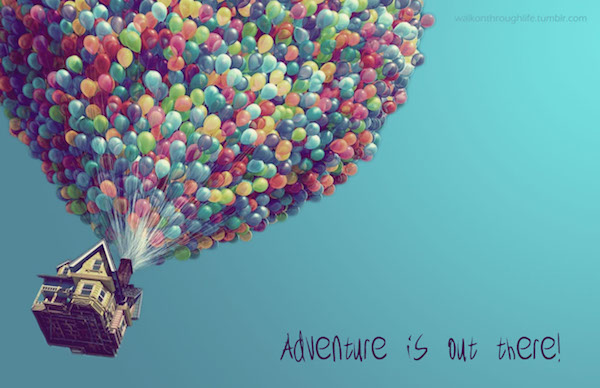
Adventure is out there! – Up (Pixar)
I know I usually choose quotes by famous real-life people for this challenge, but this line from Up was the first quote to pop into my head when I read this week’s prompt, so I just decided to run with it. On the theme of adventure, here’s a short story I wrote inspired by the tagline of Up. Enjoy!
Adventure is Out There!
“Shh, there it is, Bernie!”
Farryn crouched behind the bushes, her younger brother Bernard kneeling on the grass beside her. The two adventurers peeked out through the foliage at the enormous black hound lying just outside the entrance to the cave.
“You really think we can get past it, Farr?” Bernard whispered. His sister smiled at him and winked.
“Just follow my lead.”
Farryn slowly crept out from the bushes. Bernard unsheathed his sword and followed only a few steps behind. The moment it sensed them approaching, the massive hound lifted its head and turned to face them, stopping them in their tracks.
“Head to the left,” said Farryn as she slowly reached behind her back, never breaking eye contact with the beast for a second. Her brother did as he was told while she carefully pulled a large discus from her backpack. At the sight of the object, the hound started panting and wagging its tail furiously.
“You want this?” Farryn teased with a sly smile. “Go get it!”
She tossed the disc to her left, where Bernard was already waiting to catch it. The sight of him swiping it out of the air seemed to excite the animal further; within seconds, it had leaped to its feet and was bounding toward the explorer with a wild look in its red eyes. Quick as a flash, Bernard tossed the disc back to his sister. The beast skidded and whirled around just in time to see Farryn snatch it behind him. The moment it started toward her, she turned and flung the disc into the lake several meters away. The hound chased after it and plunged into the water with a great splash.
“Go, go, go!” Farryn called, and she and her brother raced toward the cave before the animal even had time to resurface. Bernard used his sword to slice through the invisible barrier they knew was sealing the entrance, and the two of them hurried inside. As soon as they had crossed the barrier, they collapsed into fits of giggles.
“We did it!” Bernard said as though he couldn’t believe the plan had worked.
His sister laughed. “I told you! The Discus of Distraction works every time!” Suddenly, she stopped giggling and covered her brother’s mouth with her hand as she whispered, “Quiet! We’re in the sleeping giant’s cave, remember?”
The pair of adventurers rose to their feet and crept down the dark hallway toward the chamber at the end of the cave. A colossal tiger was guarding the entrance when they arrived, but they were prepared for it. Farryn reached into her backpack again and extracted a large ball of rope, which she tossed behind her to roll away into the darkness. The beast bounded after it in a flash, chasing it down the hallway and out of sight.
“Animals are so predictable,” Bernard mused quietly as they crept into the room that the tiger had just left unguarded.
The first thing they noticed upon entering was the giant sleeping in his huge throne in the middle of the floor, his thunderous snoring echoing throughout the chamber. The siblings tiptoed their way over and cautiously scaled their way up the stack of giant-sized books beside the throne until they were level with the armrest.
“Where’s the idol?” Bernard whispered. Farryn pointed at the giant’s hand, underneath which they could see a black corner of the object they sought, the prize of their quest.
The adventurers knew what to do. Bernard gently slid the flat of his sword underneath the giant’s wrist and edged it upwards with the greatest of care. When enough of the idol was exposed, he stopped and held the sword in place while Farryn eased the item out from between the massive fingers, inch by inch, until at last it was free of the giant’s grasp and sitting in the palm of her hand.
Bernard carefully lowered the giant’s wrist back onto the armrest, then the siblings stared at the idol in wonder. It was long and rectangular, with oddly-shaped buttons all across the upper face. Their quest was over; they had finally found…
“The Lost Control of Remoté!”
As they spoke in unison, the young explorers suddenly realized that the giant had stopped snoring. Looking up, they noticed him beginning to stir, and they paled at the sight of him gradually opening his eyes.
“RUN!”
Farryn and Bernard tumbled down the tower of books and ran out the exit as a great rumbling filled the room behind them. They dashed down the hallway for the cave entrance, but their path was suddenly blocked by a huge shadowy figure, and the next thing they knew, they were frozen in place, staring up at a second giant looming over them…
“What are you kids doing?”
The children looked up at their mother in silence, too stunned to answer. She looked around to make sense of the scene before her. Through the open door of the den, she could see her husband yawning and stretching in his squeaky armchair, a stack of books collapsed beside it. The ginger cat was curled up in a corner of the living room, busy tearing away at a ball of yarn between her paws, and outside the glass doors leading to the backyard, the dog was swimming laps in the pool with a frisbee in his mouth. Looking back at her children, the woman noticed a remote control in her daughter’s hand and a cardboard sword in her son’s. She smiled at them.
“Did the giant take away your TV privileges again?”
Farryn and Bernard exchanged awkward looks, then nodded as they stared at the floor. Their mother laughed.
“Well, I’m glad to see you know how to keep yourselves entertained. In fact, since you’re such great explorers, I have another quest for you.” She took the remote from Farryn, then extracted a piece of paper from her pocket and handed it to the girl. “It’s from the Dessert Kingdom. Follow this map to find the sweet hidden treasure of Cocina Temple. I hear it tastes great with milk.”
Farryn and Bernard grinned at their mother as she winked. They looked down at her hand-drawn map of the house, then thanked her and dashed past her toward the kitchen, where a batch of freshly baked chocolate chip cookies was waiting for them. Their mother laughed again as she heard her children shouting for joy from down the hall.
“Adventure is out there!”
I hope you enjoyed my story! Be sure to join the Writers Quote Wednesday Writing Challenge and share your quote-inspired works! Thanks for reading!
Writers Quote Wednesday Writing Challenge is a weekly blogging event by Colleen Chesebro of Silver Threading in collaboration with Ronovan Hester of Ronovan Writes. Be sure to check out both these authors’ blogs for your weekly dose of inspiration! Happy writing!
by Naomi L. | June 13, 2016 | Blog, Word of the Week |
Word: epiphany
Pronunciation: ə-PI-fə-nee
Part of Speech: noun
Definition: a moment of sudden revelation or insight
Source: Oxford Dictionaries
Homer: [while throat singing with the medicine woman] How long are we doing this?
Medicine Woman: Until you have an epiphany.
Homer: Okay. [they continue throat singing; he pauses and taps her on the shoulder] What’s an epiphany?
Medicine Woman: Sudden realization of great truth.
Homer: …Okay.
– The Simpsons Movie (2007)
Barney: Guys, I was sitting at home last night, and all of a sudden, I had a piphany! And my piphany was this–
Ted: Actually, it’s e-piphany.
Barney: No, Ted, this is the piphany.
– How I Met Your Mother (Season 7, Episode 21 – Now We’re Even)
I know, I don’t usually use two examples in one vocabulary post, but I had such a hard time choosing between these two that I just decided to go with both! In the former scene from The Simpsons Movie, an Inuit medicine woman is teaching Homer throat singing to help him come to the revelation that will save his family and his town. Meanwhile, in the latter scene from How I Met Your Mother, Barney tells his friends about his own revelation without knowing how to properly pronounce the word for it. Whether it’s “In order to save myself, I have to save Springfield!” or “Make every night legendary!”, Homer and Barney have something in common: they each claim to have had an “epiphany”!
An “epiphany” is a moment of sudden insight or revelation. The word arose in Middle English and comes from the Greek noun epipháneia, meaning “manifestation”. This noun stems from the verb epiphaínō “I appear”, which comprises the preposition epí “upon” and the verb phaínō “I bring to light”.
While its meaning as a revelation seems to be the most common use of the word, the primary definition of “epiphany” actually refers to “the manifestation of Christ to the Gentiles as represented by the Magi (Matthew 2:1–12)”. In Christianity, the Epiphany, also known as Three Kings’ Day, is a festival celebrating the revelation of God in human form as His Son, Jesus Christ. According to the American English edition of Oxford Dictionaries, the word can also be used in the general sense of “a manifestation of a divine or supernatural being”. If your stories call for your characters experiencing “Eureka!” moments or sightings of divine beings, you may soon find yourself writing about an “epiphany”!
http://www.youtube.com/watch?v=WjfHnCjy3Pc
What are your thoughts on this word? Any suggestions for future “Word of the Week” featured words?
by Naomi L. | June 8, 2016 | Blog, Creative Writing, What If? Writing Prompts |
Okay, so this is a little embarrassing, but it seems I’m having trouble keeping up with blogging again. It’s hard to manage so many things at once, so for now I’ll have to tide over my creative writing topics with some “What If?” Writing Prompts. Thanks for understanding! Since I haven’t featured some in a while, now may be a good time to share a few more fantasy and science fiction prompts. See what stories you can create from these ideas! Enjoy!
 What if… you and your pet switched bodies for a day?
What if… you had the power to rewind time at will?
What if… you found a portal to another dimension hidden in your own basement?
What if… all humans were naturally born with different magical abilities?
What if… you discovered that your computer had the ability to think for itself?
Have fun writing more fantasy and science fiction tales!
If you have any “What If?” writing prompt suggestions (for any theme), please feel free to share them in the comments below. Ideas I like may be featured in future “What If?” posts, with full credit and a link to your blog (if you have one)! Also, if you’ve written a piece based on an idea you’ve found here, be sure to link back to the respective “What If?” post. I would love to see what you’ve done with the prompt! Thank you!
by Naomi L. | June 6, 2016 | Blog, Word of the Week |
Word: epitome
Pronunciation: ə-PI-tə-mee
Part of Speech: noun
Definition:
- a person or thing that is a perfect example of a particular quality or type
- a summary of a written work; an abstract
Source: Oxford Dictionaries
Here’s another word that’s quite common but that’s tripped me up in the past. Funnily enough, I had both heard it spoken often and read it a few times before, yet I didn’t realize at first that it was the same word because I expected it to have a different pronunciation based on its spelling. It didn’t help that I’d heard other people incorrectly pronounce it “E-pi-tohm”, but when you think about, that just seems to make this word an “epitome” of the challenges of learning English!
An “epitome” of a given quality or type is a perfect example of it. In literature, “epitome” refers to an abstract or summary of a written work. The word arose in the early 16th century and traces back to the Greek noun epitomḗ ,meaning “abridgment”. This noun stems from the verb epitémnō “to abridge”, which in turn consists of the prefix epi “upon” and the verb témnō “to cut”.
Much like the word “hyperbole“, I find “epitome” interesting for the apparent discrepancy between its spelling and pronunciation, though this should hardly be surprising given that both these words come from Greek. Similar to its meaning as an abstract of a written work, this word also has an archaic sub-definition: “a thing representing something else in miniature”. If you ever find yourself needing to perfectly exemplify an idea in your stories, an “epitome” would be an excellent device to deploy!
What are your thoughts on this word? Any suggestions for future “Word of the Week” featured words?



Recent Comments