by Naomi L. | August 11, 2014 | Blog, Word of the Week |
Word: paean
Pronunciation: PEE-ən
Part of Speech: noun
Definition: a song of praise or triumph
Source: Oxford Dictionaries
I recently discovered this word on YouTube when I happened upon a video of a VOCALOID song titled “Eternal Paean” (translated from its Japanese title 悠久賛歌 “Yūkyū Sanka”). Curious to know what exactly a “paean” was, I did a quick search for its dictionary entry, and when I learned what the word meant, I realized how fitting it was for a song in which Kaito and Meiko sing about the beauty and splendors of nature. After all, is there anything on this Earth that deserves more praise?
A “paean” is a song that demonstrates triumph or praise. This Latin derivative originated from the Greek noun paian, meaning “hymn of thanksgiving to Apollo” (the Greek god of the sun, knowledge and various arts). This noun evidently comes from the name Paion (or one of its alternative spellings), who, according to Greek mythology, was the physician of the gods.
Note that a “paean” doesn’t necessarily have to be a song. Another use for the word is to indicate a creative work that expresses enthusiastic praise, such as books that can be considered “paeans” to knowledge. Since I myself only recently learned about this word, I have yet to find a good place for it in my own stories, but if you feel it fits the tone of your writing, feel free to get as creative with it as you like. Your stories may just come across as “paeans” to artistic language!
What are your thoughts on this word? Any suggestions for future “Word of the Week” featured words?
by Naomi L. | August 6, 2014 | Blog, Creative Writing, What If? Writing Prompts |
Last week, I shared my thoughts on why I believe “What if?” should be every writer’s favorite question. In the interest of running with that idea, today I’m opening a new segment on my blog based on this fascinating “gateway” question: “What If?” Writing Prompts!
The purpose of this is to create a more interactive portion of my blog where anyone can contribute their ideas for collective creativity. With a hectic schedule coming up in my real life that will definitely keep me from writing as often as I like, outside contribution will be a big help to keeping my blog an active source of inspiration for readers in the near future. So please, don’t be shy about sharing your ideas; I would love to feature your prompts in future “What If?” posts, always with full credit and a link to your blog, of course! Thank you!
To start this segment off, here are five prompts I came up with based on the theme of reimagining classic fairy tales. See what you can do with these and how many more you can think up yourself! Have fun!
 What if… certain fairy tales were set in a different time/place/culture?
(Source: various reimagined adaptations of my favorite fairy tales)
What if… that fire-breathing dragon the knight slew was really a divine guardian keeping an evil princess captive in order to protect the kingdom?
What if… the Fairy Godmother had actually sent Cinderella to the ball on a mission to kill the Prince?
(Source: music video for “Cendrillon“, a VOCALOID song by Signal-P featuring Hatsune Miku and KAITO)
What if… witches and wizards didn’t use magic to make amazing things happen, but real science instead?
What if… characters in fairy tales never fell in love at first sight?
Sure, these may not be outstanding, but at least they’re a start. Good luck reimagining your favorite fairy tales!
If you have any “What If?” writing prompt suggestions (for any theme), please feel free to share them in the comments below. Ideas I like may be featured in future “What If?” posts, with full credit and a link to your blog (if you have one)! Also, if you’ve written a piece based on an idea you’ve found here, be sure to link back to the respective “What If?” post. I would love to see what you’ve done with the prompt! Thank you!
by Naomi L. | August 4, 2014 | Blog, Word of the Week |
Word: verbatim
Pronunciation: vər-BAY-təm
Part of Speech: adjective; adverb
Definition: in exactly the same words as were used originally
Source: Oxford Dictionaries
I must give credit to Beth Teliho of Writer B is Me for reminding me to add this word to my list (even if she didn’t realize it). This is a word with which everyone who writes frequently should be familiar. Some writers often quote the sayings of others word for word, and when they do, they sometimes need to make it clear that said quote is not their own. Fortunately, there’s a word that fits that very need.
To cite a quote “verbatim” is to use exactly the same words as in the original. Likewise, a “verbatim” citation is a word-for-word passage. The word arose in the late 15th century and is rooted in the Latin noun verbum, meaning “word”.
While I rarely read the word in fiction, I have seen “verbatim” come up quite a few times in technical writing. Its Latin origin seems to make it a great word for academic composition, so you may want to consider that if you choose to work it into your stories. Whether you use it as a technical term for citation or a dialogue indicator of a particular character’s intelligence, “verbatim” is indispensable to any prolific writer’s vocabulary!
What are your thoughts on this word? Any suggestions for future “Word of the Week” featured words?
by Naomi L. | July 28, 2014 | Blog, Word of the Week |
Word: acerbic
Pronunciation: ə-SƏR-bik
Part of Speech: adjective
Definition: (especially of a comment or style of speaking) sharp and forthright
Source: Oxford Dictionaries
Today’s vocabulary word is another one pulled from the flashcard pile, but that’s the most common place I’ve ever seen it. Truth be told, I can’t actually recall reading the word “acerbic” in a story before (not that I don’t believe I have, but if I ever did, it’s been a long time since). However, I did see it come up several times while studying vocabulary, and since I found it interesting, I decided it was worth adding it to the list.
“Acerbic” speech is that which is straightforward, presumably to the point of being bitter and harsh. In its archaic or technical sense, “acerbic” indicates a sour or bitter taste. The word supposedly arose in the mid 19th century and comes from the Latin adjective acerbus, meaning “sour-tasting”.
Though I’m still unfamiliar with the word in fiction, I have seen various dictionary examples of “acerbic” being used to describe a particularly sharp manner such as wit or attitude. I’ve also seen it used once as an adjective to directly describe a person, though I can’t yet be sure this is correct. Given that its definition regarding sour taste is considered archaic, you’re most likely to encounter it in its more abstract sense. Keep the word “acerbic” in mind if you like to write characters with brutally sharp wits!
What are your thoughts on this word? Any suggestions for future “Word of the Week” featured words?
by Naomi L. | July 23, 2014 | Blog, Creative Writing, Writer's Toolkit |
I’ve already used my Writer’s Toolkit segment to talk about the advantages of keeping a journal and a pocket notebook. Now to complete the trio of handy note-taking tools, today’s topic covers a utility that every prolific writer (especially novelists) should have under their belt: index cards.
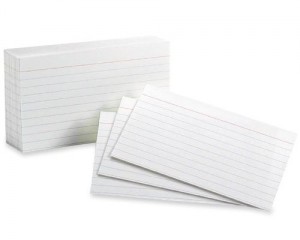
Oxford Ruled Index Cards
There probably isn’t much else I can add about the usefulness of index cards that hasn’t already been covered by the journal and the pocket notebook, so instead I’ll briefly cover the advantages they have over both of these. Like the aforementioned items, index cards are great for taking notes, and while they aren’t quite as convenient to carry around as a pocket-size book, they do have a significant feature that makes up for that: separability.
Notebooks are useful for keeping track of ideas as they come to you; the challenge is sorting through those ideas later. Cutting up pages and sticking pieces together doesn’t seem like a very productive way to go about it (unless you’re into scrapbooking, in which case it may actually be fun). A good alternative, therefore, is to scan through the highlights and note those on separate cards. You can categorize your ideas by topic and sort through them anytime to find the most relevant ones for your current project. Essentially, notebooks are for taking with you to jot down ideas on the go, while index cards are for organizing those ideas in your private workspace. How convenient is that?
While every writer can benefit from using index cards this way, novelists get the most use out of them with an additional purpose. If you’ve ever owned a cork board, you may already be familiar with the concept of pinning notes and pictures in an orderly fashion (if you’re like me, though, they’re probably all pinned haphazardly with no discernible pattern whatsoever). In a similar manner, writers planning out a novel can pin index cards to keep track of character profiles, settings and important plot points, so as to get a clear vision of the story as a whole. For writers who are total scatterbrains, this is an excellent habit to pick up!
Summary
Advantages of Using Index Cards
- Easy to sort ideas
- Categorize topics for quick reference
- Keep track of important plot details
- Visualize novel storyline
Index cards are a great option for many writers, but almost a necessity for novelists. Whether you like to set aside the occasional note for future reference or lay out the entire detailed storyline of an upcoming novel, index cards are a useful tool to help you keep your creativity in order!
by Naomi L. | July 21, 2014 | Blog, Word of the Week |
Word: lackadaisical
Pronunciation: la-kə-DAY-zi-kəl
Part of Speech: adjective
Definition: lacking enthusiasm and determination; carelessly lazy
Source: Oxford Dictionaries
Today’s Word of the Week was suggested by my best friend, who used to work with someone who said it all the time. Apparently he’s a big fan of amusing words, and “lackadaisical” certainly fits into that group. I mean, come on, it has the word “daisy” in it! “Lacka-daisy-cal”! Try and tell me that’s not just a little funny. But what’s even funnier is how well it seems to match its definition.
Describing someone or something as “lackadaisical” indicates a lack of determination and enthusiasm. The word is derived from the archaic interjection “lackaday” or “lackadaisy”, alternative forms of the exclamation “alack-a-day” (“an expression of regret or dismay”). This expression contains the root noun/verb “lack” (“the state of being without or not having enough of something”), which possibly stems from the Dutch and German noun lak “deficiency”.
Speaking as someone who has never used the word “lackadaisical” before, I would probably try to work it into a context where I wanted laziness to come across as something funny. It seems like a word that would fit perfectly in humorous writing, so it’s definitely one I’d keep in mind for comedy. If you enjoy writing silly stories about lazy characters, “lackadaisical” is the perfect word for you!
What are your thoughts on this word? Any suggestions for future “Word of the Week” featured words?



Recent Comments