by Naomi L. | July 14, 2014 | Blog, Word of the Week |
Word: extrapolate
Pronunciation: ik-STRA-pə-layt
Part of Speech: verb
Definition: extend the application of (a method or conclusion) to an unknown situation by assuming that existing trends will continue or similar methods will be applicable
Source: Oxford Dictionaries
I’m going with a more scientific word this week. Though I rarely see it in fiction, the word “extrapolate” does come up in a lot of the academic papers I read. It’s a verb that defines a practice many scientists adopt: to draw conclusions about unknown situations based on data previously collected from similar scenarios. Think of it as a fancy word for “guesstimate”. It may not sound very scientific when you put it like that, but it’s immensely helpful when constructing theories, and you’d be surprised how often we rely on this method to make sense of the world around us.
To “extrapolate” information is to extend it to theoretical scenarios in order to estimate potential results, based on the assumption that the same methods will continue to be applicable in similar situations. The word is a combination of the Latin preposition extra “outside” and a shortened form of the verb “interpolate” (“insert between fixed points”). The latter word contains the root verb polire, which means “to polish”.
You’d probably get the most use out of “extrapolate” if you write a lot of scientific language; in mathematics, for instance, it indicates the extension of data by inferring unknown values from existing trends. In fiction, it may work as a partial synonym for “estimate”, though this would likely still depend heavily on context. I don’t recall reading the latter use very often, but it’s your call whether “extrapolate” can work as a suitable verb in your stories. You may never use it for your own writing, but at least now you’ll know what it means if you ever happen to read a scientific article!
What are your thoughts on this word? Any suggestions for future “Word of the Week” featured words?
by Naomi L. | July 7, 2014 | Blog, Word of the Week |
Word: idiosyncrasy
Pronunciation: i-dee-ə-SIN-krə-see
Part of Speech: noun
Definition:
- a mode of behavior or way of thought peculiar to an individual
- a distinctive or peculiar feature or characteristic of a place or thing
Source: Oxford Dictionaries
Look, you do understand that Sheldon really doesn’t care when he gets the money back. It’s actually one of the few idiosyncrasies that doesn’t make you want to, you know, kill him.
– Leonard Hofstadter, The Big Bang Theory (Season 2, Episode 14 – The Financial Permeability)
Here’s another fun word I learned from The Big Bang Theory. Some time after borrowing money from Sheldon, Penny starts to feel guilty for not yet being able to pay him back, a fact made evident by her increasingly irritable behavior. In an attempt to make her feel better, Leonard reassures her that Sheldon doesn’t mind going an extended period of time without the money he lent her, which, unlike most of his other quirks, is actually a positive one.
An “idiosyncrasy” is a characteristic that’s peculiar to a person, place or thing. The word arose in the early 17th century and was used in the sense of “physical constitution peculiar to an individual”. It is derived from the Greek word idiosunkrasia, which is comprised of three roots: idios “own, private”, sun “with”, and krasis “mixture”.
Aside from its informal uses as a synonym for “peculiarity”, the word “idiosyncrasy” also functions as a medical term to mean “an abnormal physical reaction by an individual to a food or drug”. Of course, this definition would most likely only be useful if you write medical dramas, so if you choose to include the word in your writing, you’ll probably use it in its more common sense. It’s an especially great word to keep in mind if you like to write eccentric characters, so have fun throwing plenty of “idiosyncrasies” into your stories!
What are your thoughts on this word? Any suggestions for future “Word of the Week” featured words?
by Naomi L. | July 2, 2014 | Blog, Creative Writing, Tropes |
Some time ago, I wrote a blog post about a trope known as Chekhov’s Gun, a literary device in which a seemingly unimportant detail later becomes significant to the plot. But what if you want to achieve the opposite effect, that is, introduce a supposedly important detail that later turns out to have little or nothing to do with the main story? Today’s post features a sister trope that’s equally useful and just as fun to write. Do you enjoy misleading your readers with deceptive clues? Then let me introduce you to the next handy tool in your arsenal: the Red Herring.
Herring? Where?
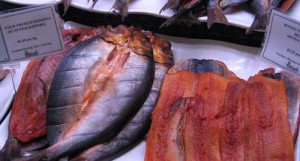
The “red herring” is a type of heavily cured/smoked kipper. The idiom may have originated from anecdotes relating its use as a tool for misleading hunting dogs.
(CC Image by misocrazy via Flickr)
The Red Herring is a common device in fiction, employed by writers who like to keep readers on their toes. Simply put, it’s a clue intended to lead in the wrong direction. This is an especially useful trope for plots that involve a lot of mystery, as misleading details help to keep the element of surprise. After all, a story in which the major secret is easy to deduce from the beginning isn’t really worth the read, is it?
Like the Chekhov’s Gun, a Red Herring generally relies on the principle of conservation of detail to work properly: every detail presented in a story must have a reason for being there, otherwise it should be discarded. Of course, as mentioned above, a Red Herring functions in the opposite manner as a Chekhov’s Gun in that it’s intended to seem important upon its introduction but is later revealed to have been a distraction from the true secret of the story. The challenge for the audience is trying to tell the fake clues from the real ones!
Placing a Red Herring
Although every Red Herring is purposely used to throw the audience off, the best ones still have some significant connection to the plot even after being revealed as false leads. For instance, a clue can be introduced to set up suspicions about a certain character. This character may later turn out to be innocent, but the clue that seemed to be pointing to them justifies another character as the culprit instead. The example provided on TV Tropes is that of suspects in a hypothetical murder case, but I suppose it could apply to any kind of mystery. The only limit is your own imagination!
For writers who like to get really creative, Red Herrings come in different “flavors”. Subtropes include the Red Herring Shirt, when someone in the background turns out to be an important character; the Red Herring Mole, when a character who seems suspicious turns out to be innocent; and the Red Herring Twist, when a detail played as a potential Chekhov’s Gun turns out to be nothing more than a distraction from the main plot. It’s also possible to create a similar effect with a mistake as opposed to intentional misdirection, while a plot twist confused for a Red Herring due to its overly obvious nature is known as an Untwist.
Overall, I find Red Herrings very enjoyable to write, for when placed well, they can definitely add some interesting twists to a story. Have fun trying them out for yourself, and good luck throwing your readers off with misleading clues!
by Naomi L. | June 30, 2014 | Blog, Word of the Week |
Word: elucidate
Pronunciation: i-LOO-si-dayt
Part of Speech: verb
Definition: make (something) clear; explain
Source: Oxford Dictionaries
This week, I decided to share a verb taken from my experience as a Biology student. There isn’t much I can say about the word “elucidate”, except that it’s one I see quite a bit in academic writing. I was actually inspired to include it in my vocabulary segment after recently reading it yet again in a scientific paper, as I feel it’s a word that has potential to work equally well in fiction.
To “elucidate” something is to explain it or make it clear. The word comes from the Latin verb elucidare, which means “enlighten”. This verb is comprised of two roots: the preposition ex “out” and the adjective lucidus “clear”.
“Elucidate” may be one of those unnecessarily advanced synonyms for a common word, or at least that’s my impression of it. I rarely see it outside of academic texts, as most other cases in which it might work tend to use simpler terms such as “explain” or “make clear” instead. Still, you may be able to fit this less common word into your stories, particularly if you write intelligent characters who use advanced vocabulary. As long as you’re able to “elucidate” the meaning within your writing on the first try, you should be fine!
What are your thoughts on this word? Any suggestions for future “Word of the Week” featured words?
by Naomi L. | June 23, 2014 | Blog, Word of the Week |
Word: posit
Pronunciation: PAH-zit
Part of Speech: verb
Definition: assume as a fact; put forward as a basis of argument
Source: Oxford Dictionaries
Sheldon: Is anyone else troubled by the Spiderman theme song?
Leonard: Why would it trouble you? […]
Sheldon: […] the Spiderman lyrics posit that “Spiderman, Spiderman, does whatever a spider can.”
Howard: Yeah, so?
Sheldon: I can think of many things Spiderman can’t do that a spider can.
– The Big Bang Theory (Season 6, Episode 10 – The Fish Guts Displacement)
Here’s another word that I learned from a flashcard and first heard in context on The Big Bang Theory. While hanging out with his friends, Sheldon points out the major flaw in the Spiderman theme song: its assertion that Spiderman is capable of every feat possible to a spider. By subsequently listing examples of feats that only a spider could do – crawl into a person’s ear and die; legally leave Guatemala without a passport; and of course, copulate with a spider – he proves why the lyrics incorrectly state Spiderman’s complete similarity to spiders as fact (I’m sure we could all come up with a lot more examples if we tried, but let’s just focus on learning a new word for now).
To “posit” a statement is to put it forward as a fact or a basis of argument. The word arose in the mid 17th century and is based on the Latin root posit- “placed”. The participle positus is derived from the verb ponere, meaning “to place”.
Note that there are alternative definitions for the verb “posit”. According to Oxford Dictionaries, it can also mean “put in position” or “place”, while to “posit something on” is to “base something on the truth of a particular assumption”. In Philosophy, the word also functions as a noun to mean “a statement made on the assumption that it will prove to be true”. In any case, the definitions you’re most likely to come across have to do with stating something as fact, so keep this in mind if you decide to work “posit” into your stories. If you write characters who tend to assume things as truth, you can definitely get a lot of use out of this word!
What are your thoughts on this word? Any suggestions for future “Word of the Week” featured words?
by Naomi L. | June 16, 2014 | Blog, Word of the Week |
Word: reciprocate
Pronunciation: ri-SI-prə-kayt
Part of Speech: verb
Definition:
- respond to (a gesture or action) by making a corresponding one
- experience the same (love, liking, or affection) for someone as that person does for oneself
Source: Oxford Dictionaries
Here’s another of my favorite words. Unlike several others featured in my vocabulary segment, this is one I use all the time. It may be partly the sound of the word “reciprocate” that I like, but I think I appreciate it mostly for its connection to Math (a subject that I always loved in school). I was using the related word “reciprocal” in mathematical contexts long before I learned the similar verb that could be used in my other passion of storytelling, and you can only imagine how my writing took off when I finally discovered it.
To “reciprocate” a gesture is to return it in equal measure, while to “reciprocate” someone’s emotions is to feel the same way about that person as they feel about you. The word comes from the Latin verb reciprocare, meaning “to move backwards and forwards”. The definition of this word is somewhat easy to remember as it contains the roots re- “back” and pro- “forth”.
I usually use the word “reciprocate” to indicate the returning of a gesture from one character to another, the gesture in most cases being a smile. Of course, I’ve also found a place for it in romantic stories for characters who share equal feelings toward each other. Apparently, the word also works as an adjective in the form “reciprocating” to describe a part of a machine that moves backward and forward in a straight line, but I much prefer it as a verb. It’s a good word to keep in mind if you write plenty of interactions, so use it well along with all the others, and your readers will be more likely to “reciprocate” the respect you show them by giving them a good story to enjoy!
What are your thoughts on this word? Any suggestions for future “Word of the Week” featured words?



Recent Comments