by Naomi L. | June 9, 2014 | Blog, Word of the Week |
Word: sagacious
Pronunciation: sə-GAY-shəs
Part of Speech: adjective
Definition: having or showing keen mental discernment and good judgment; wise or shrewd
Source: Oxford Dictionaries
Time to draw another word from the flashcard stack. Like others previously mentioned in my vocabulary segment, this one had me stumped the first time I read it even though it really shouldn’t have. I don’t remember what definitions I may have initially guessed, but I do remember thinking how simple it should have been to get it right once I recognized its similarity to the word “sage” (not the herb, the other meaning).
A “sagacious” person is someone who has a sharp mind and generally shows good judgment. The word arose in the 17th century, possibly as the adjective form of the noun “sagacity” (“keenness of perception”). These words stem from the Latin adjective sagax, meaning “wise” or “perceptive”.
I haven’t yet worked the word “sagacious” into one of my stories, not because it’s never accurately described any of my characters, but because I haven’t yet felt that it fits the tone of my writing. Maybe it’s just me trying to avoid flowery prose, but I often consider this word an unnecessarily sophisticated synonym for the word “wise”. Still, I suppose it could be used to describe a specific type of person, possibly someone who’s both wise and sharp-witted, so it’s certainly worth noting if you write plenty of intelligent characters. At the very least, a wise choice of words will help you come across as “sagacious” to your readers!
What are your thoughts on this word? Any suggestions for future “Word of the Week” featured words?
by Naomi L. | June 2, 2014 | Blog, Word of the Week |
Word: peruse
Pronunciation: pə-ROOZ
Part of Speech: verb
Definition: read (something), typically in a thorough or careful way
Source: Oxford Dictionaries
“Peruse” is an example of a word that I almost never see because it’s a formal variant of a common word. Even in the few times I have seen it, there was at least one instance in which it was being used satirically. Still, I figure it’s worth knowing, especially for stories that call for a more sophisticated level of language. Why mention that a character is simply “reading” when it’s possible to imply a little more with a different word?
To “peruse” something is to read it carefully and thoroughly. The word evidently arose in the 15th century and originally had a definition along the lines of “use up” or “wear out”. It possibly shares its origin with the Anglo-Norman French verb peruser “examine”, as both contain the Latin prefix per-, meaning “thoroughly”.
Maybe it’s more of a testament to the type of material I’m used to than anything else, but I rarely see the word “peruse” as more than just a flowery synonym for “read”. Of course, that isn’t to say it shouldn’t be taken seriously when context calls for it. After all, it doesn’t have the exact same meaning as its common counterpart, for this verb implies a specific type of reading. In addition, it can also be used to mean “examine carefully or at length”. Some writers (myself included) may feel inclined to avoid this word for fear of risking purple prose or confusing readers who think it means “glance over”, but if you like to use formal words in your writing, this is definitely a good one to know. Hopefully your audience will enjoy “perusing” your stories!
What are your thoughts on this word? Any suggestions for future “Word of the Week” featured words?
by Naomi L. | May 26, 2014 | Blog, Word of the Week |
Word: effusive
Pronunciation: i-FYOO-siv
Part of Speech: adjective
Definition: expressing gratitude, pleasure, or approval in an unrestrained or heartfelt manner
Source: Oxford Dictionaries
Have you ever felt so grateful to someone that you just had to go all out to show them how happy you were? If so, what you gave them was an “effusive” thank-you for their kindness. And who wouldn’t appreciate that? Such a heartfelt display of gratitude reveals a warm side of human behavior, so it’s only natural that some writers would want to show that side of their characters too, right?
An “effusive” act is one that expresses heartfelt gratitude, pleasure or approval. This word shares its origin with the verb “effuse” (“talk in an unrestrained, excited manner”), which comes from the Latin verb effundere “to pour out”. This verb is made up of the preposition ex “out” and the verb fundere “to pour”.
Being a scientist, it’s likely that I’ve seen this word as much in its geological context as in its behavioral sense. In Geology, “effusive” refers to a type of igneous rock that forms from rapid cooling of molten rock on the Earth’s surface (as opposed to intrusive rock, which forms from slow cooling underneath the Earth’s crust). Most fiction writers would probably make better use of the first definition, but this one is still worth knowing if you tend to write a lot of scientific terms. Either way, “effusive” is a good word to keep on your vocabulary list, even if the only use you can find for it now is to describe the level of gratitude you’d like to show your most supportive readers!
What are your thoughts on this word? Any suggestions for future “Word of the Week” featured words?
by Naomi L. | May 19, 2014 | Blog, Word of the Week |
Word: alienate
Pronunciation: AY-lee-ə-nayt
Part of Speech: verb
Definition: make (someone) feel isolated or estranged
Source: Oxford Dictionaries
This is one of those words I learned in elementary school, and every time I see it, I’m reminded of my first impression of it. I’m sure I wasn’t the only student in the class who initially thought it was some sci-fi verb that meant something along the lines of “turn into an alien”. Of course, what I didn’t realize at the time was that the term “alien” has a much broader definition than the extraterrestrials we know so well from science fiction, and that root is the key to understanding what this verb really means.
To “alienate” someone is to figuratively push them away to the point where they feel isolated. The word comes from the Latin verb alienare, meaning “to estrange”. This word stems from the adjective alienus, which means “foreign” or “belonging to another”.
Additional meanings of the word “alienate” include the complementary definition “cause (someone) to become unsympathetic or hostile”, as well as the legal definition “transfer ownership of (property rights) to another person or group”. I myself much prefer the most common meaning mentioned above, but these extra ones are certainly worth noting too, especially if you write plenty of legal terms and/or emotionally heavy scenes. It’s up to you which definition you want to use; what matters most is that it happens exclusively among your characters, while you avoid “alienating” your readers with poor quality writing!
What are your thoughts on this word? Any suggestions for future “Word of the Week” featured words?
by Naomi L. | May 12, 2014 | Blog, Word of the Week |
Word: inauspicious
Pronunciation: i-nah-SPI-shəs
Part of Speech: adjective
Definition: not conducive to success; unpromising; unlucky
Source: Oxford Dictionaries
Oh, here / Will I set up my everlasting rest, / And shake the yoke of inauspicious stars / From this world-wearied flesh.
– Romeo Montague, Romeo & Juliet (5.3.109-112) (William Shakespeare)
Recognize this excerpt? If you ever had to study Shakespeare in high school (or you’re a nerd like me who just reads Shakespeare for fun), you should remember this quote from Romeo’s final monologue in the timeless play Romeo & Juliet. There are probably a dozen words from this monologue alone that could have made it into my vocabulary segment, but I decided to start with “inauspicious” because it’s in my favorite part of Romeo’s speech. Maybe it’s me, but a Shakespearean tragedy just doesn’t feel complete without at least one character criticizing the misfortunates brought on by fate.
Anything “inauspicious” is not favorable to good fortune. The word is derived from the archaic noun “auspice”, which means “a divine or prophetic token”. This word comes from the Latin noun auspicium “divination”, which in turn stems from the noun auspex “diviner by birds”, as divination in the 16th century involved observing bird flight.
While planning for this post, I actually had a choice between the positive and the negative form: “auspicious” or “inauspicious”. Not to seem too “glass-half-empty”, but I opted to go with “inauspicious” because of the reference to my favorite play. That’s why I find the latter word a little more poetic, though one could just as easily use the former for the opposite definition. Perhaps you’d prefer to write about “auspicious” events if your plots tend to run a more fortunate course, or maybe you’re like Shakespeare and often have “inauspicious” circumstances drive your characters to a tragic end. Either way, I think both words sound quite elegant, so it’s up to you to fit them to the tone of your stories. Choose wisely!
What are your thoughts on this word? Any suggestions for future “Word of the Week” featured words?
by Naomi L. | May 7, 2014 | Blog, Creative Writing, Writer's Toolkit |
So I figured it was time for another Writer’s Toolkit post, as it’s been a while since I’ve shared one. While trying to decide which tool to write about next, I realized I haven’t yet mentioned an essential one that’s been especially useful in my experience as a writer. So to name another indispensable item for the serious artist, here’s a brief review of one of my personal favorites: the pocket notebook.
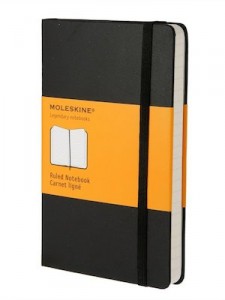
Moleskine Classic Pocket Notebook
The pocket notebook I use was a Christmas present from my cousin, one of several people in my family who know of my passion for creative writing. She told me it was for carrying around in my pocket or backpack so I could jot down ideas as they came to me. So that’s what I did, and ever since, it’s been a handy tool for taking notes while on the go. I use it to keep track of random thoughts, lists of blog post ideas, possible story titles, etc. It’s always great to have with me whenever I go out!
One of my favorite places to take my notebook is the airport. While sitting in the café waiting for arrivals, I like to observe people around me and try to imagine what their stories might be, and these thoughts sometimes become notes that I could use later on. Another fun use for my notebook is keeping track of the observations I make about nature when I sit outside, as these often become inspiration for poetry. Being naturally forgetful, keeping a written record of my observations has been immensely helpful for my fictional works.
Much like the journal I’ve written about before, my notebook serves a useful purpose as a collection of the scraps of ideas that come out of my head. This gives me a clear vision of my thought processes, especially the more random and incomplete ones that don’t appear in my journal. This also makes my notebook a great source of inspiration whenever I hit a creative block. Sometimes notes that seemed like simple observations at the time of writing turn out to be good ideas for fiction. So don’t neglect to record your thoughts while you’re out and about. You may discover something in your notes later on that you never even realized was there!
Summary
Advantages of Carrying a Pocket Notebook
- Always be prepared when new ideas strike
- Write down observations as they happen
- Keep scraps in one collection
- Maintain source of possible inspiration for future writing
A pocket notebook is a great tool for any writer, especially fiction writers who are constantly seeking new ideas for stories. If you find that inspiration often strikes at unpredictable and even inconvenient moments, you should definitely consider keeping a small notebook with you at all times. The writer in your mind will thank you!



Recent Comments